The area of gravitational influence around planets, stars, and black holes is spherical because it pulls equally in all directions.
Black holes, one of the most mysterious entities in the universe, are often imagined as perfect spheres that suck in everything around them. However, recent discoveries in theoretical physics have led scientists to ask: Is the shape of black holes really that simple? This question has launched a journey of research, from classical physics to advanced theories of extra dimensions, with the potential to change the way we view the universe.
Why black holes are thought to be spherical
In the universe as we know it, gravity is the force that governs the shape of celestial bodies . When massive stars run out of fuel and collapse, they form black holes. During this process, gravity pulls all the matter toward the center, giving black holes a roughly spherical shape.
This also applies to the event horizon, the boundary around a black hole from which nothing (not even light) can escape. In a universe with three spatial dimensions (left-right, up-down, front-back) and one time dimension, classical physics calculations support the idea that black holes should be spherical.
This formation process is similar to the process of forming planets and stars, when clouds of gas and dust accumulate under the influence of gravity, compressing into a sphere. Therefore, the idea of spherical black holes has become a popular view in astrophysics.
Explore higher dimensions
In recent years, theoretical physics has opened the door to possibilities far beyond conventional concepts. String theory, one of the most prominent theories, suggests that in addition to the three spatial dimensions we perceive, the universe may contain many additional spatial dimensions.
These extra dimensions, though invisible or untouchable, can have a powerful effect on how objects behave in space. In this context, the 'spherical' rule of black holes may no longer hold.
Much advanced mathematical research has been done to determine the possible shapes of black holes in higher dimensions. The results are surprising: black holes can take on completely different shapes, such as toruses (like doughnuts) or other complex structures. This raises a big question: Are these strange shapes just theoretical, or do they actually exist in the universe?
Non-spherical black holes – a change in the concept of the universe
The idea of non-spherical black holes could change the way we see the universe. Although there is no direct experimental evidence yet, these theories open up a world of possibilities. It's like looking into a window we never thought we could see, into a universe that holds more surprises than we ever imagined.
These unusual black hole shapes could provide insights into the nature of gravity in higher dimensions, which is particularly important for unifying Einstein's general theory of relativity and quantum mechanics – two pillars of modern physics that are not yet fully compatible.
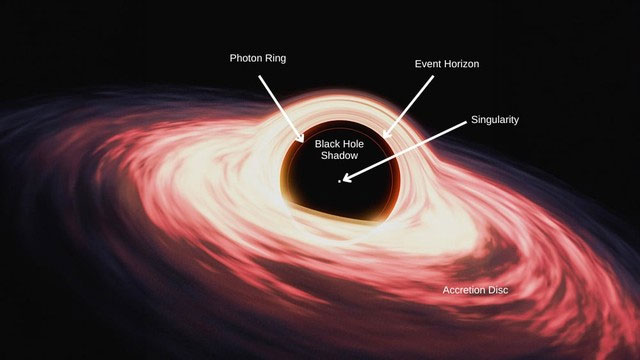
The idea of spherical black holes has become a popular view in astrophysics.
Experimentalization of theories
Beyond theory, particle physicists are working to find experimental evidence to verify the existence of extra dimensions. One approach is to use giant particle accelerators like the Large Hadron Collider (LHC) to recreate the high-energy collisions that can create microscopic black holes.
If these black holes were observed, even for extremely short lifetimes, they could confirm the existence of extra spatial dimensions and bring the theory of non-spherical black holes closer to reality.
Mathematics and geometry of black holes
Over the past two decades, a number of studies have shown that black holes in higher dimensions can have complex shapes. Calculations have shown that black holes are not limited to spheres, but can have previously unseen geometric structures.
This opens up the question of whether the geometry of black holes can provide information about the fundamental laws of nature. These studies not only help us better understand black holes, but also provide a new approach to exploring the nature of space-time.
The larger significance of the discoveries
Studying black holes doesn't just expand our understanding of a particular cosmic phenomenon. It also pushes the boundaries of human knowledge, challenges preconceptions, and opens up new avenues of scientific research.
The intersection of theoretical and experimental physics, of mathematics and astronomy, is bringing us closer to answering big questions about the universe: Is there more to it than we can see? What principles does the universe follow that we don't yet fully understand?
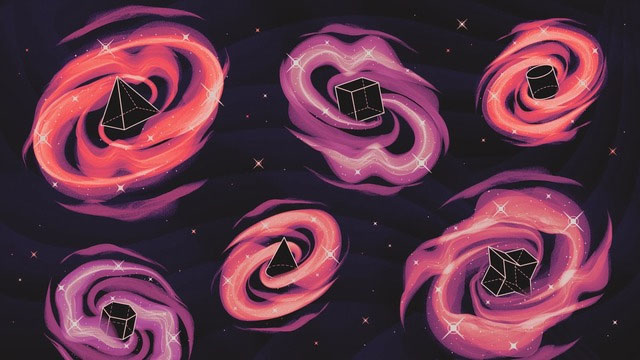
The idea of non-spherical black holes could change the way we view the universe.
For a long time, the prevailing view was that black holes were always spherical. However, advances in theoretical physics, along with studies of higher spatial dimensions, have called this notion into question.
While current non-spherical black hole theories remain theoretical, they have opened a new window into our understanding of space-time and the nature of the universe. Future discoveries, perhaps through particle physics or advanced astronomical observations, will continue to unravel these mysteries, bringing us closer to understanding the true nature of black holes – and the universe itself.
