The structure and way its atoms bond together makes gold so flexible that it can be rolled 400 times thinner than a human hair.
Gold is the most malleable element , according to Mike Bullivant, a chemist at the Open University in Milton Keynes, England. Gold is so malleable that it can be hammered to a thickness thinner than one wavelength of visible light, according to a 1977 study from the University of Leeds in England. Why is gold so malleable?
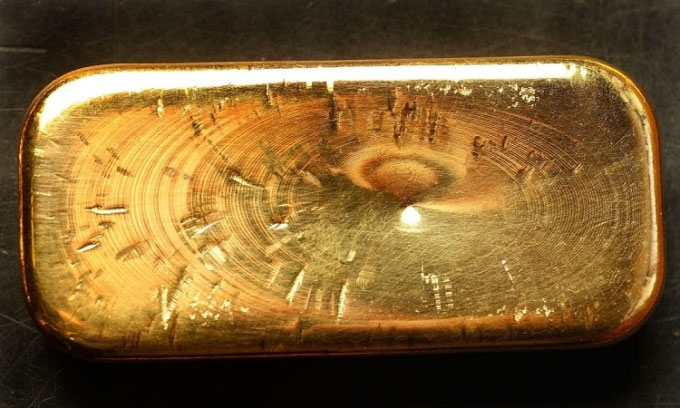
Gold does not tarnish with oxide layers on its surface like copper and silver. (Photo: Patrick Aventurier)
First, it's important to distinguish between ductility and softness . Ductility is a measure of how well a material can be hammered into a new shape without breaking. While other metals shatter into pieces when hammered beyond a certain point, 28 grams of gold can be hammered into sheets 5 meters on each side. Gold foil can be as thin as 0.000127 mm, about 400 times thinner than a human hair, according to the Jefferson Lab in Newport News, Virginia.
In contrast, there are many definitions of hardness and softness, depending on how the material's strength is tested. On the Mohs scale, which measures how well a material resists scratches, the softest metal is cesium , which is soft enough to cut with a butter knife, according to Guinness World Records. But the softest metal may be mercury, which is liquid at many temperatures and more malleable than gold, according to Mark Jones, a chemical consultant and researcher at the American Chemical Society.
Gold's ductility is likely a result of two factors: "its atomic structure and how the atoms are bonded together," says Dror Fixler, an optical engineer and director of the Bar-Ilan Institute for Nanotechnology and Advanced Materials in Israel. Gold's atomic structure gives it a face-centered cubic crystal structure, in which each atom is surrounded by 12 neighboring atoms. The arrangement of atoms in a face-centered cubic lattice allows for easy deformation without affecting the overall structure.
Additionally, gold is a metal. This means that its atoms are held together by metallic bonds, with the outermost electrons of each atom free to move around the structure. This cloud of electrons that doesn't stay in place allows the atoms to slide past each other easily, making gold malleable, Fixler explains.
However, Jones wonders whether these factors alone are enough to explain gold's ductility. " Copper and silver also share similar electron configurations. They have similar chemical bonds, but they are not as ductile as gold. That means there are other factors at play."
Gold is less likely to chemically bond with other elements, which means that gold particles are not tarnished by oxide layers on their surfaces, as copper and silver are. Oxide layers make copper and silver more brittle. Conversely, the lack of an oxide layer can make gold more malleable than other metals.