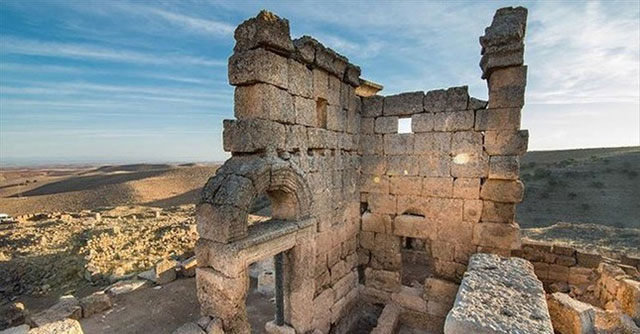
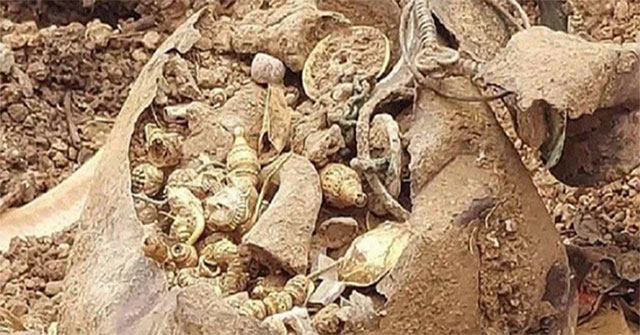
2,500 years ago, at an abandoned ancient fortress in Italy, someone left a priceless and mysterious treasure for modern archaeologists .
According to Ancient Origins, the treasure with the "absurd double appearance " was found in the village of Rupinpiccolo in the province of Trieste, Friuli-Venezia Giulia region of Italy.
This village was once home to a fortified fortress built between 1800 and 1650 BC, during the Bronze Age.
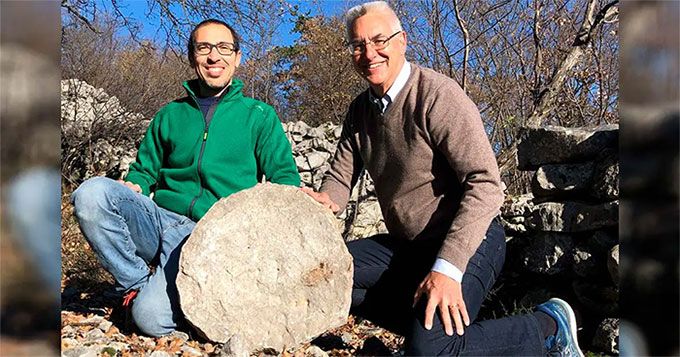
Archaeologist Federico Bernardini and astronomer Paolo Molaro at the Rupinpiccolo fortress and the treasure they discovered - (Photo: INAF)
From the 5th century BC, that is 2,600 years ago, the Rupinpiccolo fortress was abandoned.
The treasure that the Italian National Institute for Astrophysics (INAF) has just announced is two mysterious circular stones found in the ancient fortress area.
One rock represents the Sun , while the other is a celestial map .
The results of the dating were puzzling: They were carved around the fourth century BC, or 2,500 years ago.
That was when the fortress had been abandoned for 100 years. Therefore, it is impossible to know who and why carved and left this pair of round stones in that era.
The image of the Sun being placed next to celestial maps as a vague hint of heliocentrism is also puzzling, although they do not represent a precise understanding that the Sun is the center of its planets, and not the center of other celestial bodies.
The first person to propose the modern form of heliocentrism was the astronomer Nicolas Copernicus, who lived in the 15th century AD.
The 29 individual carvings on the cosmographic stone were selectively engraved celestial bodies, including the constellations Scorpio, Orion, Cassiopeia, and the Pleiades star cluster.
Another star not present today but suspected to be Theta Scorpil , could be observed from the hill where the fort was located around 400 BC or earlier.
This discrepancy with today's cosmic map allows scientists to identify a new supernova, which may have turned into a black hole in the sky. If a black hole is found from Theta Scorpil, the hypothesis that the rock is a celestial map will be further confirmed.
Although controversial because of the lack of some bright stars in the sky, scientists argue that the carved stars were chosen for a certain purpose, rather than carving the entire sky.
The analysis also showed that the carvings were made with hammers and chisels . However, the biggest mystery of who created them and for what purpose remains unsolved.
These 2,500-year-old treasures are still being studied further. If all the above arguments are confirmed, their value will be further enhanced because they will become the oldest celestial maps ever discovered in the world, representing "timeless" knowledge.