The GRX-810 alloy, developed using a combination of modeling and 3D printing, can withstand temperatures exceeding 1,000 degrees Celsius.
NASA is developing a new alloy for use in aerospace and space exploration that is 1,000 times stronger than the most current alloys, Interesting Engineering reported on April 20.
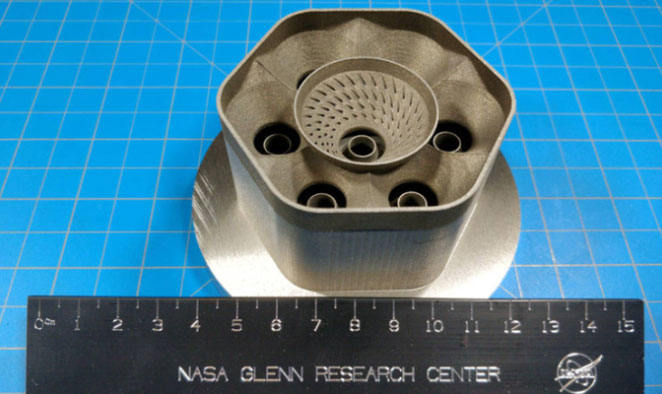
The turbine engine combustion chamber was 3D-printed using GRX-810 alloy at NASA's Glenn Research Center. (Image: NASA)
This space agency is always looking for materials that can withstand the harsh conditions of launch as well as the frigid temperatures of outer space. The new material, called GRX-810, is an oxide dispersion-enhanced alloy (ODS) , capable of withstanding these extremely harsh conditions before reaching fracture.
The GRX-810 alloy could be used in rocket nozzles and even fission or fusion reactors, and moreover, could usher in an era of rapid progress in materials science.
GRX-810 is made primarily of nickel, cobalt, and chromium, but it is combined with nanoscale metal-ceramic particles called yttrium , creating an "oxide dispersion-enhanced" (ODS) alloy.
During the research and development process, NASA uses materials modeling to determine which metal combination will yield the best results. Previously, experts often applied a "trial and error" process to find suitable new materials. This process often took many years.
By combining material modeling with 3D printing, NASA can quickly identify the necessary components of a desired alloy and produce it in a short time. The modeling method allows NASA to find the ideal alloy composition after only about 30 simulations.
"What would normally take years of testing and debugging now takes only weeks or months to figure out ," said Dale Hopkins, deputy project manager for NASA's Transforming Instruments and Technology project.
The new alloy can withstand temperatures up to 1,093 degrees Celsius. At this temperature, its fracture resistance doubles, its ductility and malleability increase 3.5 times, and its high-temperature pressure strength increases 1,000 times compared to current alloys.
"Previously, increasing tensile strength (the ability to withstand force when stretched without breaking) often reduced elongation and bending ability. That's why our new alloy is so noteworthy ," Hopkins added. According to NASA, the flexibility of the new material will bring major performance improvements.
Furthermore, the use of 3D printing technology also saves time and costs compared to traditional processes. "This is a revolutionary breakthrough in materials development. New, stronger, and lighter materials are crucial as NASA aims to transform future flights ," Hopkins stated.
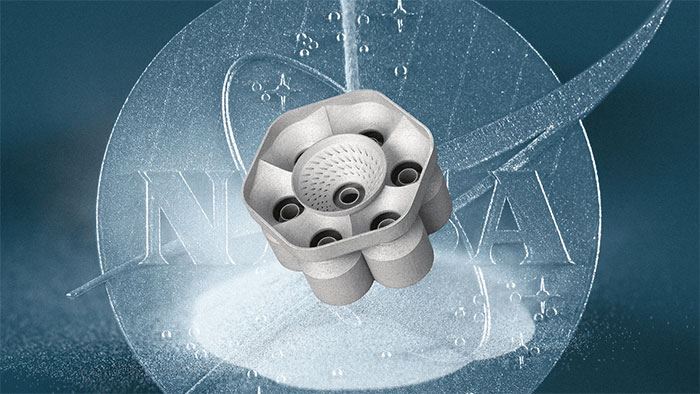
GRX-810 promises to usher in a new era in materials science. (Image: NASA)
NASA's next step is to continue researching the GRX-810 manufacturing process and explore ways to scale it up and increase its resilience to extreme temperatures and pressures so that it can be launched into space as soon as possible.
In just a few years, the US will unveil a space rocket using a nuclear-fired thermal engine. Currently, defense technology giant Lockheed Martin has won a half-billion-dollar contract from NASA and the Pentagon's Defense Advanced Research Projects Agency (DARPA) to build rocket engines that use nuclear fission reactors instead of chemical combustion to generate thrust.
Used in space, thermonuclear rockets could be far more efficient than chemical rockets and could power faster journeys to Mars and beyond.
- Is it humans who caused the appearance of the "mysterious hybrid monkeys" on Borneo Island?
- Top 6 foods recommended by Japanese experts to help 'absorb oil' in the blood and reduce visceral fat.
- Scientists climbed onto the church roof to collect cosmic dust.