If the Earth were the size of a marble, the Sun would be the size of a yoga ball, and the largest star in the universe has a diameter that would be hard to believe.
We all know that the Earth is just a grain of sand compared to the universe, but very few people can imagine how great the distances between celestial bodies are.
Suppose the diameter of the Earth is 1 cm which is equivalent to the size of a marble. The diameter of the Moon is 0.27 cm. The sizes of Mercury, Mars, Venus, Uranus, Neptune, Saturn and Jupiter will be 9.5 px, 13.25 px, 22.5 px, 100 px, 95 px, 235 px, 275 px respectively (1 px = 0.026458333 cm), where Saturn and Jupiter are equivalent to the size of a tennis ball.
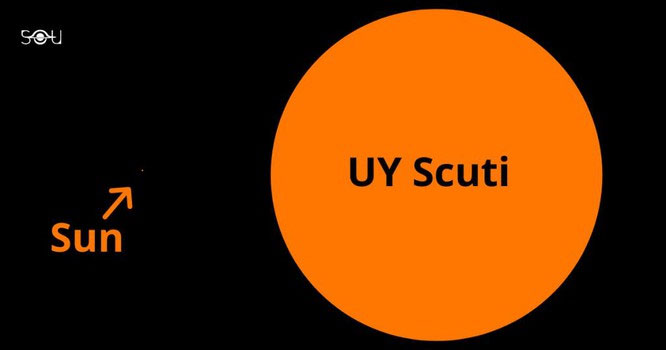
The largest star in the observable universe is UY Scuti.
As the largest star in the solar system, the Sun is 2750px in diameter, which is about the same as a large yoga ball. You can imagine how big the gap between a marble and a yoga ball is.
Yet, in the entire universe, the Sun is just one small star among countless stars. Today, the largest star in the observable universe is UY Scuti, a red supergiant in the constellation Scutum with a diameter of 2.4 billion kilometers, 1,700 times the diameter of the Sun. Even the speed of light to travel from one end to the other takes 133 minutes.
This means that if UY Scuti were placed at the center of the Solar System, it would engulf the orbits of Mercury, Venus, Earth, Mars, and possibly even Jupiter. This is an illustration of the enormous scale of this celestial body.
The sheer magnitude of UY Scuti puts it in a class of its own, far surpassing other notable stars like Alpha Orionis (also known as Betelgeuse) in sheer size.
The enormity of this supergiant star not only challenges our understanding of the evolution of stellar systems, but also captures the imagination of astronomy enthusiasts.
It gives us a clear perspective on the vastness of the universe and our place within it.
Star formation is a process that has been going on for an unknown amount of time, but begins in the cold, dense cores of giant molecular clouds scattered throughout galaxies.
These clouds of gas and dust become 'nursery' for stars to form. This happens when regions inside them collapse under the force of gravity, creating conditions for nuclear fusion in their cores to form.
However, the process is more complicated for supermassive stars, as their formation may involve the merger of smaller stars, through the accretion of material from their surroundings.
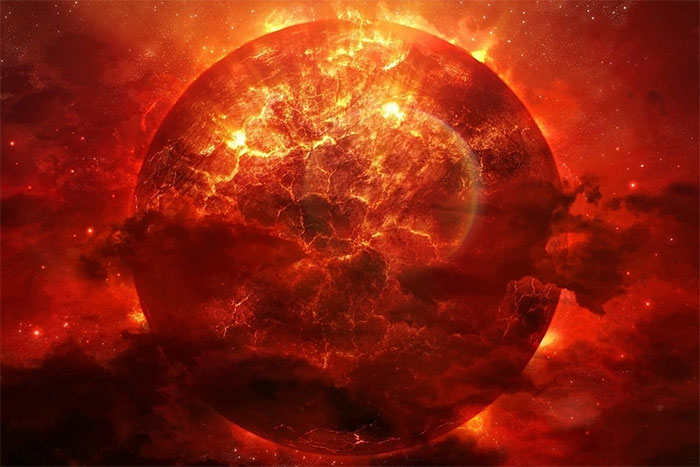
Image depicting the enormity of UY Scuti. (Photo: Getty).
Of course, UY Scuti is not a large planet in the universe, we all know that the largest object in the universe is a black hole. The black hole, numbered SDSS J140821.67 + 025733.2, has a mass 196 billion times that of the Sun. If the diameter of the Earth is 1 cm and the diameter of the Sun is 1 meter, then the diameter of the black hole is 920 km.
We only know that the diameter of the Milky Way is about 100,000 light years, equivalent to 200 million kilometers, and the thickness is 12 million kilometers. This length is equivalent to the distance from the Earth to the Sun. Therefore, if the Earth takes one year to orbit the Sun, the ellipse formed is equivalent to the Milky Way.
Compared to the largest stars in the universe and the Milky Way, our Earth is so small, yet it has all the necessary ingredients for human existence.