The bizarre 'rolling' floodwaters in Arizona could be harmful to many species of creatures, even humans.
On July 15, 2020, a strange black stream was discovered in a dry canal in the US.
Video taken in the arid Cañada del Oro Wash in Arizona shows the flow as a mixture of mud, dirt and dead branches, all smoking and billowing like waves.
The video was posted to Twitter by officials in Pima County, Arizona. They captioned it: "Video taken July 15, 2020 in Cañada del Oro Wash, northern Pima County, after a light rainstorm."
Accordingly, the strange flow is a flood, the result of rain and forest fires.
"Floods can happen anywhere at any time. But did you know that wildfires increase the risk of flooding? Yes," Pima County officials wrote in the video caption. "Wildfires like the Bighorn Fire leave the ground dry, bare, and unable to absorb water. Even a small amount of rain can cause flash flooding, often with little warning."
The Bighorn Fire in Arizona has burned more than 120,000 acres (48,377 hectares) since June 5, 2020. While the fire is under control, it is still burning in the foothills of the Catalina Mountains.
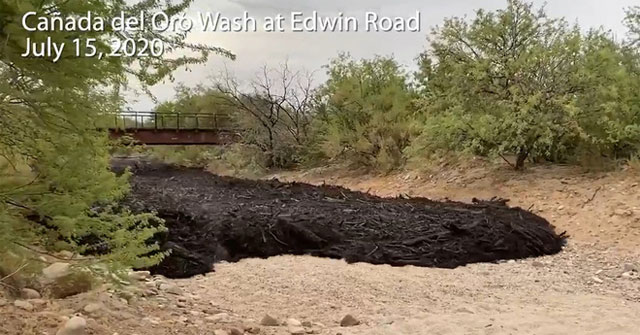
The strange flow is a flood, the result of rain and forest fires.
Scientists agree with Pima County officials that wildfires make rain more dangerous. Fire changes the structure of the soil by mineralizing organic matter and releasing nutrients, metals, and toxins that are not normally washed away by water. This new soil structure does not absorb water.
'Compared to non-fired areas, burned areas are more susceptible to flooding when rainfall occurs,' explains the USGS's California Water Science Center. 'In Southern California, as little as 7 mm of rain in 30 minutes can cause flash flooding.'
As vegetation is lost, ash and loose soil flow into streams and rivers. This silt reduces dissolved oxygen levels in the water, increasing nutrients that allow cyanobacteria to grow and algae to bloom. As a result, oxygen levels in the water continue to drop.
The lack of oxygen eventually suffocates fish and crabs, leading to mass deaths. A prime example is the unprecedented bushfires in Australia in late 2019 and early 2020.
Even if aquatic life survives, it may starve to death later because it cannot see food in the murky water. Aquatic plants and algae also die because they do not get the light they need for photosynthesis.
This layer of mud when flowing into rivers and streams can cause mass fish deaths.
Sediment from wildfires can also flow into dams and threaten people's drinking water, making the sludge too thick for filtration systems to handle.
When floodwaters contain large solid debris, they contribute to soil erosion, posing a risk to water treatment infrastructure.
'Fast-moving, destructive floodwaters caused by heavy rains are among the most dangerous consequences of wildfires. Such flows are especially dangerous because they come with little warning,' the USGS explains.
"Floodwaters can strip vegetation, clog drains, damage infrastructure and endanger human life."
Ecologist Paul McInerney, from Australia's Commonwealth Scientific and Industrial Research Organisation (CSIRO), has explained how to deal with mudflows. McInerney says we can use erosion control measures to limit the size of the floodwaters. Ensuring that waterways are well vegetated can also help in the long term.
However, floods can have long-term, irreversible impacts. In some cases, fish populations never recover, ecologist Lee Baumgartner told The Guardian, citing the 1939 bushfires that devastated the Lachlan River fish population in Australia.