Both space and time seem to be frozen inside it, behind the tin shell, just waiting for someone to open it one day.
What would you do if you opened your refrigerator one day and discovered that the can of fish you bought at the supermarket had expired? Many people would simply throw it in the trash. Or they would open it, pour the fish inside to the cat, and then toss the tin in a corner to wait for the scrap metal sale.
But don't do that, because you can sell these cans to scientists for a lot of money. The older the can, the more maggots in it, the more valuable it becomes to ecology.
By opening these cans of expired fish , scientists are also opening time portals, allowing them to peer into the marine ecosystems where the fish were caught decades ago.
Each expired can of fish is, in that sense, a miniature museum of natural history. Space and time seem to be frozen inside, behind the tin, just waiting for someone to open it.
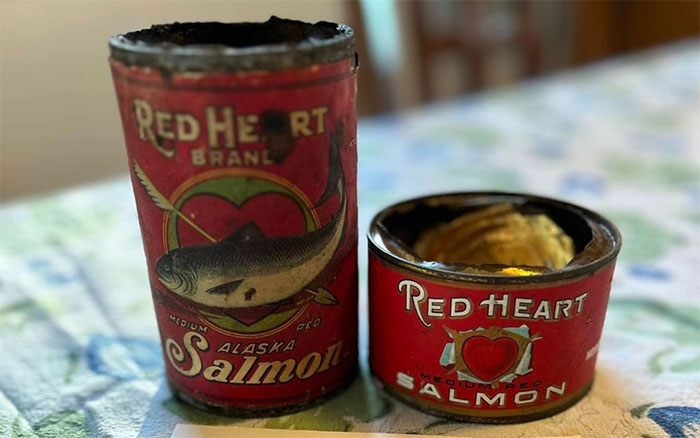
Canned fish has a very long history.
In case you didn't know, canned fish has a long history , as they were first invented in 1795. It was during the Napoleonic Wars and the French emperor at the time offered a reward of 12,000 francs to anyone who could come up with a way to preserve food for a long time.
Napoleon needed such a food to feed his expeditionary army, which often had to fight far from home and for long periods of time.
12,000 francs at that time was equivalent to more than 5 billion VND at this time. And the prize was awarded to Nicolas Appert , a confectioner who came up with a way to put fish in a glass jar and then sterilize it by placing the jar in boiling water.
At that time, the existence of bacteria was unknown, so Appert could not explain why food spoiled and why dipping the glass jars containing the fish in boiling water would preserve the fish. He only knew that it worked.
It was not until more than 50 years later, when another French scientist, Louis Pasteur, formulated his germ theory , that bacteria and their damage to food became known.

Nicolas Appert, a French confectioner, invented canned fish in 1795.
But back to the canned fish. Nicolas Appert originally used glass jars to store his fish, but they often broke during shipping. So an English merchant named Peter Durand came up with the idea of packing the fish in tin cans.
Then the canned fish we see today was born.
Both Nicolas Appert and Peter Durand can be considered the "Father of Canned Fish". Initially, these canned fish were only served to soldiers during the war. But later, with the advantage of being preserved for a long time, up to years, they became a consumer product for all classes of people.
But perhaps, when inventing canned fish, both Nicolas Appert and Peter Durand did not think that one day, their product could be used for another purpose. That is scientific research, even when the canned fish has expired and is no longer edible, they still have value.

Even if the cans of fish are expired and no longer edible, they still have value.
In a study published in the journal Ecology and Evolution, a team of ecologists at the University of Washington said they purchased 178 cans of expired fish at a high price from the Seattle Seafood Association (SSPA).
These are leftover fish cans that SSPA collects from local producers every year as part of its quality control procedures. Some of the cans are opened for analysis, but some are stored to see how long they can be stored. Some are simply spare samples, collected in excess, and have remained in SSPA's warehouse since the 1970s.
After all these years, one day when SSPA decided to clean out its warehouse to get rid of all the expired and unused fish cans, they suddenly remembered Chelsea Wood, an associate professor at the School of Aquatic and Fishery Sciences at the University of Washington, who had come in to ask to buy the old fish cans.
Associate Professor Wood was asked by the staff at the seafood association if she would like to buy nearly 180 cans of expired fish. Like finding a treasure, Associate Professor Wood's answer was of course yes, she would buy them all at any price.
But why are expired cans of fish so valuable to scientists?

The value of expired cans of fish lies not in the fish itself, but in the worms inside, says Associate Professor Wood.
It turns out that the canned fish actually contained the remains of worms. These sea worms belong to the parasitic species anisakids , each only about 1 cm long and were killed during the process in which the canned fish was sterilized at 130 degrees Celsius.
Although their bodies remain inside the fish, they are no longer capable of causing illness in humans.
'People think worms in salmon are a sign that the can has gone bad,' says Associate Professor Wood. 'But I see their presence as a signal that your fish has come from a healthy ecosystem.'
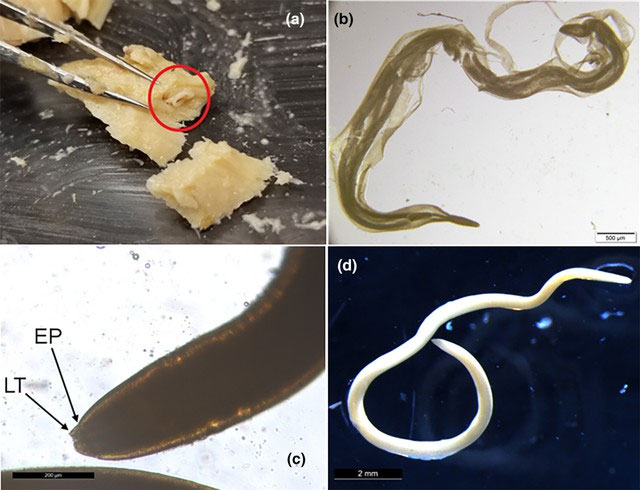
A sea worm sample was found in a can of salmon that had expired in the 1970s.
The truth is, sea worms play a very important role in the ecosystem . They initially serve as food for plankton. The plankton are then eaten by fish. Some worms or worm larvae simply survive after being swallowed by these animals.
They then begin to parasitize and reproduce inside the fish's gut. These fish may be eaten by larger fish, and even marine mammals. They will continue to reproduce, lay eggs, and their eggs will be excreted by the fish into the ocean. At this point, the cycle begins again.
'Without a host, the worms cannot complete their life cycle and their numbers will decline,' said Associate Professor Wood.
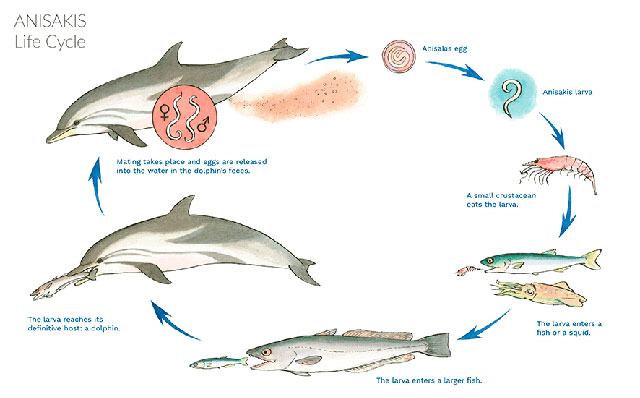
Life cycle of sea worms.
So, for 178 canned fish samples collected from the 1970s to the present, her team simply opened them and counted the number of sea worms they found inside. The samples included 42 cans of dog salmon (Oncorhynchus keta), 22 cans of coho salmon (Oncorhynchus kisutch), 62 cans of pink salmon (Oncorhynchus gorbuscha), and 52 cans of sockeye salmon (Oncorhynchus nerka).
Scientists found that worm counts increased over time in pike and pink salmon, but not in sockeye and coho salmon.
'Finding the number of marine worms increase over time, as in pink salmon and trout, suggests that these parasites have found suitable hosts to reproduce,' said study co-author Dr. Natalie Mastick from Yale University.
'That could indicate a stable or recovering ecosystem, with enough suitable hosts for the marine worms.'

Information about the number of marine worms in salmon samples allowed scientists to draw an ecological map of the Gulf of Alaska and Bristol Bay areas where these salmon were caught.
By opening cans of expired fish and counting the number of sea worms in them over time, scientists have gained a glimpse into the ecosystem in the Gulf of Alaska and Bristol Bay, where these salmon were caught.
This is a completely new approach to marine biology, and it could open up many new avenues of research, revealing much more information. So the question that arises from this study is:
Do you have any expired cans of fish in your house? What factory were they made in, and what waters were they caught from? If you don't plan on eating them, don't throw them away, just put them away, and who knows, you might be able to sell them to scientists for a surprising amount of money.