A new analysis of chaos in the Solar System has revealed how planetary collisions were avoided for billions of years .
According to physical models, the inner Solar System is a mess . New research may explain its relative stability.
The Chaos of the Solar System
The orbits of the inner planets of the Solar System —Mercury, Venus, Earth, and Mars— are chaotic , and models have suggested that these inner planets should have crashed into each other. However, that hasn't happened.
New research published May 3 in the journal Physical Review X may finally explain why.
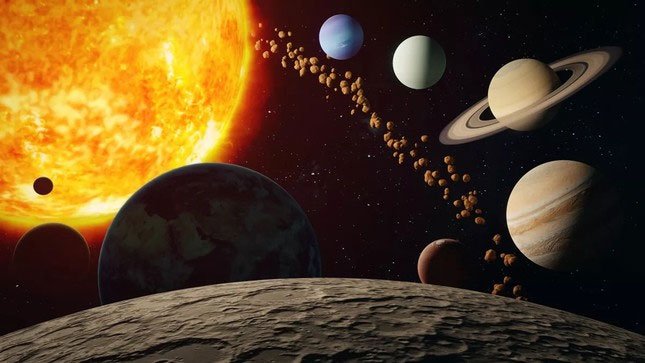
The inner Solar System is a mess.
Through in-depth study of planetary motion models, researchers have discovered that the motion of the inner planets is constrained by several parameters that act as a tether that prevents chaos in the system.
Besides providing a mathematical explanation for the apparent harmony in the Solar System, the new research's insights could help scientists understand the orbits of exoplanets around other stars.
The unpredictable planets
Planets constantly exert gravitational pulls on each other, and these small tugs constantly cause small adjustments to the planets' orbits. The outer, much larger planets are able to counteract these smaller tugs and thus maintain relatively stable orbits.
However, the problem of the orbits of the inner planets remained too complex to solve precisely . In the late 19th century, mathematician Henri Poincaré demonstrated that it was mathematically impossible to solve the equations governing the motion of three or more interacting bodies, commonly known as the "three-body problem".
As a result, the uncertainty in the details of the starting positions and velocities of the planets increases over time. In other words: There are two possible scenarios in which the distances between Mercury, Venus, Mars and Earth differ by the smallest amount, and in one case the planets collide, in the other they drift apart.
In 1989, Jacques Laskar, an astronomer and research director at the National Center for Scientific Research and the Paris Observatory in France and a co-author of the new study, calculated the Lyapunov time characteristic of the inner Solar System's orbital planet to be just 5 million years .
If the initial uncertainty in a planet's position is 15 m, then 10 million years later this uncertainty will be 150 m; after 100 million years, another 9 digits are lost, giving an uncertainty of 150 million km, equivalent to the distance between the Earth and the Sun.
While 100 million years may seem like a long time, the Solar System itself is more than 4.5 billion years old, and the lack of dramatic events—like a planetary collision or a planet being ejected from all this chaotic motion—has always puzzled scientists.
Laskar then looked at the problem another way: by simulating the orbits within the planet over the next 5 billion years, stepping from one moment in time to the next. He found only a 1% chance of a collision between the planets. Using the same approach, he calculated that, on average, it would take about 30 billion years for any planet to collide.
Reign in Chaos
Working mathematically, Laskar and his colleagues first identified "symmetries" or "conserved quantities" in the gravitational interactions that create real-world barriers in the chaotic wandering of planets.
Renu Malhotra, a professor of planetary sciences at the University of Arizona, who was not involved in the study, emphasized the sophistication of the mechanisms identified in the study. What is interesting, Malhotra said, is that the orbits of the Solar System's planets exhibit particularly weak turbulence.
In another study, Laskar and colleagues are looking for clues about whether the number of planets in the Solar System ever differed from what we see today. For all the apparent stability today, whether that was always true in the billions of years before life evolved remains an open question.