Astronomers have discovered two active black holes merging at the furthest distance ever seen, some 900 million years after the Big Bang. It is the first time two glowing supermassive black holes have been spotted in the dawn of the universe.
The cosmic dawn is the period that encompasses the first billion years of the universe. During this period, about 400 million years after the Big Bang, the Epoch of Reionization began, during which light from newborn stars stripped hydrogen of its electrons, leading to a fundamental reshaping of galactic structures.
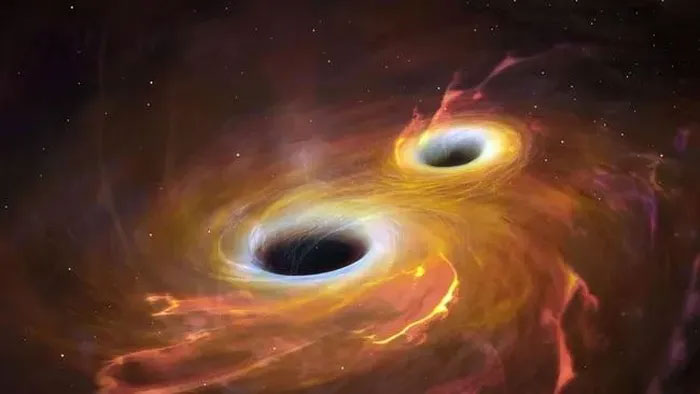
Illustration of two black holes merging. (Image: Mark Garlic/Science Photo Library).
'The existence of merging quasars during the Epoch of Reionization has long been predicted. Now it is confirmed for the first time ,' said study lead author Yoshiki Matsuoka, an astronomer at Ehime University in Japan.
Black holes are born from the collapse of massive stars and grow by relentlessly devouring gas, dust, stars, and other black holes in the star-forming galaxies that host them. If they grow large enough, friction heats up the material spiraling into the black hole's mouth and they turn into quasars—shedding their gas cocoons with jets of light trillions of times brighter than the brightest stars.
Previous simulations of the cosmic dawn suggest that billowing clouds of cold gas may have coalesced into massive stars that quickly collapsed, creating black holes. As the universe evolved, the first black holes may have rapidly merged with others to create even more supermassive black holes across the cosmos.
The researchers found the quasar pairs using the Subaru Telescope 's Hyper Suprime-Cam , where they appear as two pale red streaks against a glittering background of galaxies and stars.
Astronomers then continued to take spectral images and confirmed that the light source was a pair of quasars moving in spirals.
The discovery will help understand how the quasar's powerful beam of light created the structure of the universe we see today, researchers say.