In the place where one or more planets may be forming, astronomers have found three times more water than Earth's oceans combined.
Using the ALMA observatory - the world's most powerful radio observation instrument located in Chile's Atacama Desert - scientists discovered a giant "sea of space" 450 light-years away from Earth, in the constellation Taurus.
It is a young, tiny star surrounded by a protoplanetary disk that shows only faint signs of its first planet about to form, called HL Tauri .
And that place contains an unbelievable amount of steam.
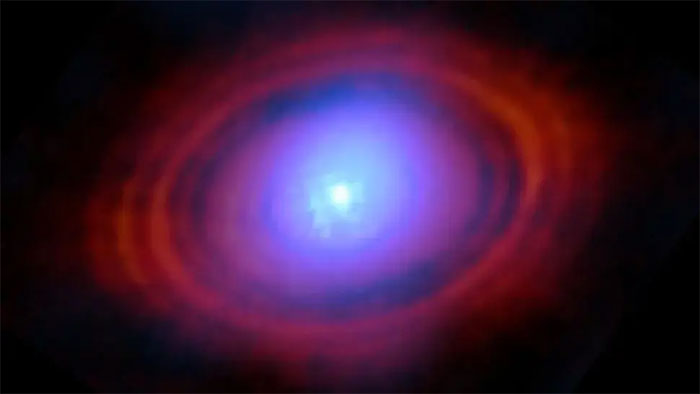
Protoplanetary disk HL Tauri - (Image: ALMA (ESO/NAOJ/NRAO).
Estimates suggest that the amount of water could be equal to the volume of the Pacific, Atlantic, Indian, Arctic and Southern Oceans combined, multiplied by three!
According to astronomer Stefano Facchini from the University of Milan (Italy), who led the research team, this discovery shows how the presence of water can affect the development of a star system.
What we are looking at in the constellation Taurus may be an image of the Solar System 4.5 billion years ago, when the "seeds" of Earth and other friendly planets were forming from a dense protoplanetary disk of gas and dust.
More specifically, we may be looking at a 4.5 billion year younger copy of Earth.
A study summary in Space.com shows that the water in HL Tauri is not evenly distributed , but is most abundant in a small groove in the disk.
The grooves in a protoplanetary disk form when, in a certain location, gas and dust coalesce into a protoplanet. So where there is a lot of water, a planet may be forming.
Where there is water, there is hope for life . So it is entirely possible that we are looking at a planet that billions of years from now will possess a civilization like our own, a world with mountains, rivers, complex lakes on continents and vast oceans.
Water vapor is also thought to have significantly influenced the chemical composition and formation of a planet.
This discovery not only marks an important step in our understanding of how planets form, but is also a major achievement for ALMA.
Finding signs of water 450 light years away is a feat that is difficult for Earth-based observatories, which typically have to peer through the atmosphere.
However, ground-based observatories are facilities that can accommodate more bulky but sophisticated machines than space telescopes. Therefore, making the most of their potential is an opportunity for humanity to open new doors in the field of cosmology.