A collaboration between scientists from the University of Ottawa and Sapienza University has captured for the first time the dance of two quantumly entangled photons in real time.
Specifically, the team of scientists demonstrated a new technique that allows them to reconstruct the wave function image of two quantum entangled light particles (photons).
Comparing a pair of photons to a pair of shoes, the phenomenon of 'quantum entanglement' can be thought of as randomly selecting one shoe and, upon identifying it, immediately knowing the nature of the other shoe regardless of where it is. However, the intriguing element is the uncertainty of the process of determining the nature of the shoe, which is not clear until the exact moment of measurement.
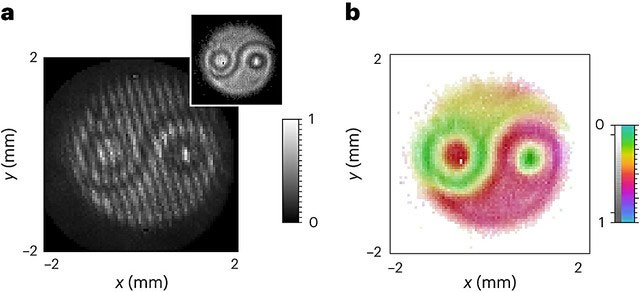
Reconstructed image of a pair of quantum entangled photons - (Photo: Nature).
The wave function , which is a central principle of quantum mechanics, provides a concrete view of the quantum state of a particle. As in the shoe example above, the 'wave function' of a shoe would include information such as whether it is a left or right shoe, shoe size, shoe color, etc.
More precisely, the wave function allows scientists to predict the results of measurements of a particle's quantum properties, such as position or velocity.
This predictability is worth its weight in gold, especially as the field of quantum technology advances at a dizzying pace. Once we know how a quantum state is generated, or the properties of a particle, we can test quantum computers. Furthermore, the quantum state of a particle in a quantum computer is inherently complex, involving many entities with their own quantum states.
Determining the wave function of a quantum system is inherently difficult—a process known as quantum state tomography , or quantum tomography for short . The basic approach requires a large number of measurements, the number of which increases as the system becomes more complex.
But previous research has shown that it would take a team of researchers hours or even days to capture the quantum state of two photons in a complex system. What's more, the quality of the measurements is highly sensitive to noise and highly dependent on the complexity of the system.
The method of reference used in quantum tomography can be compared to looking at the shadow cast on a wall by an object. Based on what is observed, scientists can estimate the state of the entire photon. For example, from a 2D image, we can infer the 3D shape of the object.
In classical optics, there is another way to create 3D images. Called digital holography , this method is based on a single image generated from the amount of light scattered after shining on an object.
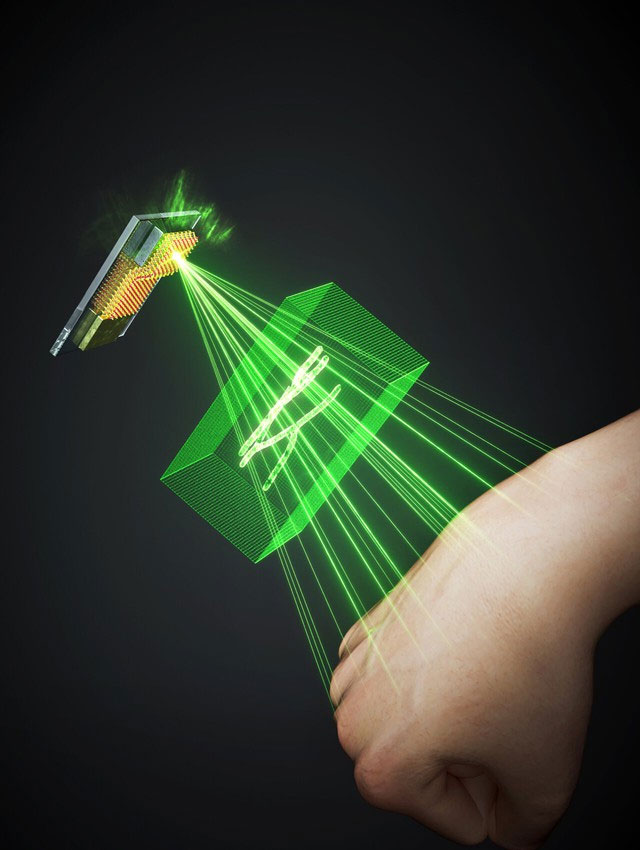
The more technology develops, the more advanced the ability to create 3D images - (Photo: Internet).
Applying and simultaneously extending this method to a pair of photons, the research team led by Ebrahim Karimi - co-director of the Ottawa Linkage Quantum Technology (NexQT) research institute and associate professor at the Faculty of Science - attempted to image the phenomenon of quantum entanglement.
Reconstructing the quantum state of two photons requires scientists to superimpose another well-understood quantum state on top of them, then analyze the positions of the two photons. The resulting image of the positions of the two photons is called a 'coincidence image'. These photons could come from the light source used in the experiment or from some other unknown source, since quantum mechanics dictates that the source of the photon cannot be determined.
Measuring photons produces interference patterns from which scientists can calculate wave functions. The experiment was made possible by a camera system that can record pixels at nanosecond resolution.
Professor Alessio D'Errico of the University of Ottawa, one of the authors of the new study, stressed the advantages of the innovative research method. ' This is much faster than previous methods, taking only minutes or seconds compared to days. Most importantly, the time [to measure the results] is not affected by the complexity of the system ,' the professor said.
The new research is not just important for the academic community. It has the potential to accelerate the pace of quantum technology research, from simply improving our ability to determine the nature of quantum states to quantum communication systems, and even helping develop new quantum imaging methods.
The study was published in the journal Nature Photonics.