On an expedition to find new species in the Sudest Island, Louisiade Islands, southeast Papua New Guinea, scientists have discovered a frog that can change color as it matures.
As a child, their skin is shiny black with yellow spots and when they mature, the skin color suddenly turns peachy with bright blue eyes.
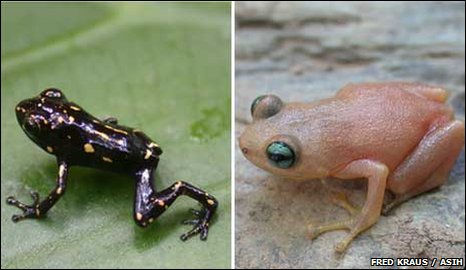
Frogs change color found in Papua New Guinea (left picture: a baby frog; right picture: a mature frog of the same species)
Scientists have discovered this new frog, Oreophryne Ezra, that changes its unique skin color on an expedition to find new species on the island of Sudest, in the southeastern part of New Guinea. Among the new species they found, this particular frog attracted their attention. Scientists believe that the frog frog's blip acts to alert the enemy, but strangely the adult frogs lose that color.
Research results of scientists The Bishop Museum in Honolulu, Hawaii, USA in Copeia magazine shows: 'Amphibians have all the colors and shapes, from colored poison frogs. Colorful colors to ordinary green toads. Some frogs change color when it is larger, however, it is unclear why adult frogs and frogs have different colors and shapes. '
Dr. Fred Kraus, who conducted the study of this color change frog, said: 'It is interesting to discover a new species. However, the unusual variation of this frog is a particularly interesting discovery . ' The doctor also said: 'What is remarkable about this frog is the dramatic change in color from a baby frog to a mature frog'.
Although not yet tested, this frog may contain an extremely toxic substance under the skin like poisons of dart frogs. Under the skin of poisonous dart frogs containing poison alkaloids as a protective layer against predators. Dr Kraus said: 'This is a way to show this species' independent evolution in nature. This frog's colorful color shows that it wants to inform its enemies that it is poisonous and should not come near it. '
Researchers say that baby frogs often sit in conspicuous places during the day and never escape enemies that show they have their own defense. An inexplicable aspect is that the frogs use color to defend themselves, so why do the frogs when they reach adulthood change color without using color to protect themselves? According to Dr. Kraus, "there is no case like this frog, if they use color to defend themselves, the color change when they mature is a mystery."