The universe is about 13.8 billion years old, but how do we know that?
Scattered throughout the vacuum of space are stars, galaxies, stellar remnants, and other objects that are billions and billions of years old. As of today, the universe is about 13.8 billion years old. How do we know that?
Scientists say it is possible to determine the age of the universe by analyzing light and other types of radiation traveling from deep space, but they do not always agree on the age of the universe and continue to search for a more precise answer with each improvement in space telescopes.
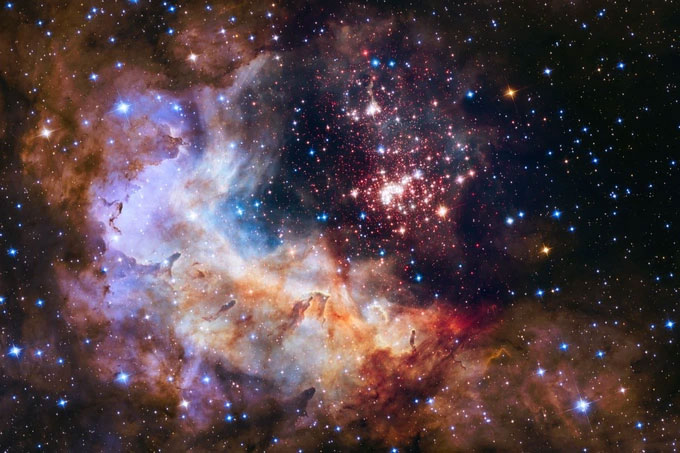
By analyzing light, we can know the age of the universe. (Photo: NASA).
In the 1920s, astronomer Edwin Hubble figured out how to determine the relationship between an object's distance, based on the time it takes light to travel from the object to Earth, and the speed at which that light leaves Earth, based on how much light from distant locations has redshifted . (Redshift is the phenomenon in which light emitted by objects moving away from the observer appears redder.)
This number, now called the Hubble constant , describes the expansion of the universe at different locations. According to NASA, the Hubble constant is higher for objects farther away and vice versa. This suggests that the expansion of the universe is accelerating, but this makes it harder to calculate the age of the universe.
Many scientists now believe the universe is 13.8 billion years old. They came up with this figure based on calculations in 2020 after re-evaluating data provided by the European Space Agency's Planck spacecraft and analyzing data collected from the Atacama Observatory in Chile.
This calculation makes the universe about 100 million years older than the previous estimate based on data provided by the Planck spacecraft in 2013. Both the Planck spacecraft and the Atacama Observatory have mapped the cosmic microwave background (CMB) , the light left over from the Big Bang.
By combining these data with existing models of how quickly different types of matter and objects appeared after everything began, scientists can estimate how long it took for the explosion that gave birth to the universe to take place.
According to scientists, light from the CMB appeared about 400,000 years after the Big Bang. The universe began in a plasma state , in which photons, or light, were attached to electrons.
Eventually, the universe cooled enough for photons to separate from electrons, leave the ionosphere, and wander around space, forming the CMB. So by measuring how far away that scattered light is, scientists can estimate the age of the universe.
The new figure of 13.8 billion years was proposed in 2020 by a group of scientists at the Center for Computational Astrophysics of the Flatiron Institute, New York, USA. The research team re-examined the CMB using telescopes at the Atacama Observatory.
Although the Atacama maps cover a smaller area than Planck's, the higher resolution allows for more precise measurements, said study leader Dr. Simone Aiola.
Dr Aiola and his colleagues made a breakthrough by observing the CMB at the smallest scale ever. This allowed them to see many details and anomalies that revealed what happened in the early universe and when. By comparing these high-precision maps with predictions of the age of the universe, the team calculated the age of the universe to be 13.8 billion years.
Could the universe be even older? It's possible! As telescopes get better and more powerful, they'll be able to see further back in time than we can even imagine, and find something that changes everything we thought we knew.