Many theories have been put forward, but no one is sure how the stars disappeared, or where they are now.
We live in a vast, vast universe, always containing mysteries that humans cannot explain.
One of them is the phenomenon of stars disappearing without any specific explanation. They clearly do not collide with each other, do not fly out of the Solar System, but disappear in an extremely mysterious way.
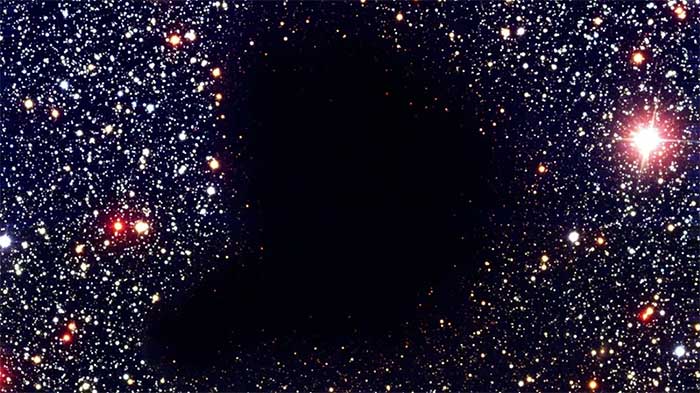
Telescopic image of the dark nebula Barnard 68. This is where the stars cannot be seen in visible light due to a giant cloud of dust obscuring them (Image: ESO).
In 2019, a project called VASCO , developed by the Institute of Astrophysics of Canarias (Spain), attempted to catalog the stars that had disappeared from our view in the past 70 years. The results were surprising, with over 100 stars missing without any specific explanation.
'We found no evidence that the disappearance of a light source would be consistent,' the study notes. 'In particular, the recordings show no evidence of unusual moving sources such as aircraft, asteroids, or elementary particles.'
'They simply disappear into nothingness , ' the study concluded.
Previously, researchers at the Palomar Observatory in San Diego, California, were also extremely surprised when they observed three stars located close together disappearing in less than an hour.
Theoretically, stars can dim, or explode as a supernova, before leaving behind a bright light for hours or days. But they simply cannot instantly disappear from view.
One possible hypothesis is that they may not have gone supernova, but collapsed into a black hole . However, this is thought to be extremely rare, with odds of less than 1 in 90 million, and would not explain why so many of the bright spots disappeared.

Images taken less than an hour apart show several stars mysteriously disappearing. (Photo: Solano).
Another possibility could be gravitational lensing . It occurs when light and electromagnetic waves emitted by an object are deflected along their path by the gravitational force of nearby celestial bodies.
This phenomenon is often more clearly observed if the light passes through black holes or galaxies, where objects such as asteroids can also be the "culprits" causing these disappearances.
According to Jamal Mimouni, an astrophysicist at Constantine 1 University in Algeria, studying these disappearing stars could be a clue to the search for advanced extraterrestrial civilizations (SETI).
"This could be a turning point in the SETI search," Mimouni said. However, the expert also admitted that there is still no evidence or exact answer to describe the above phenomenon.
'It's hard to imagine, because that would simply create a whole other set of questions,' the astrophysicist shared.