Jupiter's atmosphere is divided into four layers: the troposphere, stratosphere, thermosphere, and exosphere. Each layer has its own function and role in Jupiter's activities.
Although Jupiter is a gas planet, it does not mean that it does not have a solid core , its core is mainly composed of iron and silicon, the volume of this core is about 2 to 3 times the size of Earth's core.
Due to its extremely high density, Jupiter's core is also about 10 to 15 times more massive than Earth's core. Therefore, even if you had a drill bit many times harder than a diamond, you still wouldn't be able to penetrate Jupiter's core.
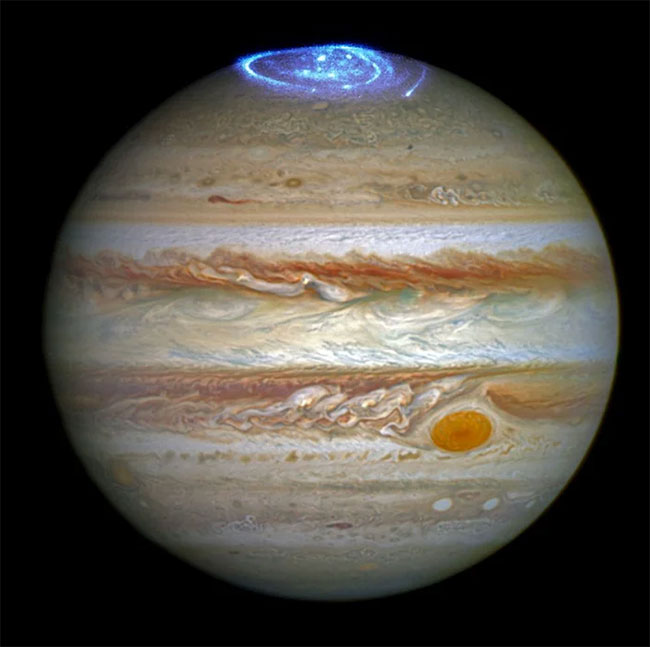
Jupiter is a gas planet but it still has a solid core.
So if you stand on the surface of Jupiter, can you fall into the core? This seems impossible , first of all, the core of Jupiter has no clear boundary , from the earth's core to the outside is a gradual thinning process. The top core consists of rocky particles and mixed hydrogen, gradually changing to a surrounding layer of liquid metallic hydrogen, then there is liquid hydrogen on top.
The phase transition pressure of this liquid hydrogen is about 2 million atm, and the phase transition temperature is about 10,000K; and when the core boundary temperature is about 36,000K, the internal pressure can reach 3,000~4,000GPa, that is, 30 million to 40 million atm.
Liquid hydrogen turns into gaseous hydrogen, which is the atmosphere of Jupiter . Scientists consider the place where the atmospheric pressure is 1 bar, that is, the depth of about 1 Earth atmosphere, to be the surface of Jupiter, and the thickness from the top layer to here is about 5,000 km. The main components of the upper atmosphere are 88-92% hydrogen and about 7-11% helium, and the remaining 1% includes methane, water vapor, ammonia, silicon compounds, carbon, ethane, hydrogen sulfide, neon, oxygen, phosphine, and is full of trace elements such as sulfur.
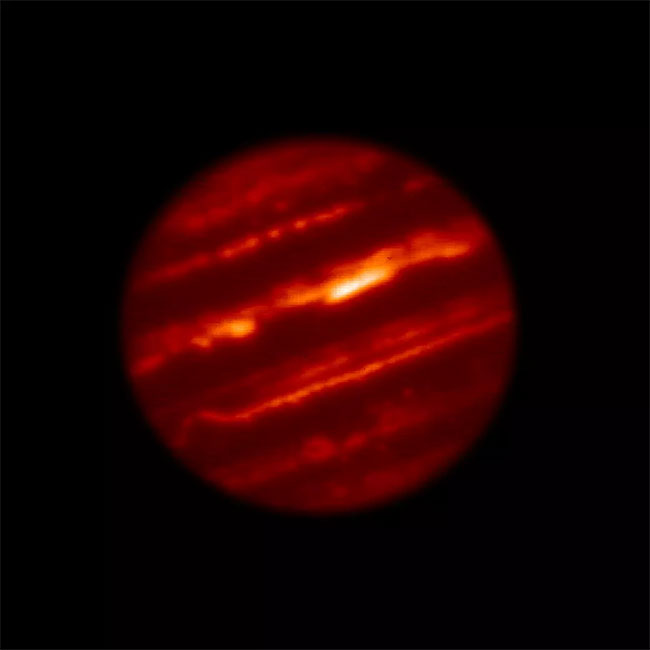
Jupiter's atmosphere is windy and cloudy, with storms reaching speeds of up to 150 meters per second.
Jupiter's atmosphere is divided into four layers, namely the troposphere, stratosphere, thermosphere and exosphere. The temperature of the atmosphere in the outermost layer is about 165K (-108 degrees Celsius), gradually moving inward is the process of increasing temperature, cooling down and then increasing again, when reaching the hot layer, the temperature can reach 1,000K, and when it goes down to the stratosphere, the temperature drops to 200K. As it goes down, the pressure and temperature get higher and higher, until the hydrogen phase turns into liquid hydrogen, and the temperature is as high as 10,000K.
Jupiter's atmosphere is windy and cloudy , with storms reaching speeds of up to 150 meters per second, compared to a Category 17 hurricane on Earth at around 60 meters per second. Jupiter's Great Red Spot is a giant storm that has existed for hundreds of years. Since Jupiter's magnetic field is 14 times stronger than Earth's, its lightning is 10,000 times stronger than Earth's, capable of tearing apart and destroying almost anything.
This is the part of Jupiter's environment that humans can understand. This knowledge is not based on imagination. It is obtained by scientists after decades of scientific modeling based on countless data and images collected through many observations and probes.

Jupiter's magnetic field is 14 times stronger than Earth's.
In such an environment, how could a person stand on Jupiter, and how could he fall into its core? We can imagine that if a spacecraft sent a person to Jupiter and let him put on a spacesuit and leave the cabin to free fall into Jupiter, the process he might go through would be as follows:
If the spacesuit could withstand the test of high pressure and temperature, then theoretically, he could fall to a depth of 5,000km. But in this process, the acceleration would be faster and faster, the temperature of friction with Jupiter's atmosphere would also be higher and higher, not to mention humans, even iron and steel would not be able to withstand it, so in this process of falling, his body would be torn into pieces and burned.
If any remnant of this separation and combustion process still manages to reach the troposphere, it will be destroyed by storms and lightning, then completely absorbed into Jupiter's atmosphere, and finally dissolved into liquid hydrogen under ever-increasing pressure and temperature without leaving a trace.

Galileo - Jupiter probe.
Galileo , a probe launched by NASA, completed its mission to explore Jupiter beyond expectations, crashing into the largest planet in the Solar System on the early morning of September 22, 2003, as planned. During the 8-year solo exploration mission, 1,500 representatives from all walks of life involved with Galileo gathered at NASA's Jet Propulsion Laboratory to conclude it.
The Galileo probe weighed about 345kg, with a thick heat shield of 200kg. When it entered Jupiter's atmosphere at a speed of 170,000km/h, or 47km/s, it experienced tremendous acceleration with a temperature rapidly rising to 10,000 degrees Celsius. Under the influence of this high temperature and high pressure, it was dissociated and burned within minutes, disappearing without a trace and becoming a trace element in Jupiter's dense atmosphere and liquid hydrogen.
