Sirius is the brightest star in the night sky with an apparent magnitude of -1.47, nearly twice as bright as Canopus, the second brightest star.
Facts about the constellation Sirius (the star Sirius)
- Discovering a companion
- Observe
- System Structure
- Sirius A
- Sirius B
- Sirius Supercluster
The name Sirius is derived from the ancient Greek Σείριος. The star's Bayer designation is α Canis Majoris (α CMa, or Alpha Canis Majoris). To the naked eye, it appears to be a single star, but it is actually a binary system consisting of a main-sequence white star of spectral type A1V, named Sirius A, and a companion, a faint white dwarf of spectral type DA2, named Sirius B.
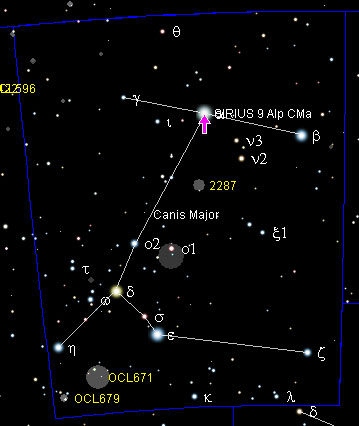
Sirius's location
Sirius shines brightly in the sky because it is a very bright star and it is quite close to Earth. At a distance of 2.6 parsecs (8.6 light-years), the Sirius system is one of our closest neighbors. Sirius A is about twice as massive as the Sun and has an absolute magnitude of 1.42.
It is twice as bright as the Sun but still much dimmer than other bright stars like Canopus or Rigel. The system is approximately 200 to 300 million years old. Initially, it was a binary system of pale blue stars. About 120 million years ago, the more powerful star, Sirius B, ran out of fuel and became a red giant, after which it ejected its outer layers and collapsed into the white dwarf it is today.
Sirius is also commonly known as the 'Dog Star' because it is located in the constellation Canis Major (The Great Dog). Besides the Sun, it features in more fairy tales and customs than any other star. When Sirius first appeared in the night sky, it coincided with the Nile flood season in ancient Egypt and was 'Dog Day' in summer in ancient Greece. In the Polynesian islands, it marked the beginning of winter and was an important day for navigation in the Pacific.
Discovering a companion
American telescope maker and astronomer Alvan Graham Clark was the first to observe this faint companion, now known as Sirius B , or 'The Puppy'. The star visible to the naked eye is called Sirius B. Since 1894, there have been observations of disturbances in the apparent orbit of the Sirius system suggesting a third, very small companion, but it has yet to be detected. The most suitable location for measurements is that it must orbit Sirius A with a six-year period and have a mass of only 0.06 times that of the Sun. This star must be ten times dimmer than the white dwarf Sirius B, making it very difficult to detect. Recent observations have consistently failed to confirm the existence of this third entity, but its existence and proximity to the Sirius system for observability cannot be ruled out. In the 1920s, observations suggested that this 'third star' might be one of the objects in the background stars.
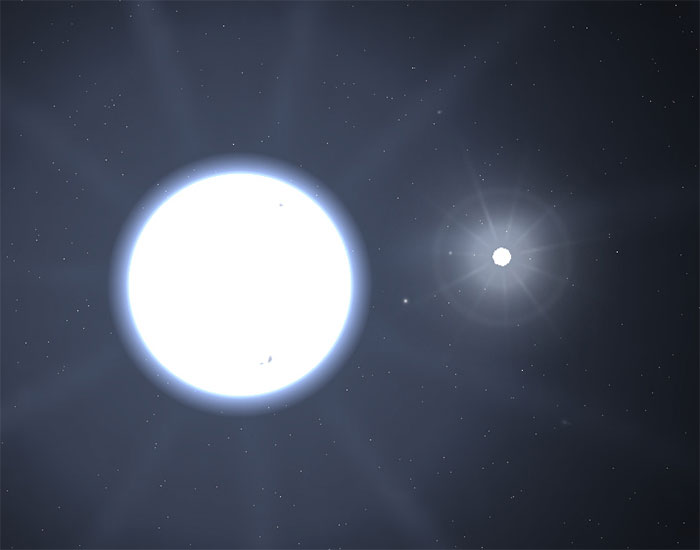
Simulated images of Sirius A and B using the Celestia program.
In 1915, Walter Sydney Adams, using a 1.5-meter reflector at the Mount Wilson Observatory, observed the spectrum of Sirius B and identified it as a faint, bright white star. This led astronomers to conclude that it was a white dwarf. The diameter of Sirius A was first determined by Robert Hanbury Brown and Richard Q. Twiss in 1959 at Jodrell Bank using an intensity interferometer. In 2005, using the Hubble Space Telescope, astronomers determined that Sirius B has a diameter close to that of Earth, 12,000 km, with a mass equal to 98% of the Sun's mass.
Observe
The halos and rays are due to the influence of optical instruments. With an apparent magnitude of -1.47, Sirius is the brightest star in the night sky, almost twice as bright as the second brightest, Canopus. However, it is not as bright as the Moon, Venus, Jupiter, Mercury, or Mars, which are also many times brighter than Sirius. Sirius is visible from most places on Earth, however, those in the north with latitudes above 73 degrees will not see it. However, it will not rise high in the skies of northern cities, reaching only 13 degrees from Saint Petersburg. Sirius, along with Procyon and Betlgeuse, forms the three vertices of the Winter Triangle for those in the northern hemisphere. At approximately -17 degrees, Sirius is a circumpolar star (a star orbiting the pole that never lies below the horizon) for those at latitudes above 73 degrees South. In the Southern Hemisphere in early June, Sirius may have nights when it sets behind the Sun and nights when it rises ahead of the Sun.
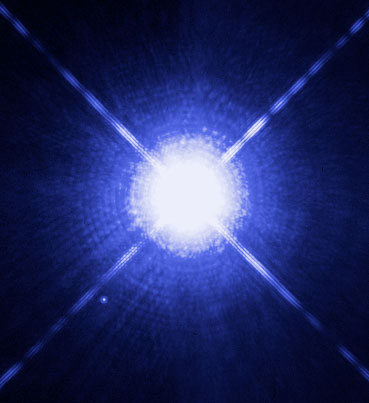
Sirius A and B were photographed by the Hubble Space Telescope. Sirius B is the smaller star located below.
Sirius can be observed with the naked eye even during the day if the conditions are right. Ideally, the sky should be extremely clear, the observer should be in a high position, the star should be directly overhead, and the Sun should be near the horizon.
The orbits of the Sirius system bring them close together for 3 seconds and far apart for 11 seconds. When they get very close, it's an opportunity to observe the faint white dwarf next to its bright companion, requiring a 300 mm telescope and extremely good conditions. The perihelion occurred in 1994, and the two stars were moving away from each other, making it the ideal time for observation with a telescope.
At a distance of 2.6 parsecs, or 8.6 light-years, Sirius is one of the six closest star systems to our Solar System, and the fifth closest. This is the main reason for its brilliant brightness, similar to another nearby system, Alpha Centauri, and in contrast to other distant but extremely bright supergiant stars like Canopus, Rigel, or Betelgeuse. However, it is still about 25 times brighter than the Sun. The brightest star closest to Sirius is Procyon, at 1.61 parsecs, or 5.24 light-years. The Voyager 2 spacecraft, launched in 1977 to study four gas giant planets in our Solar System, is expected to be 4.3 light-years from Sirius after 296,000 years of travel.
System Structure
Sirius is a binary star system consisting of two white stars orbiting each other, separated by about 20 astronomical units (approximately the distance between the Sun and Uranus), and with a period of only 50 years. The brighter star, named Sirius A, is a main-sequence star with spectral type A1V and a surface temperature of about 9,940 K. Its companion, Sirius B, is a star that has left the main sequence and entered the white dwarf phase. It is 10,000 times dimmer than the other star but is more massive. The system is approximately 230 million years old. In its early stages, they may have been two bluish-white stars orbiting each other with a period of 9.1 years. The system emits more infrared radiation than predicted, according to measurements by the IRAS ground observatory. This effect may be due to dust present in the system and is considered an anomaly in a binary system.
Sirius A
Sirius A is approximately 2.1 times the mass of the Sun. Its diameter, measured by an astronomical interferometer, shows an angular diameter of about 5.936 ± 0.016 minutes. Its relatively low rotation speed of 16 km/s prevents it from bulging at the equator. This distinguishes it from Vega, a similarly sized star with a much faster rotation speed of 274 km/s, which causes it to bulge noticeably at the equator.
The stellar model suggests that it formed from the collapse of a molecular cloud, and after 10 million years, the internal energy was generated through fusion reactions. The nucleus underwent convolution and used the CNO cycle (carbon-nitrogen-oxygen cycle, a type of cycle that occurs in the fusion reactions of stars) to generate energy. It is calculated that Sirius A will consume all the hydrogen in its nucleus after one billion years. At this point, it will transition to the red giant phase and eventually collapse into a white dwarf.
Sirius A's spectrum reveals a large amount of heavier metals than helium, such as iron. Compared to the Sun, the iron-to-hydrogen ratio in Sirius A's atmosphere is Fe/H = 0.5, meaning it has 316% more iron than the Sun. Such a large amount of metal shouldn't exist on this star. However, it's possible they are suspended in the thin troposphere near the surface.
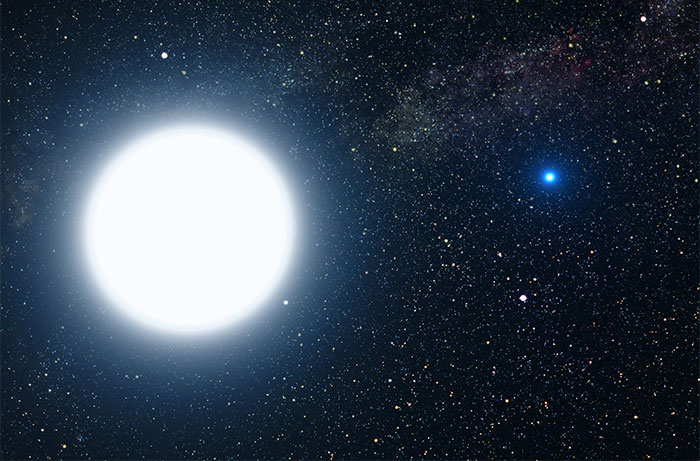
The image illustrates the Sirius system. Sirius A is a larger star than Sirius B.
Sirius B
Sirius B is one of the most massive white dwarf stars known. Despite its large mass, it is only about the size of Earth. Its current surface temperature is 25,200K. However, Sirius B is cooling down and will die out completely in 2 billion years.
A white dwarf star is formed from a main-sequence star that has gone through a red giant phase. This happened when Sirius B was about half its current age, or about 120 million years ago. This original star was five times as massive as the Sun and was a B-type star when it was in the main sequence. As it went through the red giant phase, Sirius B may have transferred a large amount of metal to its companion.
This star is composed primarily of a carbon-oxygen mixture created by the nuclear reaction of helium in its early stages. It is overlaid with a layer of lighter elements, with a completely different mass composition due to the gravitational pull of its surface. Therefore, Sirius's atmosphere is now composed entirely of hydrogen—the lightest element—and no other elements are detected in its spectrum.
Sirius Supercluster
In 1909, Ejnar Hertzsprung became the first to suggest that Sirius was a member of the Ursa Major Moving Group , based on his observations of the system's movement in the sky. The Ursa Major Moving Group is a cluster of 220 stars with similar movements in space, and at one time they were an open cluster whose gravitational pull has now been broken. However, measurements in 2003 and 2005 cast doubt on Sirius's membership; the Ursa Major Moving Group is approximately 500 ± 100 million years old, while Sirius, with a similar metallic content to the Sun, could only be half that age—too young to belong to this group. However, it may be a member of the Sirius Supercluster, which includes members such as Beta Aurigae, Alpha Coronae Borealis, Beta Crateris, Beta Eridani, and Beta Serpentis. This is one of three large star clusters within a 500-light-year radius of the Sun. The other two are the Hyades and Pleiades, which contain hundreds of stars.
- French scientists plan to raise bass on the Moon.
- Building railways and airports leads to clashes with 3,500 ancient tombs located near the "Terracotta Army".
- Why, out of nowhere, did the mother bear suddenly attack and tear at her cub as if it were an enemy?