A newly observed neutron star merger has cast doubt on the previously known mechanism of black hole formation .
Astronomers in the UK have discovered a 'supermassive' neutron star emitting radiation long before collapsing into a black hole, a development that casts doubt on some assumptions about the scientific phenomenon. The observations were announced on November 11.
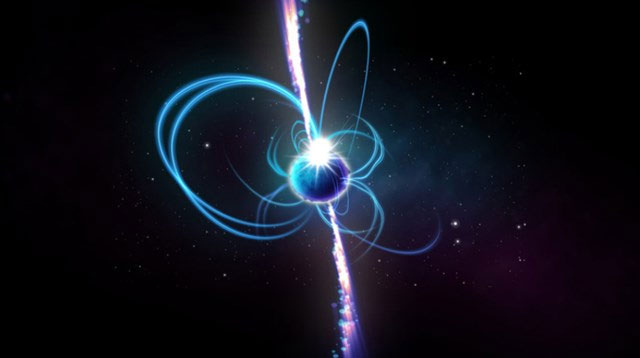
Magnetars are extremely magnetic neutron stars, some of which occasionally produce radio emissions. (Photo: Global Look Press).
A team at the University of Bath in Somerset has observed a binary star merging and creating a 'supermassive' neutron star , emitting gamma rays for more than a day before collapsing into a black hole. The black hole, dubbed GRB 180618A , is about 10.6 billion light-years away and was caught in orbit by NASA's Neil Gehrels Swift Observatory. A robotic observatory in the Canary Islands then zoomed in on the aftermath.
' A massive neutron star is generally thought to be incapable of surviving such a long life,' said Dr Nuria Jordana-Mitjans, lead author of the study .
The object's 'unusual spectral and temporal properties ' 'are evidence of a highly magnetised rotating neutron star' , Dr Jordana-Mitjans and her colleagues explain in their study in The Astrophysical Journal. The discovery, they say, 'opens a new era for searching for gravitational wave counterparts with fast-paced surveys'.
Neutron stars are thought to be the compact cores of supergiants, created by supernova explosions, with a radius of about 10 km and a mass of 1.4 suns. They are held together by a phenomenon called 'neutron degeneracy pressure' and collapse if their mass exceeds a certain limit.
'They are incredibly exotic objects. This is the first direct look we've ever had at a supermassive neutron star in nature,' said study co-author Professor Carole Mundell.
Gamma-ray bursts, which follow the collapse of neutron stars, are the most energetic events in the universe since the Big Bang, according to The Guardian. They were thought to originate from the poles of newly formed black holes, but new observations show they originate from the neutron star itself.