The Indian spacecraft only touched down on the Moon a month ago, but it has already made some major contributions to science .
Following the resounding success of India's Chandrayaan-3 lunar exploration mission , Indian scientists are continuing to analyze the data sent back to Earth by the Vikram lander and the Pragyan probe after one lunar day (equivalent to 14 Earth days) of intensive work on the Moon.
Chandrayaan-3 has been providing scientists with valuable new data and further inspiration for lunar exploration. The Indian Space Research Organisation (ISRO) is continuously sharing these initial findings with the world.
One of these was the significant achievement of the Pragyan probe in detecting elements such as iron, titanium, aluminum, calcium, and especially sulfur (along with its varying concentrations) in lunar soil.
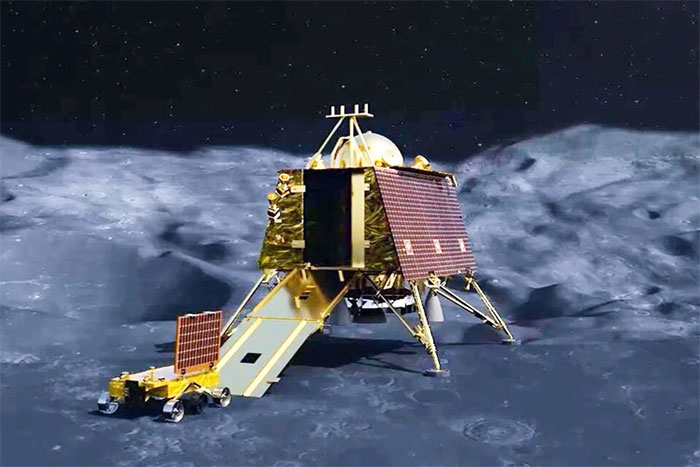
The Vikram landing ship and the Pragyan exploration vessel of the Chandrayaan-3 mission. (Photo: ISRO).
Planetary scientists previously knew that sulfur existed in the rocks and soil of the Moon, but only at very low concentrations. New measurements from the Indian spacecraft suggest that sulfur concentrations in lunar soil may be higher than previously predicted.
The Pragyan spacecraft has two instruments for analyzing the elemental composition of soil – an Alpha-Particle X-ray Spectrometer (APXS) and a Laser Fractional Spectrometer (LIBS) . Both instruments were used to measure sulfur concentrations in the soil near Shiv Shakti Point – the landing site of the Vikram lander of the Chandrayaan-3 mission.
Sulfur in the soil near the Moon's poles could help astronauts survive beyond Earth in the future. That's why astronomers view this discovery by the Indian spacecraft as a prime example of modern lunar exploration.
Sulfur in the soil of the Moon
Scientists say there are two main types of rocks on the surface of the Moon – dark volcanic rocks and light-colored plateau rocks. The difference in brightness between these two types of rocks creates the familiar "human face on the Moon" image when we see it with the naked eye.
When scientists measured the composition of lunar soil and rocks in laboratories on Earth, they discovered that materials from the darker volcanic plains tended to contain more sulfur than materials from the lighter highlands.
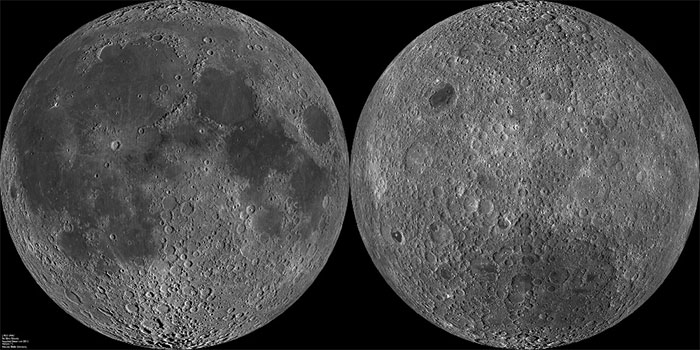
The difference in brightness between these two types of rocks creates the familiar "human face on the Moon" image when viewed with the naked eye. (Image: Internet).
Explaining this, the researchers said: "Sulfur primarily comes from volcanic activity. Rocks deep beneath the Moon's surface contain sulfur, and when these rocks melt, the sulfur becomes part of the magma. As the rock melts near the surface, much of the sulfur in the magma becomes gas and escapes along with water vapor and carbon dioxide (CO2 ) ."
Some sulfur remains in magma and is retained in the rock after it cools. This process explains why sulfur is primarily associated with dark volcanic rocks on the Moon.
In-situ sulfur measurements in lunar soil from the Chandrayaan-3 Pragyan probe mark the first of their kind on the Moon. And initial data suggests the complete opposite.
Uncalibrated data collected by Pragyan's LIBS instrument suggests that highland soils on the Moon (near the poles) may have higher sulfur concentrations than highland soils from the equator, and possibly even higher than dark volcanic soils.
Scientists note that accurately determining the sulfur concentration in lunar soil still requires a process called data calibration from ISRO.
But these initial results are giving lunar scientists new insights into how it functions as a geological system.
Formation of sulfur in the atmosphere
Measuring sulfur concentrations is of interest to scientists for at least two reasons.
First, these findings suggest that the soils of the lunar highlands may have fundamentally different compositions compared to the soils of the lunar equatorial highlands. This difference in composition may stem from differing environmental conditions between the two regions – the poles receive less direct sunlight than the equator.
Secondly, these initial results suggest that lunar soils in the polar regions somehow contain more sulfur. The sulfur concentrated there may have formed from the Moon's extremely thin atmosphere.
The Moon's polar regions receive less direct sunlight and, as a result, have extremely low temperatures compared to the rest of the Moon. If surface temperatures drop below -73 degrees Celsius, sulfur from the Moon's atmosphere can accumulate on the surface in solid form – much like frost on a window.
Sulfur in polar regions may also originate from ancient volcanic eruptions that occurred on the Moon's surface, or from sulfur-containing meteorites that struck the surface and vaporized upon impact.
Lunar sulfur is a valuable resource.
For extended space missions, many space agencies have considered building some kind of base on the Moon.
Astronauts and robots could travel from a South Pole base to collect, process, store, and utilize naturally occurring materials such as sulfur on the Moon – a concept known as resource utilization.
Utilizing local resources means that humanity no longer needs to return to Earth multiple times for supplies, allowing them to dedicate more time and energy to exploring the Moon further.
By using sulfur as a resource, astronauts can manufacture solar cells and sulfur-based batteries, mix sulfur-based fertilizers, and create sulfur-based concrete for construction.
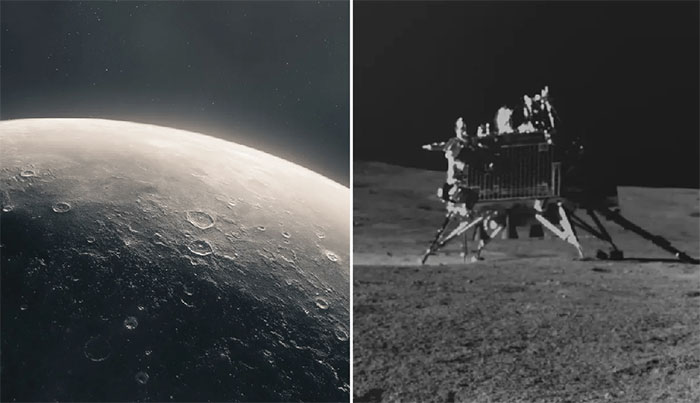
New on-site measurements from the Pragyan probe have helped scientists visualize the characteristics of lunar soil. (Image: Indy 100).
Sulfur-based concrete actually has several advantages over conventional concrete, which is commonly used in construction projects on Earth. Scientists explain:
Firstly , sulfur-based concrete hardens and becomes durable within hours instead of weeks and has higher abrasion resistance.
Secondly , sulfur doesn't require water in the mixture, so astronauts can save their precious water for drinking, producing breathable oxygen, and manufacturing rocket fuel.
For a long time, the search for and harvesting of helium-3 on the Moon has been one of the reasons why many space powers are racing to the Moon. Helium-3 is considered a clean fuel for next-generation reactors on Earth. However, it seems that finding sulfur on the Moon would benefit humanity even more if we wanted to utilize local resources.
To date, there are seven active missions on/around the Moon, but the Moon's South Pole remains largely unexplored. Therefore, the new in-situ measurements from the Pragyan probe have helped scientists visualize the characteristics of lunar soil and offer hope for future settlement on Earth's natural satellite.
Currently, scientists at the Indian Space Research Organization (ISRO) are busy processing and calibrating the data.
On the surface of the Moon, the Vikram and Pragyan spacecraft of the Chandrayaan-3 mission remained dormant after the cold lunar night. ISRO continued its efforts to re-establish communication with the two spacecraft until the next lunar night on October 6th.
There is no guarantee that the two Chandrayaan-3 spacecraft will survive the extremely low temperatures, but if Pragyan awakens, Indian scientists can expect more valuable measurements.
- NASA announces unprecedented discovery about the Moon.
- These are 7 resources we will extract from the Moon.
- Will humans exploit the amazing resources hidden on the Moon?