The construction of the new, ultra-powerful Tsar UFL-2M laser is progressing on schedule, and the system will reach its maximum capacity within 4-5 years.
Once fully operational, UFL-2M will have a power output of up to 4.6 megajoules (MJ). In comparison, the laser at the Lawrence Livermore National Ignition Facility in the US, which set a world record for laser power output in October 2023, achieves 2.2 MJ, generating a useful power output of 3.4 MJ of fusion energy. France also possesses a similarly powerful laser. France's Mégajoule Laser Facility on the outskirts of Bordeaux has a power output of up to 2 MJ.
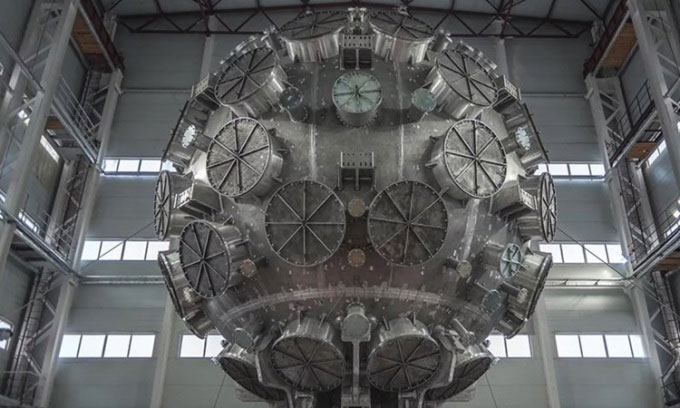
The interaction chamber of the UFL-2M laser. (Image: Russian Institute of Experimental Physics).
UFL-2M comprises 192 0.53-micron laser beams (powered by a solid-state neodymium laser), simultaneously directed into a spherical interaction chamber from all sides. The 120-ton chamber has a diameter of 10m and is encased in a 100mm thick aluminum alloy. The facility's laser hall is 130m long and built on a specially reinforced foundation to withstand earthquakes. The facility also includes a 16,000m² sterile room . The total cost of the project was approximately $485 million.
The idea for the UFL-2M laser system emerged in the late 1980s following the development of the groundbreaking 12-channel Iskra-5 laser system. UFL-2M was developed to conduct large-scale experiments on controlled fusion reactions by constraining inertial plasma. The first UFL-2M module became operational in 2020, and useful research began in 2021 and 2022.
"We have perfected the technology, physics, and physical models, deploying the first phase of the physical platform related to the engineering system of the Tsar UFL-2M laser. I think within the next 4-5 years, this system could operate at maximum power and produce results," said Dr. Valentin Kostyukov in an interview.
Along with the prospect of achieving controlled fusion reactions to produce clean energy, a dream of scientists worldwide for decades, the Tsar laser also has many other potential applications, including modeling processes at the moment of a nuclear explosion, making it useful for research into new fusion weapons.
This laser system could also support groundbreaking research in the field of high-energy density physics, specifically studying the properties of matter in extreme states, including the ultra-high pressures and temperatures characteristic of violent explosions. This could aid research into the processes occurring inside the Sun and many other stars.
Russia is a pioneer and leader in the field of laser technology. Soviet scientists Valentin Fabrikant, Alexander Prokhorov, Nikolai Basov, and Zhores Alferov conceived, developed, and built the world's first laser technologies in the 1950s and early 1960s.