According to scientists, this is the first example of "structural paint" that produces color without the need for pigments.
Debashi Chanda struggled to find a physicist who could draw. His colleagues, who work in the nanoscience lab at the University of Central Florida, had already developed a new paint. They even had colorful test vials. But when the assignment asked them to apply the paint to a flat surface, they all shook their heads.
'We can't even draw a butterfly, let alone a picture that even a child can draw,' Mr. Chanda sighed.
But they still tried their best. The shape and design look simple, but this simplicity has probably fooled many people. If we use a microscope to clearly examine the painted surface, looking into the invisible space to the naked eye, we can see that this special paint is completely different from the paint on the wall.
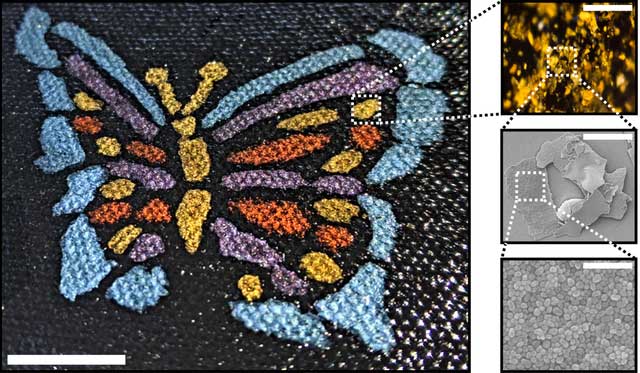
Researchers used structural paint to draw a butterfly.
Color is everywhere in nature, and we recreate it using color mixing techniques. But the way nature creates color is not simple: one need only look at a butterfly's wing or a peacock's tail to understand it.
Rather than using pigments like humans, nature creates color using topology, or in other words, creating special structures that reflect specific light spectra . The microscopic surfaces on peacock tails and butterfly wings diffract the light that falls on them, creating something called 'structural color'. This color is more durable than an artist's paint, and is not made up of pigments.
In the eyes of scientists, the key to creating a new type of paint is not only to help reduce waste in the environment, but also to help humans live more easily in an increasingly hot world.
In a paper published in the journal Science Advances, and based on the concept of structural color, the team from Chanda's lab announced a paint that never existed before. They claim it is the 'lightest' paint in the world, both in terms of mass and temperature. The paint contains aluminum flakes, and on top of these aluminum flakes, there are even smaller aluminum nanoparticles.
Weighing in at a fraction of the weight, the paint could cut down on a vehicle's fuel consumption . In addition, the newly invented paint does not absorb heat like conventional pigment paints, and is less toxic than paints made from heavy metals.
In general, paint is not environmentally friendly.
Dayna Baumeister, co-director of the Center for Biomimicry at Arizona State University, is not surprised that the new paint job has so many unexplored uses. 'It's a great demonstration of what's possible when we rethink old designs by consulting nature ,' she says.
While it may be better for the wood than the paint, there's no denying the versatility of this versatile coating. People have been using pigments for millennia, and colourists have mastered the art of mixing them to achieve the desired colour. 'They know what to add to make a colour shine; they can lighten or darken it – they've got it down to the last hundred years of experimentation ,' says Chanda.
A new form of paint would have to be more innovative, reaching beyond the realm of physical structure to just beauty. And like many other prestigious inventions, Chanda's team's breakthrough came by accident.
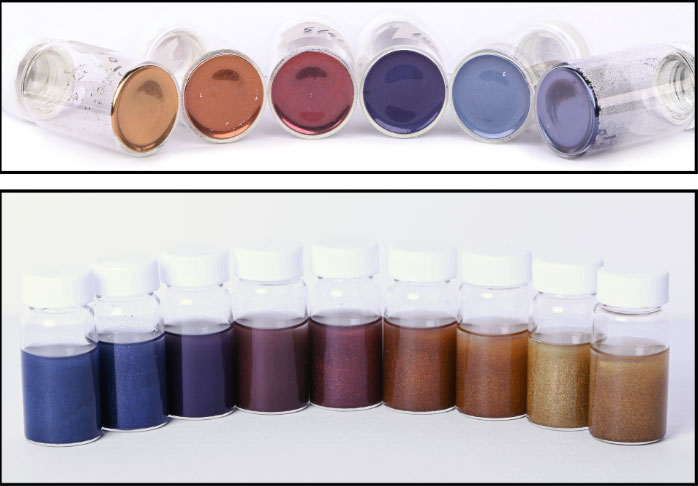
The color can be stored dry or mixed into the mixture.
The team wasn't planning on creating a new paint, but instead was trying to build a large-surface-area aluminum mirror using a machine called an 'electro-evaporation beam'. But each time they used the machine, they discovered peculiar 'nano-islands' – clusters of aluminum atoms so small they were microscopic, but still large enough to make the mirror incomplete. These nano-islands were spread all over the mirror's surface 'in a very disturbing way,' Chanda said.
And then came the eureka moment : this little bug came in handy in another way . When white light hit the aluminum nanoparticles, the electrons in the metal were excited—either oscillating or resonating. When the space-time is stretched down to the nanoscale, the atoms react in strange ways. Depending on the size of the aluminum nanoparticles, the electrons inside them oscillate at specific wavelengths of light. The white light that hit them was reflected back at a certain spectrum: coating the aluminum nanoparticles on a reflective surface caused the surface to produce colors .
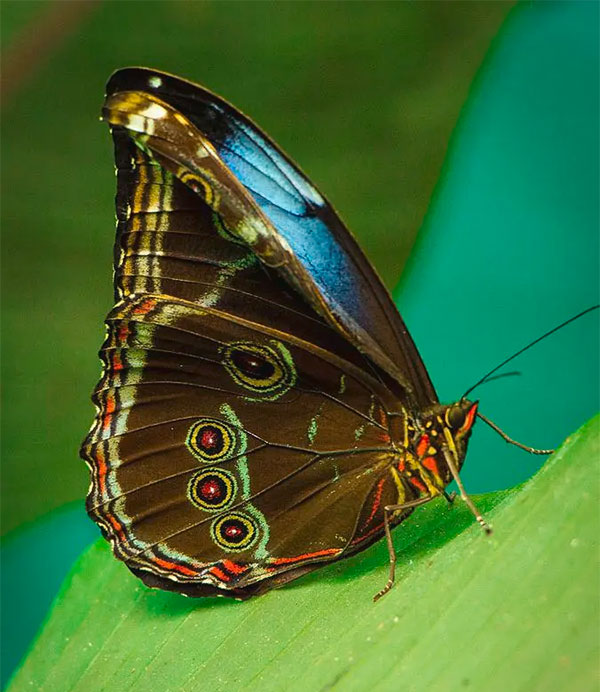
The color on butterfly wings is not produced by pigment.
The size of those nano-islands determines what color appears . 'Just by changing the orientation, you can create any color ,' says Chanda. Unlike pigments, which require a molecule to base each color, such as cobalt or something else, the base molecule for this color-making process is always aluminum, just cut into different sizes, vibrating at different wavelengths of light.
This mechanism allowed the scientists to create a new kind of paint. The team started with a thin layer of double-sided mirror, and coated each side with a buffer material that enhances the color effect. Then they placed nano-islands of metal on each side, and to make the material compatible with adhesives, they soaked the sheets in colored cotton wool. Finally, when they had enough colors to make a rainbow, the team started painting.
Because structural paint can cover a large surface with a single, ultra-lightweight layer, Chanda believes the new paint could revolutionize the aviation industry. A Boeing 747 typically requires 500 kilograms of paint to cover its surfaces, but with the new paint, aircraft manufacturers would only need 1.3 kilograms to do the same. Reducing weight means saving fuel.
Perry Flint, a spokesman for the International Commercial Air Transport Association, agrees. 'With fuel costs accounting for a large portion of operating costs [about 30% by 2022], airlines are always looking for ways to improve fuel efficiency ,' Flint says, citing a very visual example.
When American Airlines removed 30 kilograms of pilot manuals from each flight, it saved $1.2 million a year in operating costs. In 2021, American Airlines applied a new paint to its 737s, saving 1.1 million liters of fuel.
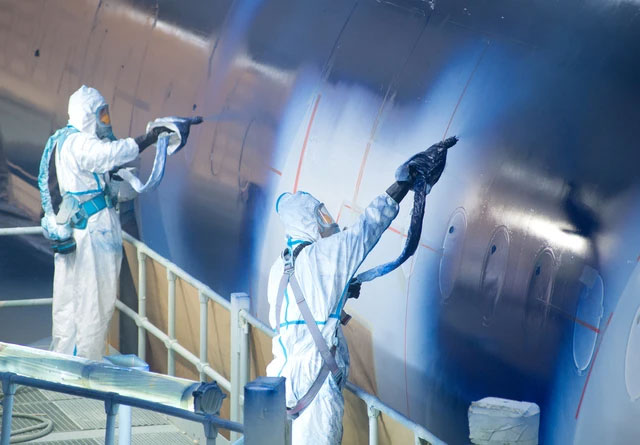
Lighter coatings mean the aircraft burns less fuel.
Experts are thinking about painting sidewalks with a new paint that would reduce the heat buildup in big cities. It could cool cars, roads, even roofs. A cooling system for infrastructure could help humanity save energy that would otherwise be used for cooling.
But mass production of the new paint is not a matter of time. 'The lab is not the factory,' says Chanda. But Baumeister says the initial applications will be small: perhaps electronics, or applications in heat-sensitive production lines.
Baumeister is hopeful about a bright future where bio-based inventions can be applied on a large scale. 'The future of humanity depends on us finding ways to work with nature ,' she said.