Photonic crystals are optical nanostructures that affect the propagation of photons within them in a similar way to the way semiconductor crystals affect the motion of electrons.
A photonic crystal is a regular optical structure made up of periodically arranged media with different refractive indices. Because this material has a photonic band gap, it can block photons of a specific frequency, thereby affecting the movement of the photons. This effect is similar to the effect of semiconductor crystals on the behavior of electrons. Due to the application of semiconductors in electronics, it is speculated that the movement of photons can be controlled through devices made from photonic crystals, such as the creation of photonic computers.
However, photonic crystals can not only control the propagation of light, but also simulate the behavior of light in a strong gravitational field. This is because changes in the shape or size of a photonic crystal will cause its periodicity to change, thereby changing its band structure and effective potential. If we choose the right parameters, we can make this effective potential similar to the gravitational field and let the light follow a curved trajectory - this is the pseudogravity effect .

Photonic crystals are made up of periodically arranged media with different refractive indices. (Illustration).
Pseudogravity is a phenomenon in which a new type of crystal bends light like a black hole. It causes the light to deviate from its usual straight path. The authors of the new study, published in the journal Physical Review A , say the phenomenon could be used in 6G communications technology. Because the crystals mimic what happens when light passes through black holes and other objects in extremely dense space, the new technique could also be used to study so-called quantum gravity, a theory that combines quantum mechanics and Einstein's theory of relativity.
According to the theory of relativity, light and other electromagnetic waves are affected by gravity. This is called gravitational lensing , and astronomers have long used it to study massive space objects such as quasars. Reproducing this effect in a laboratory setting is difficult because of the huge mass required, but scientists have long suspected that they could simulate the phenomenon using crystalline materials .

Esherby spirals have been used to create nanowires that spiral like pine trees. (Illustration).
To achieve this goal, Kyoko Kitamura, a professor in the Graduate School of Engineering at Tohoku University in Japan, and her colleagues started with photonic crystals. They exploited a crystal defect called a screw dislocation , a 'fault' in the ordered crystal structure that creates a twisting force— an 'Esherby twist,' named after scientist John D. Esherby, which has been used to create nanowires that spiral like pine trees. But this study is the first time the Escherby twist technique has been used to create crystals made from stacked, two-dimensional semiconductor layers that are atomically thick.
The team gradually twisted these crystals, disrupting the crystal lattice, then passed a beam of light through the crystals and observed how they deflected. They found that the path of light inside the crystals closely resembled the path it would take in a strong gravitational field. They also found that the angle at which the light was deflected was related to the degree of deformation of the crystals.
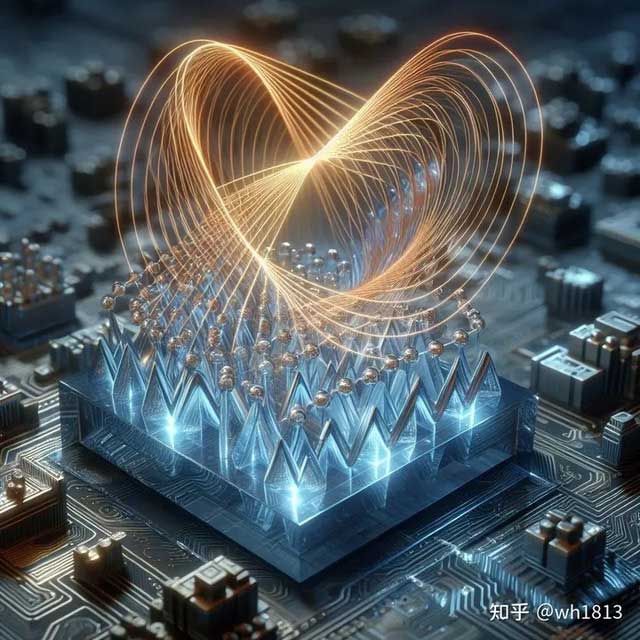
The path of light inside the crystal is very similar to its path in a strong gravitational field. (Illustration).
'Just like gravity bends the trajectory of an object, we have figured out how to bend light inside a specific material,' said Kitamura.
Manipulating light in this way is a potential path for next-generation communications technology . The next generation of communications technology will need to send information at frequencies in the terahertz range, or above 100 gigahertz. Researchers believe that creative manipulation of light is one way to reach these frequencies. The new material could also have applications in research.
' Academically, these findings show that photonic crystals can exploit the gravitational effect, opening a new path in the field of graviton physics, ' Masayuki Fujita, associate professor at Osaka University in Japan and co-author of the study, said in a statement .

There is a striking similarity between this formula and the formula describing the gravitational field. (Illustration).
The presence of a screw dislocation causes changes in the periodicity of the crystal, which in turn changes its optical properties. This change can be described by mathematical formulas. The researchers found a striking similarity between this formula and the formula describing a gravitational field. This means that screw dislocations can simulate the effects of a gravitational field.
An example of this effect is the deflection of light . When light passes through a crystal with a screw dislocation, it follows a curved path. This path is very similar to the path of light in a strong gravitational field. This is the pseudogravity effect.
One application of the pseudogravity effect is 6G communication technology. 6G communication technology refers to wireless communication technology that uses the terahertz frequency band. It has higher speed and lower latency than current 5G communication technology. However, the propagation of terahertz waves is strongly attenuated and scattered by the atmosphere. Therefore, a technology that can effectively control the direction and shape of terahertz waves is needed.

Another application of the pseudogravity effect is the study of quantum gravity. (Illustration).
The pseudogravity effect may provide such a technique. By changing the shape or size of the screw dislocation crystal, we can change the deflection angle of the light. In this way, we can achieve precise control of terahertz waves. This is very beneficial to the development of 6G communication technology.
Another application of the quasigravity effect is in the study of quantum gravity. Quantum gravity is a theory that attempts to unify quantum mechanics and general relativity. It can explain some difficult problems in physics, such as black hole singularities and the origin of the Big Bang. But experimentally verifying quantum gravity is difficult because it requires extreme conditions, such as extremely high energies and extremely small scales.
The pseudogravity effect could provide a new platform for experimental verification of quantum gravity. It allows scientists to simulate the effects of gravitational fields in the laboratory and observe the behavior of photons. This could help us discover some of the phenomena and evidence of quantum gravity.