NASA's Spitzer Infrared Space Telescope has picked up a tryptophan signal amid a "stellar nursery" that promises to be home to many Earth-like planets.
Tryptophan is one of 20 amino acids needed to form important proteins for living organisms on Earth. The signal of this vital living material was revealed through unique spectral lines in Spitzer's observational data as it looked at the Perseus Molecular Cloud.
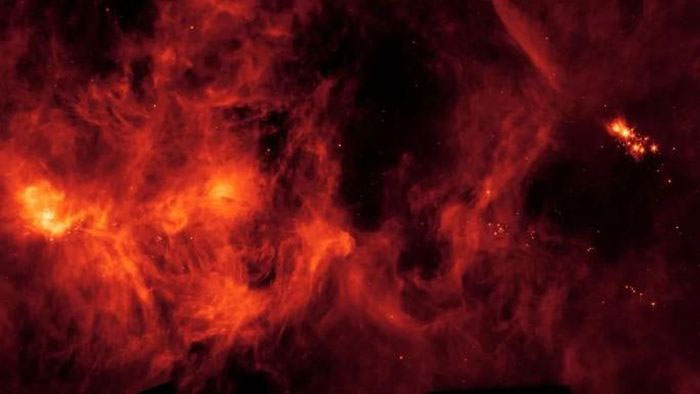
The Perseus molecular cloud "seen" by Spitzer in infrared light - (Photo: NASA).
The Perseus molecular cloud is a famous stellar nursery, 500 light years in diameter and containing many young stars, promising to have many "copies" of the Sun, giving birth to Earth-like planets.
This "golden" signal appeared in a region called IC248 of a giant cloud of gas and dust containing matter equivalent to 10,000 Suns.
"The evidence for tryptophan in the Perseus Molecular Cloud will encourage efforts to identify other amino acids in this and other star-forming regions, " said researcher Susana Iglesias-Groth from the Institute of Astrophysics of Canarias (IAC - Spain), in a statement .
What's most exciting, she says, is that these protein building blocks are ubiquitous in the gas clouds where stars and planets form, making them potentially key to the development of life on distant planets later on.
Such interstellar wandering amino acids have also been shown by many previous studies to be the origin of life on Earth itself: They entered the young protoplanetary disk, seeding the materials that would form the Earth or the meteorites that would later fall to the Earth.
The discovery also serves as a window into the early past of our star system, as this stellar nursery is estimated to be just 2-3 million years old, meaning the objects it hosts are still very "newborn" compared to our 4.5 billion-year-old world.
The findings were just published in Monthly Notices of the Royal Astronomical Society.