Russian cosmonauts on the International Space Station (ISS) have had to temporarily shut down a module after detecting a "strange smell" from the Progress 90 cargo spacecraft.
The incident occurred over the weekend. In a statement to CNN, NASA said the smell, along with the "liquid droplets" observed by astronauts, could be the result of "off-gassing from materials inside the Russian Progress spacecraft."
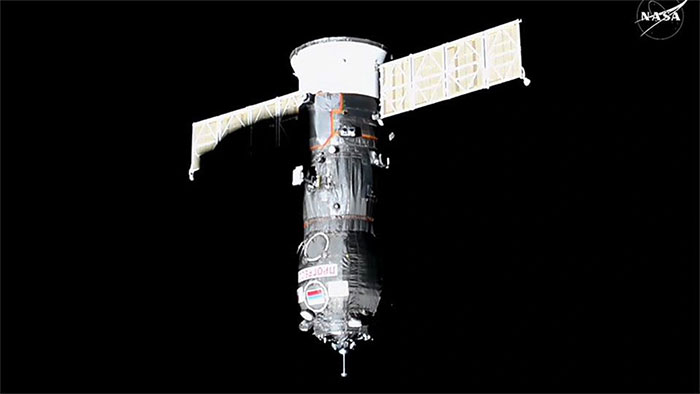
Russia's Progress 90 cargo spacecraft carries nearly 3 tons of food, fuel and supplies - (Photo: NASA+).
"Outgassing" is a phenomenon that can occur when man-made objects leave Earth's protective atmosphere and enter the radiation-filled environment of space, where temperatures can range from 121 degrees Celsius to minus 158 degrees Celsius.
The potentially evaporating "materials" NASA is referring to are inside the Progress spacecraft and are not fuel-related, according to Kelly O. Humphries, a news manager at NASA's Johnson Space Center in Houston.
After Russian cosmonauts detected the strange smell, they closed the hatch connecting the Poisk module to the rest of the space station. Controllers flying on the ground then 'activated the station's air purification equipment.'
"There are no concerns for the crew ," according to Humphries.
The Progress spacecraft arrived at the ISS after launching from the Baikonur Cosmodrome in Kazakhstan on November 21, carrying 'nearly 3 tons of food, fuel and supplies .' It uses a fuel called unsymmetric-dimethylhydrazine and the oxidizer nitrogen tetroxide. Both are extremely toxic to humans.
Although the strange smell was short-lived, it was also a cause for concern for experts, especially after leaks had been recorded on Russia's Zvezda module.
NASA hopes to continue operating the ISS with four partner agencies at least until 2030, including Roscosmos (Russia), the Canadian Space Agency, the European Space Agency and the Japan Aerospace Exploration Agency.
However, Russian officials have not committed to continuing cooperation on the space station beyond 2028 and likely won't provide a definitive answer until at least 2025, according to a recent report from NASA's Office of Inspector General.