
Discover science
The reason people can't walk through walls
The completely non-hollow structure of electrons is a barrier that prevents people from going through solid walls.
Browse ScienceInfo articles and explainers related to Neutron.
122 published items.
The completely non-hollow structure of electrons is a barrier that prevents people from going through solid walls.

The engineer who invented the N bomb declared that this weapon could distinguish what is the enemy, what is his army.

Physicist Paul Doherty and author Cody Cassidy spent two years together studying the most horrible death experiences of humans.

Researchers in the US say they have created a liquid with a negative volume in the laboratory ... which is almost unreasonable, when you push this liquid forward it will…

If you're in excess of money, consider buying calcium-48 - calcium's rare isotope for research. It was so valuable that the world famous chemist Martyn Poliakoff was not…

The Z machine at Sandia National Laboratory in New Mexico is one of the most powerful radiation sources in the world.

There are many ways to classify nuclear reactors, of which the most common classification is based on the retardants and heat transfer agents used in the reactor.

In the history of development, nuclear energy has many diverse applications, from energy production, weapons manufacturing, even for other scientific research.
The image of the Shroud of Turin, which many consider to be the Lord Jesus, can be created by radiation emanating from a powerful earthquake.

The destructive power of atomic bombs (nuclear bombs) stems from tiny nuclei of protons, neutrons and electrons.
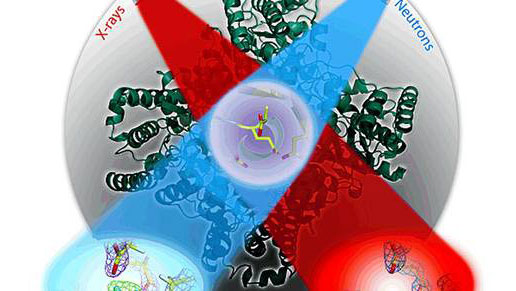
Researchers work at the Los Alamos National Laboratory, which exploits neutrons, to first accurately assess the important role of hydronium ions in certain biological re…

Ancient Roman artifacts nearly 2000 years ago have the equivalent of what was left discovered in Pompeii, Italy.

NASA researchers discovered traces of a thousand-star explosion 1.7 billion light-years from Earth.
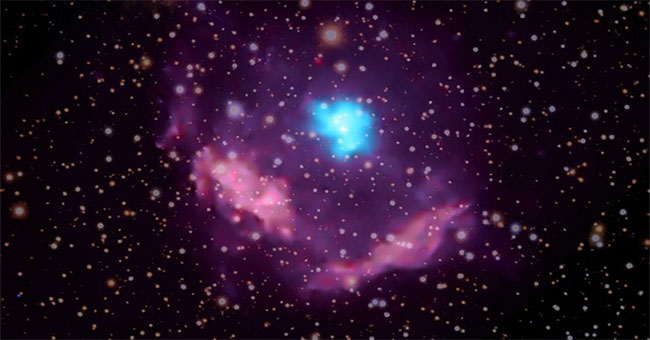
The first image was taken by Chandra X-ray Observatory of the US Space and Aeronautics Agency (NASA), showing the youngest pulsar that scientists have ever seen.
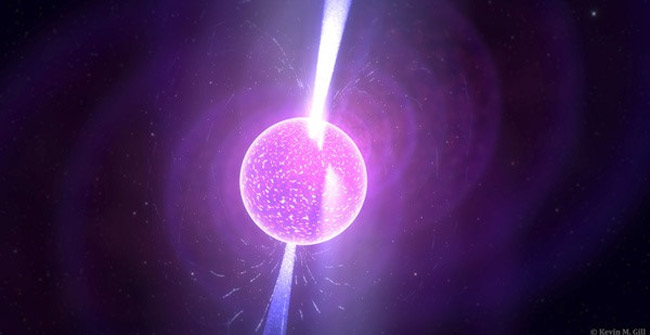
American astronomers have discovered an unusual stream of infrared radiation, around the isolated isolated neutron star and they are not sure what caused it.