The full moon on August 30 will be at its closest point to Earth, creating the brightest supermoon of 2023 .
The biggest and brightest supermoon of 2023 will rise on August 30 and is nicknamed the "blue moon." This is the result of three lunar phenomena occurring at the same time. The name "blue moon" has nothing to do with the color of the moon but comes from the fact that this is the second full moon in August, according to Live Science . This is the second supermoon to appear in the same month (the night of August 1 to the morning of August 2 and the morning of August 31).
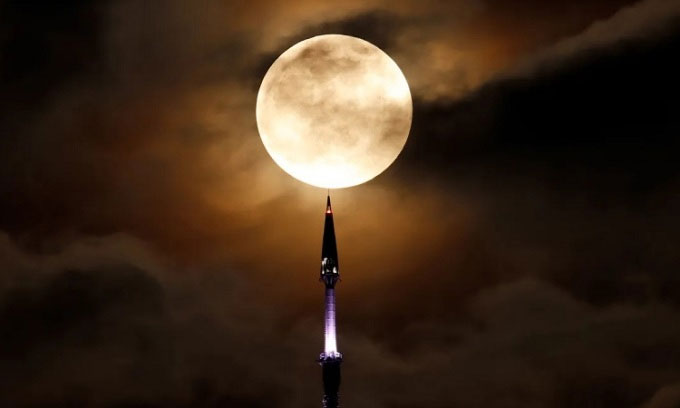
The full moon coincides with the supermoon rising in New York. (Photo: Gary Hershorn).
There are two types of blue moons . August's super blue moon falls into the first category, marking two full moons occurring in the same month, resulting from full moons rising in a 29.5-day cycle. In addition to the sturgeon moon that occurred on August 1, 2023, the full moon on August 30 is a calendar blue moon , occurring only once every 2-3 years. The next one will be on May 31, 2026.
The second type is called a seasonal blue moon , which refers to the third full moon out of four full moons in an astronomical season. This occurs when there are 13 full moons in a calendar year instead of the usual 12. The next seasonal blue moon will occur on August 19, 2024.
A supermoon occurs when a full moon is at its closest point to Earth in its orbit. The moon's orbit around Earth is elliptical, so each month it passes through its perigee (closest point to Earth) and its apogee (farthest point from Earth), according to NASA astronomer Fred Espenak.
The second full moon in August is the third and closest of the four supermoons of 2023. At a distance of 220,000 miles (357,344 kilometers) from Earth, it is the largest and brightest supermoon of the year, though it is only 20 miles (33 kilometers) closer than the supermoon on August 1 (220,000 miles). The next supermoon, called the Harvest Moon, falls on September 29 and is the last supermoon of 2023.
In Vietnam, the second supermoon of the month will appear on the full moon day (15th lunar month). At that time, the full moon will be slightly larger and brighter than usual by about 15%. Observing this event is exactly the same as for a normal full moon, that is, the sky only needs a few clouds, enough to see the moon. Observers also do not need to prepare any eye protection when observing.