Contrary to popular belief, plants are not always static but can act very quickly with timescales measured in milliseconds .
Growth rate
Bamboo was once considered the fastest growing plant in the world. The Guinness World Records website still records that some species of bamboo grow at a rate of 0.00003 km/h, adding 91 cm to their height every day.
However, recent research has revealed a new contender for the title: duckweed. Duckweeds are aquatic plants in the genus Wolffia , which includes the world's smallest flowering plant. Despite their small size, duckweeds grow at an astonishing rate. Endemic to India, Wolffia microscope can double in size in just 29.3 hours.
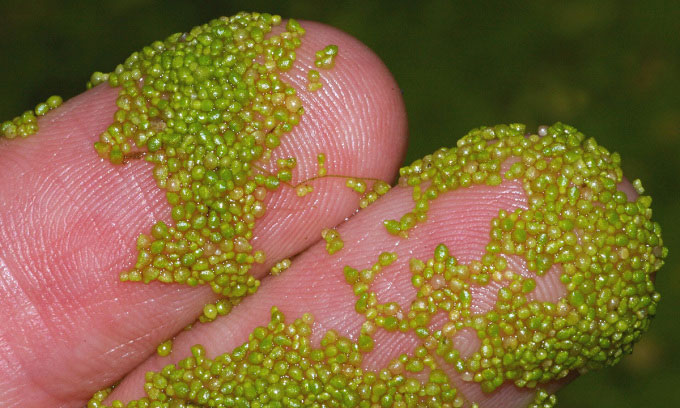
Water hyacinth on a human finger, each speck smaller than 1 mm is an individual plant. (Photo: Christian Fischer/ESA).
Why do they grow so fast? Some researchers think it's because of the removal of the light-dark cycle that normally governs plant growth . "What's surprising is that Wolffia has only half the genes regulated by the light-dark cycle compared to other plants. We think that's why they grow so fast. They're not subject to the regulations that limit the timing of growth," explains Todd Michael, author of the 2021 study on Wolffia 's growth and a professor in the Salk Institute's Laboratory of Plant Molecular and Cell Biology.
The duckweed also suppressed a number of other genes, including those involved in root defense and growth. 'It seems they have evolved to focus on uncontrolled rapid growth ,' Michael says.
Sphagnum affine moss spraying spores. (Video: Science News).
Dissemination rate
Sphagnum mosses play an important role in the formation of peat bogs, storing water, providing nutrients and preventing the decomposition of dead plants. They also reproduce rapidly, spreading by means of spores contained in sacs. In summer, the spore sacs dry and shrink, creating pressure that causes the sacs to burst and the spores to fly away.
Researchers Joan Edwards and Dwight Whitaker observed this in action in their study of Sphagnum spore dispersal published in the journal Science . They found that the spore capsule's cap ejected in less than 0.01 milliseconds. The spores initially accelerated with a g-force of up to 36,000. By comparison, the g-force during a space shuttle launch is only about 3 g.
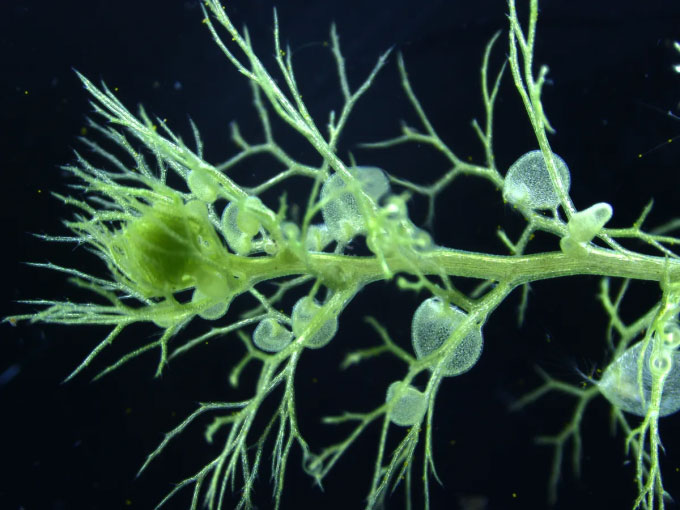
The roots of the Auricularia hirta, the world's fastest predatory plant group. (Photo: D. Kucharski K. Kucharska).
Hunting speed
When it comes to carnivorous plants, many people think of the famous Venus flytrap ( Dionaea muscipula ) . But there is a group of aquatic plants that are even faster at catching prey. Aquatic earwigs (genus Utricularia ) eat tiny prey, from insect larvae to young tadpoles, at an astonishing rate.
In a 2017 study, scientists used high-speed cameras to record the southern earwig ( Utricularia australis ) sucking in prey at speeds of up to 4 meters per second, accelerating at 2,800 g. When an animal comes into contact with the hairs, the plant opens the trapdoor, sucks in the prey, and closes the door. On average, the entire process takes just 9 milliseconds.