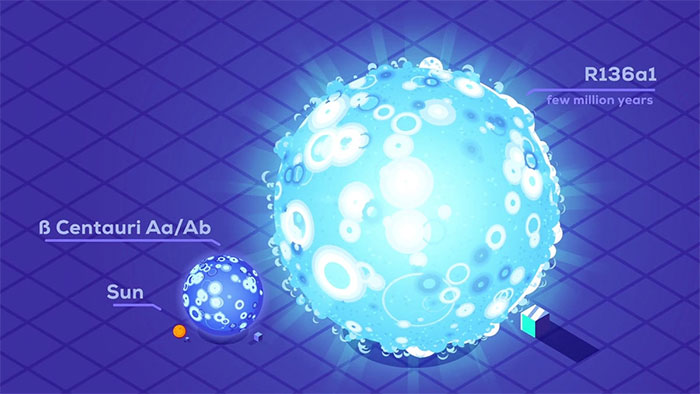
Hidden in the Large Magellanic Cloud, a nebula just outside the Milky Way, lies what may be the largest known star in the entire universe. The star, dubbed R136a1, is located about 150,000 light-years from Earth (according to Phys.org).
R136a1 was originally discovered 62 years ago by a team of astronomers at Pretoria's Redcliffe Observatory, and announced in the Monthly Notices of the Royal Astronomical Society in October 1960.

RMC 136a1 is one of the most massive and brightest stars, with a mass hundreds of times that of the Sun, and a luminosity 6.2 million times that of the Sun, and is also one of the hottest stars, with a temperature of 46,000 degrees Celsius. R136a1 is located in a constellation in the Tarantula Nebula, a cloud of dust and gas located 165,000 light years from the Milky Way. It was discovered using the European Space Observatory's telescope in the Atacama Desert, Chile.
The new study of R136a1 was published in August this year after a team of astronomers led by Venu Kalari of the Gemini Observatory studied the star cluster it is located in. They were able to image the supergiant star, which allowed them to make new estimates of R136a1's size. Their findings, published in the Astrophysical Journal Letters, shed light on the mystery of the star and what it could represent as the largest stars in our universe.

Professor Paul Crowther, working at the University of Sheffield (UK), said that when it was first formed, it was hundreds of times more massive than the Sun. 'Unlike us humans, these stars are very heavy when they are born and will become lighter over time,' he said. Crowther also said that R136a1 is very bright, with a brightness of several million times that of the Sun, and has a surface seven times hotter than the Sun.
When R136a1 was first discovered, it was initially estimated to be between 250 and 320 times the mass of our Sun. This was interesting to scientists, who thought that the maximum mass of a star was much lower, until R136a1 was discovered. This maximum mass, known as the Eddington Limit , is the theoretical point at which stars would become so bright that they would blow off their outer layers. According to research published in the journal Nature, the Eddington Limit is estimated to be around 150 times the mass of the Sun.
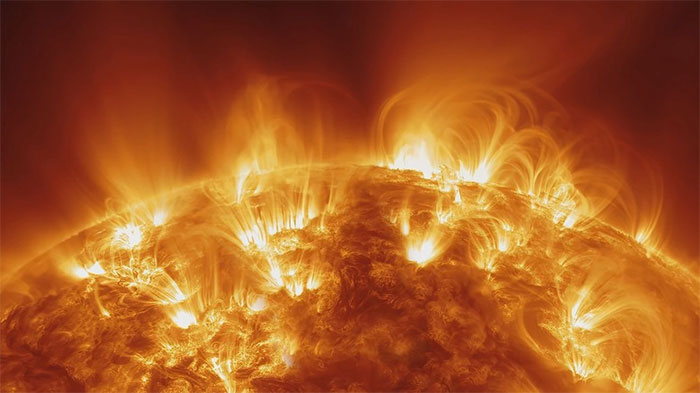
R136a1 is a Wolf–Rayet type star (stars with masses greater than 20 times the mass of the Sun, with a high rate of stellar material loss through stellar winds at speeds of up to more than 2,000 km/s. R136a1 has lost about 50 times the mass of the Sun in the past million years. R136a1 is determined to be about 1.7 million years old, and by working backwards from its material loss rate, its initial mass is estimated to be more than 320 times the Sun. This violates some previous models that assumed a star's mass limit of 150 times the Sun.
According to Phys.org, the new estimate from the research team puts the star at 170 to 230 times the mass of our Sun, a much more reasonable estimate than past research. And even so, it's still the most massive star ever found in our universe (according to the NOIR Lab).
Not only is R136a1 the most massive star discovered in our universe to date, it may be an accurate representation of how all stars of this mass work. Stars form in a wide range of sizes, from red dwarfs to blue-white supergiants. If astronomers can learn more about supergiants like R136a1, including how common they are, it could help us understand how they form, according to Phys.org.
The initial proof that R136a was a constellation was given by Weigelt and Beier in 1985. Using Speckle Interferometry, they showed that R136a was made up of eight stars within 1 arcsecond of the constellation's center, with R136a1 being the brightest. Final confirmation of the nature of R136a came after the Hubble Space Telescope launched. Its Wide Field and Planetary Camera (WFPC) will view R136a in at least 12 sections and will show that R136 contains over 200 extremely bright stars. The more advanced Wide Field and Planetary Camera 2 (WFPC2) allows the study of 46 luminous giant stars within half a parsec of R136a and over 3,000 stars within a radius of 4.7 parsecs.
Understanding how massive stars like R136a1 form could help us learn more about some of the heavier objects in our universe — those that form through supernova explosions. According to NASA, up to 80% of elements heavier than iron come from massive supernovae. These new findings about R136a1 could help astronomers search for other massive stars and supernova remnants that have occurred in the past.