Through careful observations, experts have determined that the 70-meter-wide asteroid 2022 AE1 will pass 10 million km from Earth next year.
On January 6, astronomers discovered an asteroid about 70 meters wide and named it 2022 AE1. The next day, it was predicted to have the potential to collide with Earth on July 4, 2023 by the Automated Asteroid Orbital Determination (AstOD) system of the Near-Earth Object Coordination Center (NEOCC). ) of the European Space Agency (ESA).
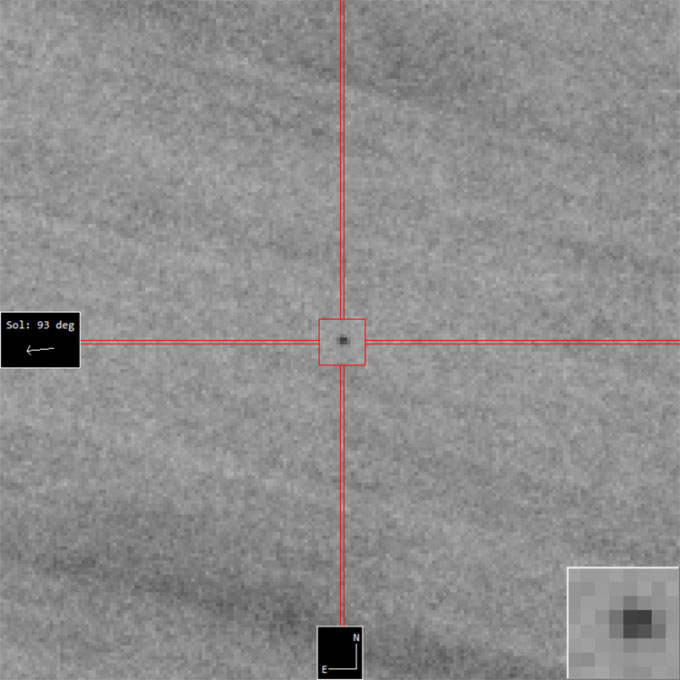
Asteroid 2022 AE1 in this image taken by the Calar Alto Schmidt telescope in Spain. (Photo: ESA/NEOCC)
The system then calculates each object's position on the Palermo scale, assessing the risk of a collision. This scale looks at an object's probability of collision and kinetic energy, estimating how much damage it will cause based on its size and speed. A score of 0 on the Palermo scale represents baseline risk. So anything with a positive value is immediately noticed.
Fortunately, scientists rarely detect objects with positive values, and even so, more careful observations rule out the possibility of a collision. The most prominent example is Apophis, the asteroid that holds the highest record in history on the Palermo scale at 1.1 with a risk of impact in 2029. But later, experts determined Apophis did not pose a danger. dangerous to the Earth at least for the next century.
Objects that score below -2 on the Palermo scale can be safely ignored because their chances of colliding with Earth are very low, or their size is too small to cause any damage on impact. However, those between -2 and 0 need to be watched carefully, and asteroid 2022 AE1 initially scored -1.5.
Subsequent observations showed an increased risk of collision. On January 11, 2022 AE1 had a Palermo value of -0.66, making it the deadliest asteroid since 2009. Just as the tension was at its highest, the Moon again baffled scientists. unobservable for the following week.
Determining the possibility of 2022 AE1 hitting Earth is extremely important. The July 2023 impact point means that humans won't be able to do any deflection in time and the asteroid's 70m diameter is large enough to cause significant damage to the impact area.
2022 AE1 is 3.5 times larger than the Chelyabinsk meteorite that injured thousands of people when it exploded over Russia in 2013. It is also larger than the meteorite believed to have caused the Tunguska explosion, which flattened 2,150 square kilometers of forest. tree in 1908.
Fortunately, on January 20, astronomers continued to observe this asteroid and narrowed its flight path to rule out the possibility of a collision next year. When AE1 2022 passes close to Earth in early July 2023, it will be at least 10 million km from Earth, more than 20 times the distance to the Moon.
The system of sky observation equipment brings safety to people, providing early warning to intervene if it detects any asteroids that may crash into Earth. NASA is also testing methods to help reduce such hazards. For example, last November, NASA successfully launched the DART spacecraft to experiment with asteroid deflection.