We finally know how death rays, also known as heat rays, work .
An eighth-grade student from Ontario, Canada, has helped settle a long-standing historical dispute by demonstrating the potential function of the "death ray" attributed to ancient Greek scientist Archimedes.
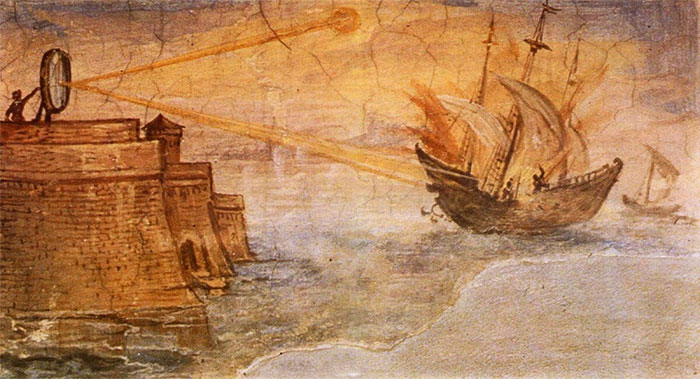
A mural from 1600 depicts the death ray, invented by Greek mathematician Archimedes, used to burn Roman military ships during the Siege of Syracuse.
Archimedes was a Greek mathematician and inventor who lived in the 3rd century BC. He is famous for his discoveries in geometry, physics, and engineering, and is widely considered to be the greatest mathematician in ancient history and one of the greatest mathematicians of all time. According to some historical accounts, he used his talents to defend his hometown of Syracuse in Sicily from a Roman siege by designing various war machines, including a heat ray that could burn wooden ships from a distance.
The heat ray consisted of a series of mirrors that reflected and focused the Sun's rays onto a single point, creating intense heat and fire. However, the existence and effectiveness of this device has been disputed for centuries, as there is no direct evidence of it in the surviving works of Archimedes.
In 1973, Greek scientist Ioannis Sakkas conducted an experiment on the Archimedes heat ray at the Skararamagas naval base near Athens. Greek sailors held 70 bronze mirrors, each measuring about 5 by 3 feet (1.5 by 1 m), aimed at a plywood model of a Roman warship about 160 feet (50 m) away. When the mirrors were precisely aligned, the ship burst into flames within seconds due to the tar coating. Sakkas concluded definitively that Archimedes could have used bronze mirrors to destroy Roman ships.
Several modern experiments have attempted to test the feasibility of heat rays and have yielded mixed results.
In 2008, the television show "Richard Hammond's Engineering Connection" featured the Keck Observatory, which featured a mirror inspired by Archimedes' mirror. The show demonstrated how a smaller curved mirror could be used to successfully ignite a wooden model.

Archimedes died after his city, Syracuse, was captured by the Romans, after suffering significant losses due to Archimedes's creativity. According to the most popular story, while working on mathematical diagrams during the capture of the city, Archimedes refused to meet with the Roman commander Marcellus when summoned by a Roman soldier. Archimedes' refusal angered the soldier, who killed him with his sword.
In 2004, the television show MythBusters found the use of mirrors as weapons implausible in their episode "Ancient Death Rays ." The following year, an MIT student tested the idea by placing 127 one-foot (30 cm) mirrors on a wooden ship at a distance of about 100 feet (30 m), the fire eventually appeared, but it only lasted under ideal weather conditions (a cloudless sky) and after a considerable amount of time (about 10 minutes).
MythBusters later repeated this experiment in San Francisco, confirming that fire could occur but due to the timing and weather requirements, more conventional weapons such as fire arrows or catapults would be significantly more effective in burning a ship at close range.
In 2010, MythBusters revisited the idea, involving 500 schoolchildren and a larger model sailboat 400 feet (120 m) away. Despite extensive testing, the sail failed to reach the temperature necessary to ignite, leading to the conclusion that the mirrors were more likely to cause blindness or distraction than to set the ship on fire.
Brenden Sener , 12, was fascinated by the mystery of the death ray and decided that he would recreate the mechanism himself. He spent several weeks researching, designing and building his own version of the heat ray, using materials such as cardboard, mirrors and lamps, and an infrared thermometer to measure the temperature of the focal point.

Materials for the experiment: Infrared thermometer; Clamp; Heating lamp (50W, 100W); Concave mirror (four); Target paper; Thermometer holder; 3-minute timer.
Sener found that when using a reflector to focus a 50-watt heat source onto a piece of cardboard, the temperature of the target increased by 2°C (3.6°F) per extra mirror—up to three mirrors. However, adding a fourth mirror caused a significant temperature increase of up to 8°C (14.4°F).
When he repeated the experiment with a 100-watt light bulb, he observed "a change in temperature at each mirror of 4°C for three mirrors and a further 10°C for the fourth mirror".
"Based on my experimental findings, I agree with the MIT team and believe that with a sufficiently strong and larger heat source, where more mirrors are all focused at a perfect angle, combustion can occur, " the young study author writes.
The boy's final assessment is that "historical descriptions of the use of the death ray in ancient Syracuse are plausible, however no archaeological evidence of Archimedes' death ray has been found beyond what is recorded in the books of ancient philosophers".

12-year-old study author, Brenden Sener.
In recognition of his efforts, Sener was awarded the Matthews Hall Annual Science Fair Gold Medal, the Thames Valley Science and Engineering Fair Gold Medal for Physical Sciences and the London Public Library Award for Inspiring Children to Take an Interest in Science and Technology.