Just a handful of land costs up to 9 billion USD, making it difficult for the super rich to buy because of its rarity. So, what kind of land is this?
The most expensive handful of soil in the world is Martian dust . According to experts, just a handful of Martian dust can be auctioned for up to 9 billion USD. This can be considered the most expensive dust in the Milky Way .
Martian dust is so valuable that it would take a decade, billions of dollars and three space missions to bring it to Earth.
Specifically, on July 30, 2020, a single-use Atlas V rocket was launched from the Earth's surface to Mars. The cost of a rocket launch is about 109 million USD. Moreover, the rocket carries the Perseverance probe and the Ingenuity unmanned helicopter. This flight lasts about 7 months.
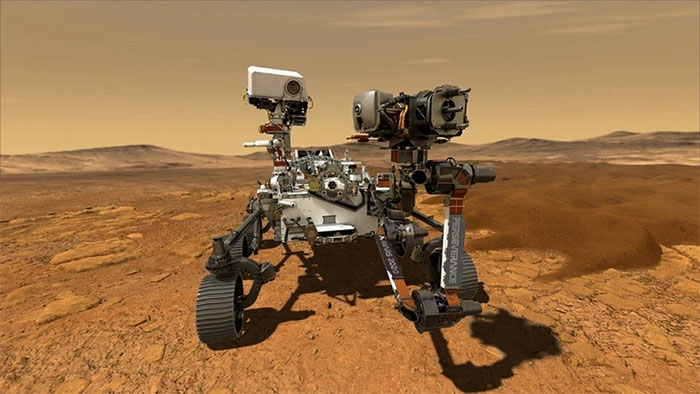
Simulation of the Perseverance rover on Mars. (Photo: Reuters).
On February 18, 2021, the Atlas V rocket finally reached its destination. Accordingly, the landing module carrying the probe and the small helicopter entered the Martian atmosphere. According to experts, this complex moves at a speed faster than sound and they are protected by a heat shield to keep the valuable robots inside from burning due to high temperatures.
After successfully landing on the surface of Mars, the Perseverance rover began the sample collection process, officially carrying out its mission to bring back the most expensive dust particles known to humans in history to Earth.
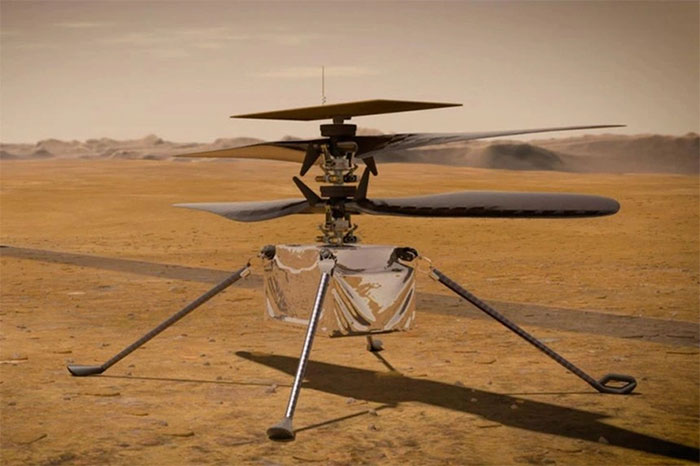
Simulation of the Ingenuity helicopter on Mars. (Photo: NASA).
Bringing Martian dust back to Earth is not easy.
In fact, this phase has already begun on Earth. Perseverance carries 43 titanium tubes, each of which can hold a soil sample the size of a pinky finger.
While preparing the tubes in the lab on Earth, the scientists blew some air through the tubes and then immersed them in a bath filled with acetone and other chemicals. This was to ensure that no bacteria remained inside. The tubes were then placed in an oven heated to 300 degrees Fahrenheit for 29 hours.
When Perseverance collects samples in these tubes, they can be stored there for at least 10 years. Meanwhile, lunar soil samples in sealed cans can only be preserved for 10 days. Scientists hope to find traces of living organisms in these soil samples.

In this photo taken by the Perseverance rover, NASA reveals the location of the first alien sample repository on Mars. (Photo: NASA).
Another goal of Perseverance is to test technology that can produce oxygen on Mars. This is called MOXIE, which stands for Mars Oxygen Resource In-Situ Utilization Experiment.
This is a small instrument on NASA's Mars rover, Perseverance. MOXIE is an instrument developed by the Massachusetts Institute of Technology (MIT) and is designed to convert carbon dioxide, which makes up about 96% of the Martian atmosphere, into breathable oxygen. This is crucial for a human mission to Mars.
If successful, the technology could be scaled up 200 times, allowing scientists to create enough oxygen for astronauts to breathe and enough fuel for rockets to return to Earth.
That's why NASA's $2.7 billion rover (including design, construction and maintenance costs) will collect soil and rock samples until 2023. However, it will leave sealed tubes containing samples right on the surface of Mars.

Getting soil from Mars is not easy. It requires a lot of time and money. Therefore, the price of a handful of Martian soil can be up to 9 billion USD. (Photo: BS).
Nearly a decade later, they will be collected. When it comes to samples, NASA will need another rover. Of course, a new mission will cost several billion dollars to develop. Then it will take seven months to get to Mars, and there will be another complicated landing.
The entire sample collection mission is expected to last about five years. Once the new samples are collected and brought back to Earth, they will be ready to be studied and humans will finally find out if there is life on Mars or not?
Furthermore, studying soil and rock samples on Mars can help scientists discover or decode a series of mysteries related to this planet. This is also the reason why dust samples on Mars are worth up to 9 billion USD .