The first recording of a dust storm on the surface of Mars revealed the 119m-tall dust tornado that 'swallowed' the Perseverance robot in September 2021 .
Related reading: NASA Robot Takes First Photo of Sunbeam on Mars.
Naomi Murdoch, a physicist at the French National Institute for Aeronautics and Space (ISAE-SUPAERO) at the University of Toulouse, and colleagues analyzed the sounds of dust devils, also known as dust devils, in a study published on December 13 in the journal Nature Communications . "We could actually hear the noise of the particles colliding with the rover. The collision sound allowed us to count how many dust particles were in the vortex ," Murdoch said.
(Video: NASA)
Dust is present throughout the surface and atmosphere of Mars . Dust movement affects both weather and climate on Mars and is in turn affected by the environment. Understanding dust movement is important for modeling Mars climate and planning missions to the planet. For example, Perseverance's wind sensors are damaged by dust, and the InSight Lander is about to shut down because dust accumulates on its solar panels, limiting the amount of power available for science monitoring.
Dust devils occur when warm air near the surface rises and spins, picking up dust and sand. Jezero Crater, which Perseverance is exploring, is a frequent site of dust devils. According to Murdoch and his colleagues, the rover's Mars Environmental Dynamics Analyzer (MEDA), which monitors environmental parameters like temperature, dust, humidity, and wind, has recorded at least 91 dust devils nearby. But on September 27, 2021, a dust devil passed over the rover. Not only did MEDA collect data during the encounter, Perseverance's navigation camera also took photos and the SuperCam microphone recorded audio of the event.
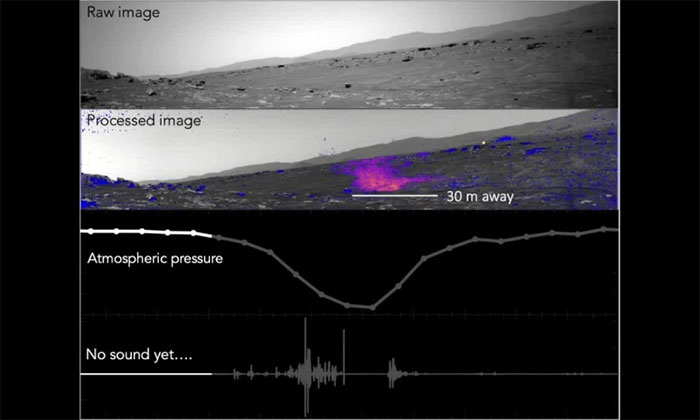
The Perseverance robot records dust storms on Mars.
Combining these three data sources, Murdoch's team discovered a 25m wide tornado, nearly 10 times the size of the robot. At 119m high, this tornado is as tall as a 40-story building. The giant tornado moved at 19km/h with maximum winds of 50km/h. However, on Mars, the atmosphere is much thinner than on Earth. This means that even when winds are high, due to the number of small particles in the atmosphere, the force of the wind is much smaller than on Earth.
In a typical dust tornado, most of the dust is concentrated in the walls of the tornado. But the dust that hit the robot came in three separate streams, from the sides and the dust cloud at the center of the tornado. The accumulation of dust inside the tornado was an unusual finding, according to Murdoch. " We still don't understand exactly how dust is lifted from the surface of Mars, but this is an important part of modeling both dust tornadoes and dust storms. With the microphones, we can directly observe the dust being lifted and determine the conditions under which it occurs."