A vast river delta, once indistinguishable from existing river deltas on Earth and possibly teeming with fossils of extraterrestrial life, has been identified by the Mars Express spacecraft.
Mars Express – a Mars exploration rover from the European Space Agency (ESA) – has sent back to Earth high-resolution images of the Holden Basin, where billions of years ago, swarms of extraterrestrial life may have inhabited the banks or the waters of its winding rivers.
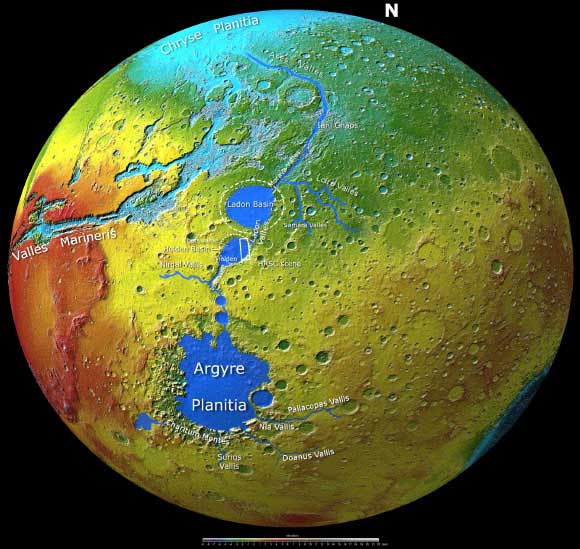
A close-up view of an ancient river on Mars, with the Holden Basin located in the middle. It is now dry, but may still be hiding treasures in its sediments - (Image: ESA)
According to Sci-News , the Holden Basin was part of an 8,000km-long river system with numerous valleys and depressions, which once helped transport water from the Argyre Planitia region in southern Mars to the Chryse Planitia region in the lower northern lands.
The complex history of this intricate network of rivers makes it a fascinating target for tracking traces of ancient extraterrestrial life, according to the Mars Express team.
Billions of years ago, the impact created the massive Holden crater and simultaneously generated this system of flows, known as Uzboi-Ladon-Morava , which meanders across a portion of Mars' surface, gradually forming a complex landform comprising the Uzboi Valley and the Holden Basin.
Water from this system eventually drains northward through the Morava Valles region. The famous Martian river Ares Vallis , at the mouth of the first mobile robot, Sojorner, 25 years ago, may also be part of this flow system.
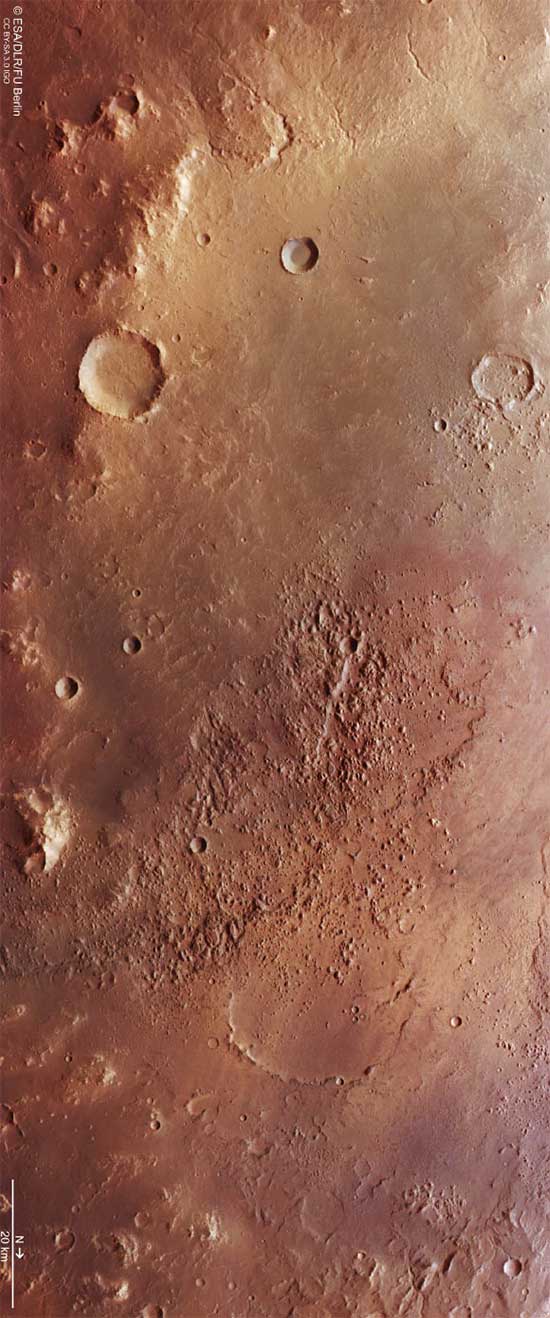
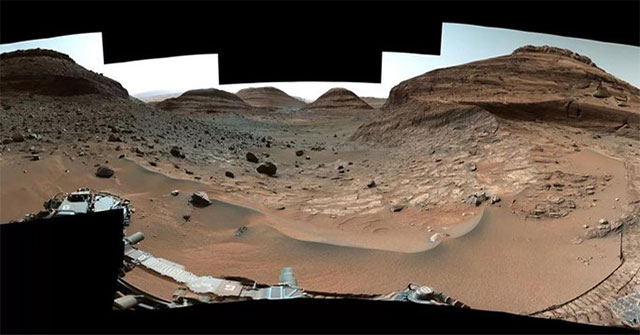
A section of the Holden Basin landscape - (Photo: ESA)
Now, based on detailed imagery clearly showing the topography and other geological data, scientists have determined that the Holden Basin, which is covered with phyllosilicate-containing sediments, is one of the most promising areas for study in the entire river system.
Phyllosilicates are a common mineral on Earth, often found in clays. They serve as reaction centers for organic molecules, the building blocks of life on Earth.
ESA scientists will be targeting this area with more instruments in the future, hoping to find tangible evidence of life that once existed on Mars billions of years ago.
- Concerns about Martian viruses invading Earth.
- NASA robot sends strange signal from "alien habitat oasis"
- NASA successfully creates oxygen on Mars.