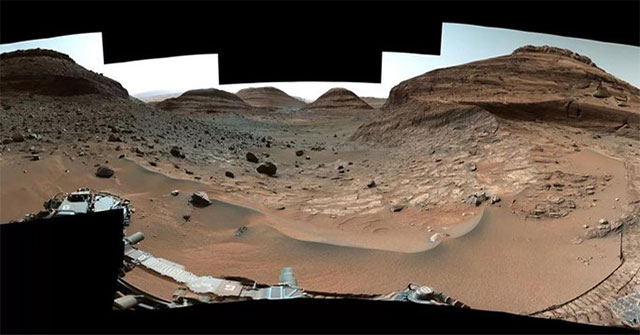
NASA's Jet Propulsion Laboratory (JPL) posted a panoramic image of a Martian sunset taken by the Curiosity rover, made up of 28 small images.
For more context, see The sound of a Martian dust devil 'swallowing' a NASA robot.
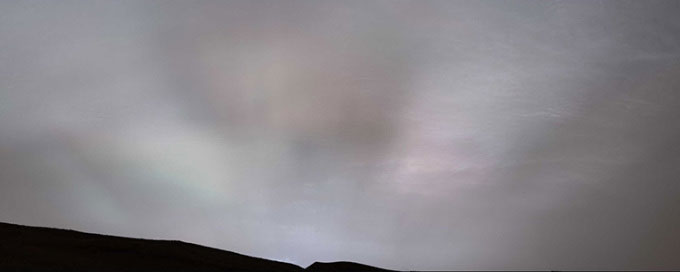
NASA's Curiosity rover captured the first images of sunlight shining through clouds at sunset on February 2. (Photo: NASA/JPL-Caltech/MSSS)
The image shows rays of light shining on a band of clouds as the sun dipped below the horizon on February 2. These rays are also known as crepuscular rays , from the Latin word for 'twilight .' This is the first time the rays have been seen so clearly on Mars.
Curiosity captured the scene as part of its latest twilight cloud survey, which builds on 2021 observations of noctilucent clouds. While most Martian clouds hover no more than 60 kilometers above the ground and are made of water ice, the clouds in the new image appear to be at higher altitudes, where they are particularly cold. That suggests they are made of CO 2 ice , also known as dry ice.
Just like on Earth, clouds provide complex and important information that helps scientists understand the weather. By studying when and where clouds form, they can better understand the composition, temperature, and winds of Mars.
During the 2021 cloud survey, many of the images came from Curiosity's black-and-white navigation cameras, providing a detailed look at the cloud structure as it traveled. But the new survey, which ran from January to mid-March 2023, used more of the color Mastcam camera, allowing scientists to see how cloud particles evolve over time.
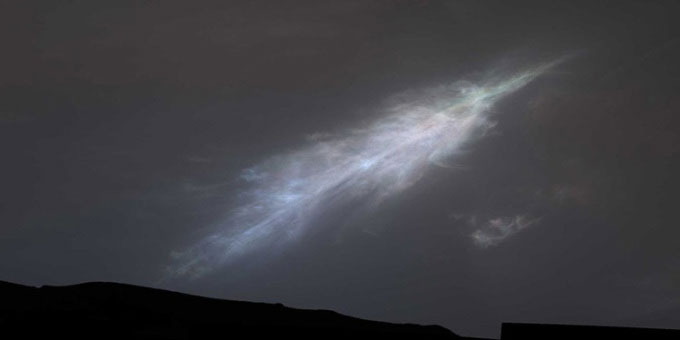
Curiosity captured this image of a feathery iridescent cloud shortly after sunset on January 27. (Image: NASA/JPL-Caltech/MSSS)
In addition to the sunbeams, Curiosity also captured a colorful feather-like cloud pattern on January 27. When illuminated by the Sun, some types of clouds can become iridescent, with rainbow-like colors.
'By looking at the color transitions, we see changes in the particle sizes in the clouds. That tells us about how the cloud evolved and how the particles changed size over time,' says Mark Lemmon, an atmospheric scientist at the Space Science Institute in Boulder, Colorado, of iridescent clouds.
Curiosity captured the sunbeams and iridescent clouds as panoramic images, each composed of 28 individual images sent back to Earth. The images were processed to highlight highlights before being posted on NASA's Jet Propulsion Laboratory (JPL) website on March 6.