An error in calculating the remaining fuel of the 22-year-old Mars Odyssey orbiter had experts thinking it was about to end its mission.
For nearly two years, NASA engineers feared that the Mars Odyssey orbiter's fuel supply was running low, leading to a tragic end for the precious craft. But in fact, they had miscalculated the amount of fuel remaining in Mars Odyssey's tanks, Gizmodo reported on March 16.
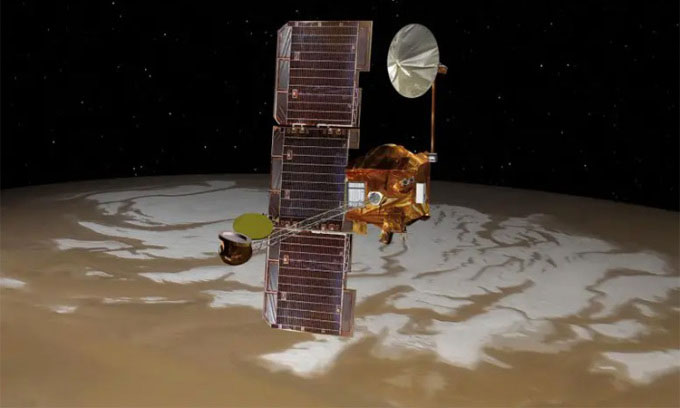
Simulation of NASA's Mars Odyssey spacecraft passing above the south pole of Mars. (Image: NASA/JPL-Caltech).
Mars Odyssey has been orbiting Mars for more than two decades, traveling about 2.21 billion kilometers in space. When it launched in 2001, the orbiter carried 225.3 kg of hydrazine fuel to operate. However, the spacecraft did not have a fuel gauge, making it difficult for mission experts to determine exactly how much fuel was left in the tank.
To test the fuel level, the team will heat up two of the spacecraft's propellant tanks and see how long it takes them to reach a certain temperature . "Like a teapot, a tank that's almost empty will heat up faster than a full tank ," NASA explains. The method isn't perfect, but it still gives experts a pretty good estimate of how much fuel is left in the tank.
In the summer of 2021, estimates suggested that Mars Odyssey was running low on fuel, with only about 5 kg remaining. By the end of January 2022, the team calculated that the remaining hydrazine was 2.8 kg. This meant the spacecraft would run out of fuel in less than a year, sooner than originally predicted.
The mission's engineering team was stumped. The cause could have been a fuel leak on Mars Odyssey, or estimates were off . They struggled for months to find a reason before bringing in an outside consultant, Boris Yendler, who specializes in estimating spacecraft propellant.
After studying the inner workings of Mars Odyssey, Yendler figured out what was causing the fuel loss. The spacecraft actually used heaters to keep parts from freezing in space, including one that connected the fuel tanks. The heaters caused the propellant to heat up at a faster rate than expected, causing the mission team to overestimate the fuel levels.
The mission team then recalculated Mars Odyssey's fuel load to account for the added heat. The result is that the orbiter should still be operational well into 2025. However, the mission team is still working to refine the measurement method to make it even more accurate.
Mars Odyssey is a key member of NASA's Mars "army ." The orbiter not only relays data between NASA's ground control station and the rovers, but also helps detect minerals, ice deposits, and potential landing sites.