To this day, no one knows exactly how the fig tree came to be in that location, or how long it has been growing .
In the ancient ruins of Baiae, near the modern city of Bacoli in Italy, there is a tree famous not for its thousand-year-old age, massive body or beautiful flowers. but for its strange posture . People call it the upside-down fig tree .
No one can explain
Looking at the tenacious tree growing on the roof of an ancient Roman arch , it's easy to see why it's called the inverted tree. It literally grows upside down, growing with its top facing the ground, as if suspended from the arch, defying the laws of physics and leaving botanists baffled.
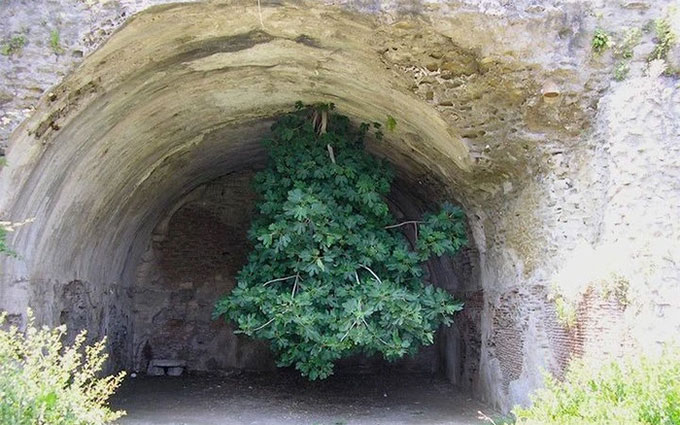
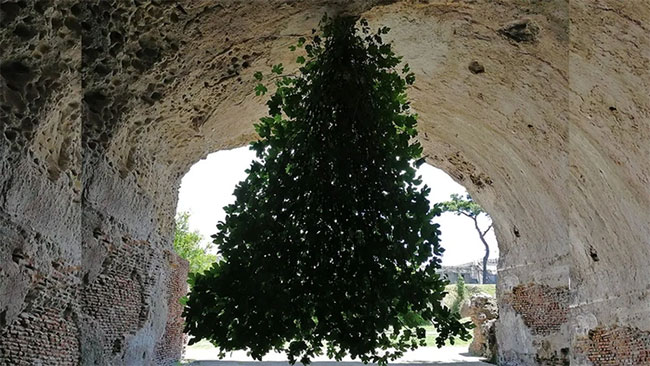
The upside down fig tree defies the laws of physics.
To this day, no one knows exactly how the fig tree got there, or how long it has been growing, but one thing is certain – despite its strange location, the fig tree grows stronger every year and occasionally even bears fruit.
The common fig (Ficus carica) was one of the first trees to be cultivated by humans. Fossils of the tree have been found in the Jordan Valley dating back to 9,400 BC. So it's no surprise that this particular gravity-defying tree would turn up in the ancient Roman town of Baiae .
Fig trees typically prefer dry, sunny locations, but their strong roots and ability to thrive in low-water conditions allow them to thrive in harsh environments. This upside-down fig tree is proof of that. It grows surprisingly well without water.
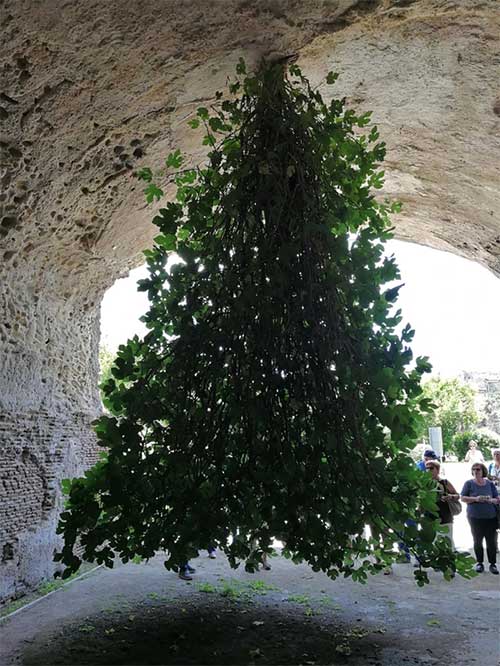
This upside down fig tree has become one of the most popular tourist attractions in Baiae.
Once a vibrant retreat for Rome's ruling class, Baiae is now an archaeological park that attracts tourists from around the world.
In recent years, this upside-down fig tree has become one of the most popular tourist attractions in Baiae. It is proof that nature is full of wonders that humans cannot imagine.
Ancient Land
In its heyday, the ancient Roman city of Baiae was a vibrant and fashionable resort for the ruling class. Now, a fifth of the city is underwater. The vast underwater archaeological park is described by archaeologists as the home of emperors such as Augustus, Caesar and Nero.
Baiae is also a volcanically active area. Over the centuries, the undulation of the Earth's crust in the area has triggered hydrothermal and seismic activity that has caused much of the city to sink below the shore.
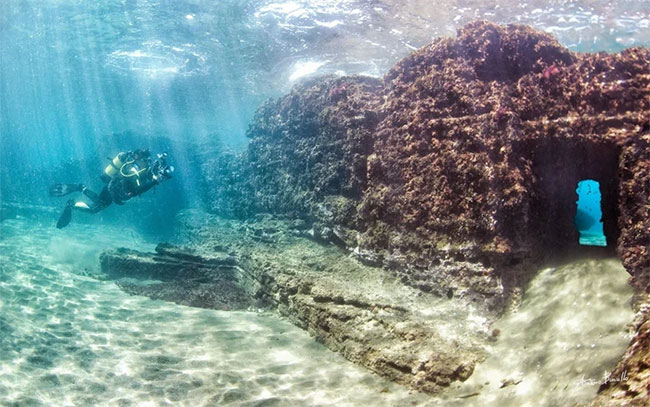
Not only is there the famous upside-down fig tree among the ancient Roman ruins , visitors here can also visit the submerged city, with glass-bottom boat tours that travel across the water at the archaeological site.
The way it was discovered was also surprising. In the 1940s, a pilot flying a plane in the sky noticed something unusual beneath the waves just off the coast of Naples. Although the photos taken by the pilot seemed to show structures in the ocean, it would be two decades before researchers would take submarine trips to get a closer look at the ancient submerged city.
Not only is the famous inverted fig tree among the Roman ruins above ground at Parco Archeologico delle Terme di Baia, visitors can also visit the submerged city, with glass-bottom boat tours that cruise the ancient archaeological site.