Dinosaurs are among the most famous ancient creatures on Earth, with countless fascinating mysteries that are still being uncovered today.
The truth about dinosaurs
- 1. In the beginning, people thought dinosaurs were. elephants?
- 2. What color were dinosaurs?
- 3. How can you distinguish between male and female dinosaurs?
- 4. Dinosaurs. weren't exactly intelligent creatures.
- 5. Why did they quickly become the dominant species on Earth?
- 6. Why did some dinosaurs walk on two legs, while others walked on four?
- 7. How did dinosaurs care for their eggs?
- 8. Were the ancestors of dinosaurs creatures that were much smaller than them?
- 9. Did some dinosaur species have the ability to regulate their body temperature?
- 10. They grow big, but are tiny when they first hatch.
You probably already know that, no matter how much you try to deny it, dinosaurs are the most famous animals of prehistoric times. Huge, terrifying. and we still don't know much about them. Therefore, it's no exaggeration to say they are the greatest mystery everyone wants to unravel.
However, science is constantly advancing, and we continue to discover more and more about them. So, let's explore the top 10 fascinating facts about these creatures.
1. In the beginning, people thought dinosaurs were. elephants?
In 1677, the English professor Robert Plot discovered a giant bone buried in the ground at a quarry in Oxford. At the time, other scientists were baffled, and they hastily concluded that it must be the bone of. a gigantic elephant. Indeed, at that time, no one imagined that animals as large as dinosaurs could have existed on Earth, which is why they thought of the largest land animals currently in existence.
Gradually, scientists discovered more and more. In 1842, zoologist William Buckland caused a strong reaction when he claimed that these bones belonged to a giant, extinct reptile, based on the discovery of many other bone fragments similar to what Robert had found earlier. He called it "dinosaur".
2. What color were dinosaurs?
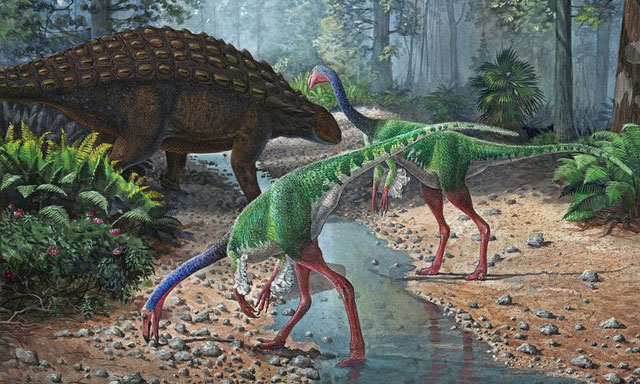
For many people, dinosaurs can have come in many different skin colors.
You've probably thought about this many times, haven't you? Of course, we don't know for sure, because fossils only provide information about the skeleton, leaving no information about skin color. Everything you see in movies is just speculation.
For many people, dinosaurs could have had a wide variety of skin colors. If many modern reptiles have blue skin, why couldn't dinosaurs? Or perhaps they had colorful appendages, such as a brightly colored crest to attract females during the breeding season.
3. How can you distinguish between male and female dinosaurs?
Essentially, this is the question of the century and very difficult to answer. So far, all we can do is speculate, because dinosaurs left us nothing but a few incomplete skeletons and a pile of fossilized eggs.
During excavations, scientists frequently found dinosaur skeletons of varying sizes lying side-by-side, leading them to speculate that males and females of the same species would not be of the same size . According to scientists, female T-REX dinosaurs were larger than their males.
4. Dinosaurs. weren't exactly intelligent creatures.
Despite their relatively large bodies, dinosaurs weren't particularly intelligent because they had tiny brains . For example, although weighing between 2 and 3 tons, the Stegosaurus had a brain about the size of a walnut.
And if we're talking about the most intelligent dinosaurs? It would definitely be Troodon, because their brains were the size of a chicken egg. Perhaps this is why Troodon is described as relatively active and cunning, befitting its predatory status, while Stegosaurus is considered a dinosaur with relatively slow reaction times?
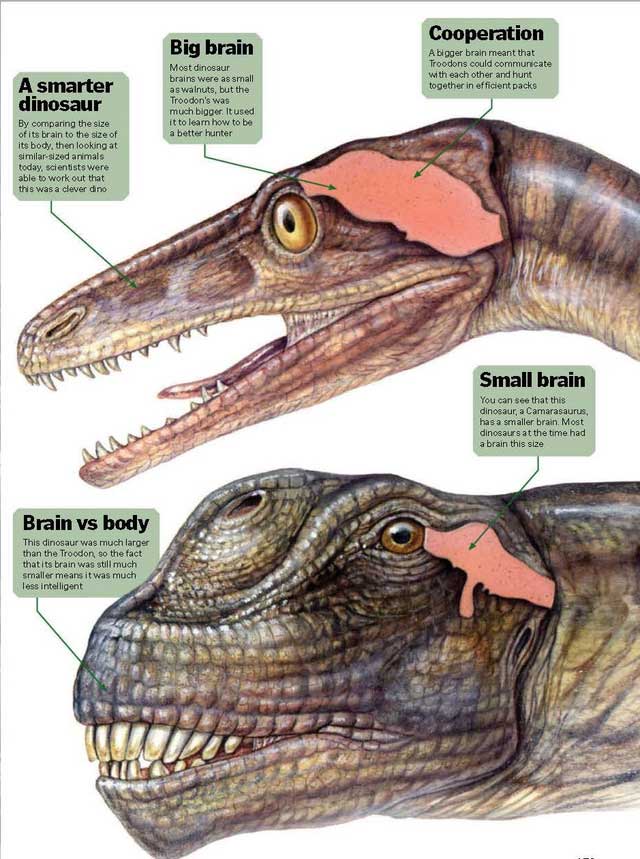
Basically, dinosaur brains were about the same size as those of modern reptiles like turtles, lizards, or crocodiles.
5. Why did they quickly become the dominant species on Earth?
At the beginning of the Mesozoic era, 250 million years ago, 90% of species had disappeared. This gave dinosaurs a free environment to thrive. When the second mass extinction occurred unexpectedly at the end of the Triassic period, 210 million years ago, dinosaurs had no rivals and quickly became the dominant species.
6. Why did some dinosaurs walk on two legs, while others walked on four?
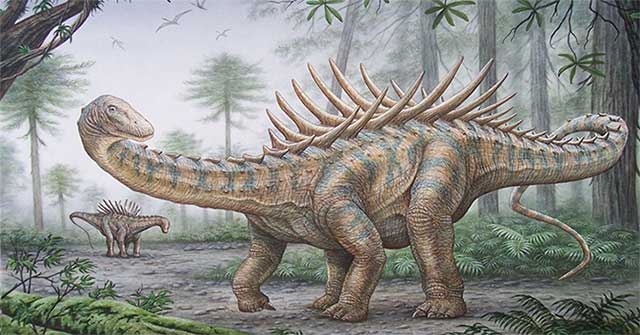
One common characteristic of dinosaurs is that their front legs are always shorter than their hind legs. Therefore, theoretically, all dinosaurs could walk upright on their hind legs. However, why couldn't most herbivorous dinosaurs do that?
The answer lies in the "weight" factor . Essentially, having bodies that grew to be too large and heavy forced them to revert to walking on four legs, as they could no longer stand on two.
7. How did dinosaurs care for their eggs?
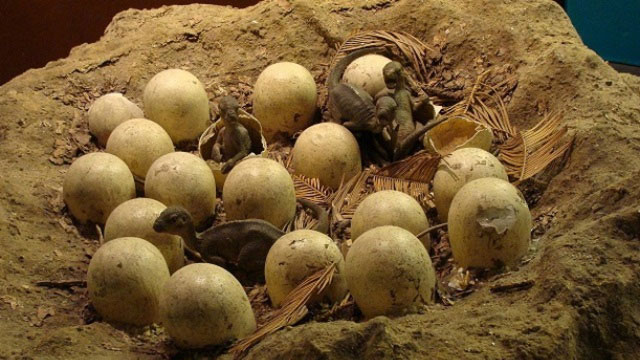
Dinosaurs laid their eggs and arranged them in a regular circle in a nest dug deep in the ground.
According to fossils discovered by scientists, dinosaurs laid eggs and arranged them in a regular circle in a nest dug deep in the ground. Initially, scientists believed they only laid eggs and didn't care for them like most reptiles. However, they eventually realized that dinosaurs did incubate their eggs when they found dinosaur skeletons covering their nests.
8. Were the ancestors of dinosaurs creatures that were much smaller than them?
According to research, the ancestor of dinosaurs – the Lagosuchus species, belonging to the Archosaur group of primitive reptiles – was only about the size of a rabbit: 50 cm long, weighing 100 grams, and had front legs shorter than hind legs, similar to later dinosaur species.
The most famous ancient dinosaur is believed to be Eoraptor (meaning "dawn robber"), which lived during the Triassic period about 225 million years ago and was discovered in Argentina in 1991. It only reached a length of 1 meter and weighed just 11 kg.
Later, scientists also found many other skeletons that were even smaller. The smallest was probably Microraptor, which was only 40cm long, and the largest known to date was 83cm, while the largest species, Amphicoelias, was up to 60m long.
9. Did some dinosaur species have the ability to regulate their body temperature?
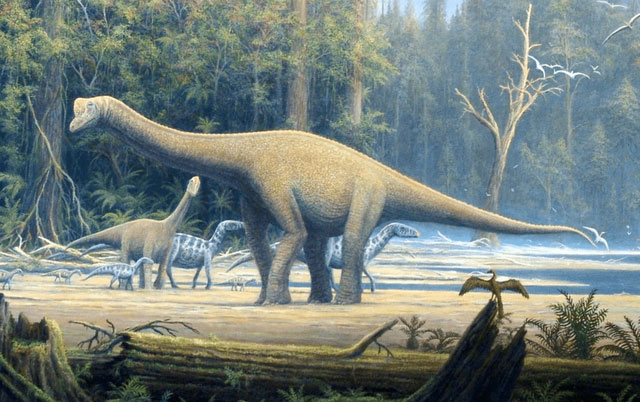
Scientists believe that sauropod dinosaurs were capable of regulating their body temperature.
Normally, this would be impossible because dinosaurs were reptiles. This means they were cold-blooded like lizards and needed to warm themselves in the sun. But for Sauropods, because they were so large, it's thought that if they absorbed heat from the sun, they wouldn't have had time to release it. Therefore, the ability to regulate their body temperature is clearly the most plausible hypothesis.
Furthermore, based on research from bone cross-sections of several small carnivorous dinosaur species, scientists have realized that while some dinosaurs were cold-blooded, others must have been warm-blooded. This is a characteristic of birds – species believed to be descendants of dinosaurs.
10. They grow big, but are tiny when they first hatch.
Even among the largest dinosaur species when fully grown, there were tiny ones, quite different from what humans imagine. Some newborn dinosaurs weighed less than 3 kg and were only 40-5 cm long. The reason these baby dinosaurs were so small was because they were born in eggs that averaged only 45 cm in length, while the largest eggs scientists have found are only about 60 cm long.
Of course, in that case, the dinosaur eggs couldn't be any bigger. Increasing the size would mean the baby dinosaurs wouldn't be able to break through the eggshell when hatching, meaning they'd easily get stuck inside.
Conversely, baby dinosaurs grew incredibly fast, as rapid growth was necessary to gain enough strength to defend themselves against dangerous predators.
- Why did China have 494 emperors, but only 4 are considered "the greatest emperors of all time"?
- The 18 most terrifying months in history: The sun disappeared, and people couldn't see their own shadows at midday.
- The mysterious bubble that appeared at the center of the Milky Way has finally been "decoded".