The cutting-edge James Webb Space Telescope has just set a new record by identifying the four oldest galaxies ever known in the universe, born just 300 million years after the Big Bang.
The new data actually gives scientists a direct look into the past, because for galaxies 13.5 billion light years away to appear, light not only had to travel that distance, but it also took 13.5 billion years for the journey.
In other words, it's an image of 13.5 billion years ago, literally traveling through space-time , offering a realistic look at the dawn of the universe.
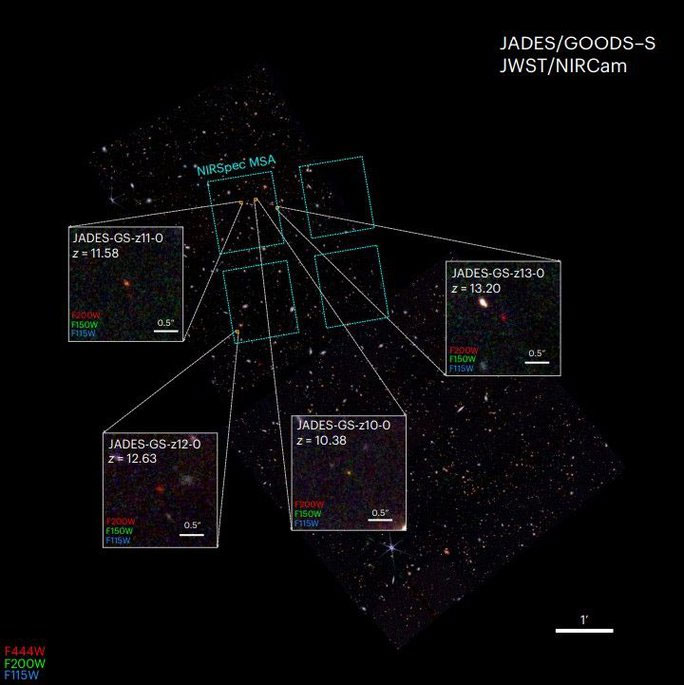
Images transmitted to Earth from 13.5 billion years ago reveal four ancient galaxies - (Photo: NATURE).
The new research was carried out by an international team of scientists from the UK, Italy, the Netherlands, the US, Germany and Australia, led by Dr Emma Curtis-Lake from the Centre for Astrophysics at the University of Hertfordshire (UK) and Dr Stefano Carniani from the Scuola Normale Superiore di Pisa (Italy).
According to Live Science, unlike some previous studies of what were "supposed to be galaxies" with almost the same age, also from James Webb data, this new study confirms that they are indeed ancient galaxies and are not likely to be disguised objects.
Not only that, they also analyzed signs of the operation of these galaxies. They existed during the "reionization" period, when the first stars were created.
The article published in the journal Nature said that after confirming the age of the galaxies, the researchers measured the size of the stars and found that they were smaller than the stars in the Milky Way galaxy that currently contains Earth.
But surprisingly, star formation was occurring vigorously, at a rate they had not expected in such a primitive world.
These galaxies also appear to contain no particularly complex elements, suggesting that their stars have not had time to create heavy elements and are made up of only hydrogen and helium atoms from the early universe.
This also fits with theories and models of the early universe with a simple chemical composition.
The intense star formation also suggests that these galaxies grew very quickly, meaning the early universe had a more vibrant start than we imagined.
These ancient galaxies and their stars can be considered the "ancestors" of what exists today, including the Milky Way or, more modestly, our Earth.
Simple stars in early galaxies are also poor in composition and often have short lifespans, but their lives—including the fusion reactions in their cores that occur when they die and explode as supernovas—are enough to serve as "factories" for synthesizing heavier elements.
Accordingly, the death of these stars - and possibly the four galaxies above have long since died - provides richer elements for the new class of galaxies and stars.
This process, which occurred continuously over many generations, created the universe with the rich chemical composition it has today, just as humanity diversified its genome and developed to new levels in the evolutionary process.
James Webb is the world's most advanced telescope today, developed and operated primarily by NASA, with the cooperation of ESA and CSA (European and Canadian Space Agencies). Its main mission is to look into the cosmic dawn to search for ancient objects.