How Does Humanoid Robot Locomotion Work?
Humanoid robot locomotion is the control of walking, running, stepping and terrain adaptation on a human-like body while maintaining balance, managing contacts and coordinating the rest of the robot.
Explore robots built to operate in human environments, from embodied AI and locomotion to manipulation, sensors and general-purpose robotics.
Begin with clear explanations of the key ideas, discoveries and questions in this subject.
Humanoid robot locomotion is the control of walking, running, stepping and terrain adaptation on a human-like body while maintaining balance, managing contacts and coordinating the rest of the robot.
Tactile sensing lets robots measure contact, pressure, force, shear, slip and surface deformation so they can understand what is happening at the poi…
Humanoid robot actuators are the motor, transmission, sensing and control assemblies that generate joint motion and torque, turning software commands…
Synthetic data for robotics is training or evaluation data generated by simulation, procedural systems or generative models instead of being captured…
Humanoid robots balance by controlling their center of mass, contact forces, momentum and foot placement while using fast feedback to recover from di…
Sim-to-real in robotics is the process of transferring policies, models or control strategies developed in simulation to physical robots while managi…
Read recent ScienceInfo stories and explainers about Humanoid Robots.
Whole-body control for humanoid robots coordinates the legs, torso, arms and hands as one physical system so the robot can move, balance and interact without treating ea…
Robot simulation uses software models of robots, sensors, physics and environments so developers can design, test, train and validate robotic systems before or alongside…
Robot teleoperation is the remote control of a robot by a human operator through interfaces such as joysticks, control stations, VR systems, motion trackers or leader de…
Dexterous manipulation is the controlled movement of an object through coordinated robot-hand contacts, including regrasping, rotation, translation and in-hand adjustmen…
Tactile intelligence is a robot’s ability to interpret touch, combine tactile signals with other senses and use contact feedback to learn, decide and adapt its actions i…
Dexterous robot hands use multiple articulated fingers, carefully designed actuation, sensing and coordinated control to grasp and manipulate objects with more flexibili…
Robotic grasping is the process of choosing how to approach an object, selecting contact points, closing a gripper or hand and maintaining a stable hold despite uncertai…
Physical AI and embodied AI overlap around perception and action, but they emphasize different questions. Embodied AI focuses on intelligence grounded in a body and envi…
Continue with more articles, discoveries and explanations from this subject.
Humanoid robots are machines whose body layout or behavior resembles aspects of the human form, often combining sensors, motors, control software, and AI to move and wor…
A vision-language-action model, or VLA model, combines visual observations and language instructions with action generation so robots can connect what they see and hear…
Physical AI combines perception, reasoning, prediction and control so AI systems can understand physical environments and take useful actions through robots, autonomous…
AI world models learn representations of how an environment changes so an agent can predict possible future states, compare actions and plan before acting in the real or…
A robot foundation model is broadly pretrained on robot, visual, language or action data so it can be adapted across many tasks instead of being built for one fixed beha…
General-purpose robots are designed to perform many different tasks instead of one fixed job. They combine adaptable hardware, perception, control and AI so the same pla…
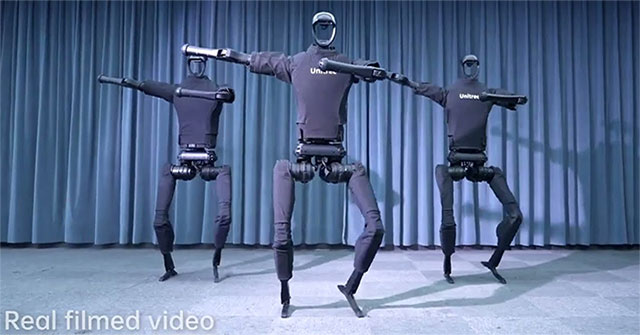
Unitree Robotics announced that its bipedal humanoid robot H1 set a new speed record by moving at 3.3 meters per second (11.9 km/h).
Embodied AI studies intelligent agents that perceive and act through a physical or simulated body, grounding learning and reasoning in interaction with an environment.
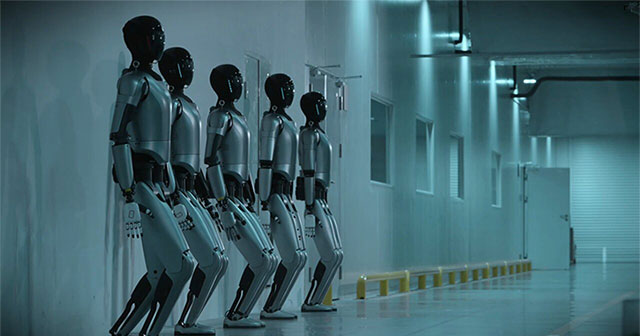
Robotics startup MagicLab introduces a fleet of humanoid robots at a factory to train them in a variety of jobs.
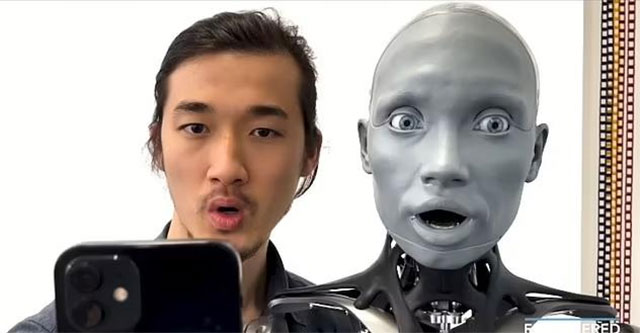
Ameca, a British-made humanoid robot, appears to be filming a hilarious clip with a scientist in which the human and robot display the same creepy-perfect expressions.
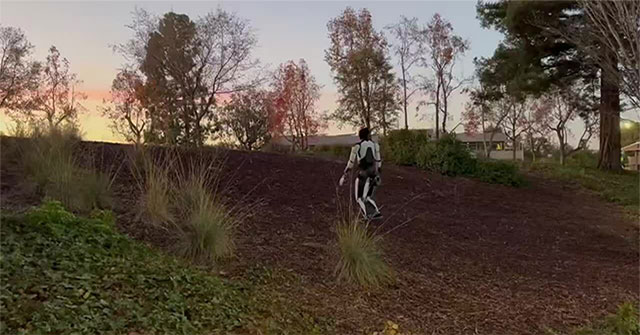
In the latest video, Elon Musk and Tesla show off the humanoid robot Optimus' skills in walking on rough terrain without falling.
Guinness World Records on December 4 released footage of Toyota's CUE6 humanoid robot shooting a basketball from a distance of 24.55 meters.