When the astronauts set foot on the Moon, they realized a shocking truth: in the one day they spent exploring that strange world, many days had passed on Earth! This amazing phenomenon quickly sparked a global debate.
Space exploration has always been one of mankind's greatest dreams. In the field of space exploration, landing on the Moon is certainly one of the most important and challenging missions. So how do astronauts spend a day on the Moon? On the Moon, 360 million kilometers away from Earth, time is very different from the Earth we are familiar with.
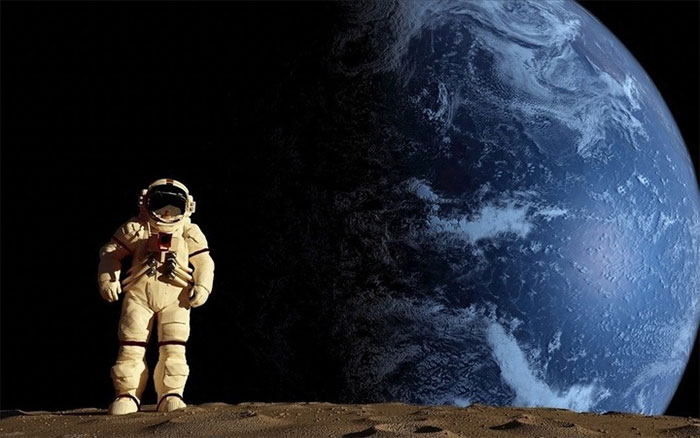
One of the greatest scientific discoveries in human history was the first human landing on the Moon. It was on July 21, 1969, when astronaut Neil Armstrong became the first person to walk on the Moon. Since that day, human exploration of the Moon has never stopped, and scientists have also begun to conduct in-depth research on a day on the Moon. (Photo: ZME).
A day on Earth is 24 hours long, while a day on the Moon is about 29 Earth days long. In other words, while the Earth completes a rotation every 24 hours, the Moon experiences a sunrise about every 709 hours. This means that an astronaut's day on the Moon is much longer than a day on Earth , which is a very interesting phenomenon.
When the astronauts woke up, they found themselves in a very special environment. The surface of the Moon was extremely hot and had no atmosphere or moisture, only large craters and a grayish-white lunar surface could be seen. The first thing to do was to check the equipment and contact the control center on Earth. The astronauts had to make sure that the various systems of the lunar base were working properly to ensure smooth progress.
A day on the Moon is not all about research, experiments and data collection. They are also required to perform tasks such as maintaining equipment, collecting samples and performing recovery operations. Moving and working is relatively easy due to the lower gravity, but astronauts still need to approach each task carefully, as precision and detail are key to success.
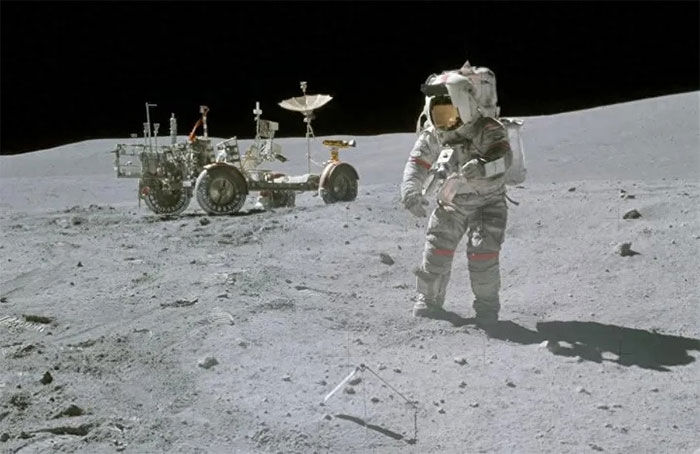
Scientists have studied a lunar day in depth and used this time difference to help them better understand the properties of the Moon. For example, by studying solar radiation and temperature changes around the Moon, scientists can infer the physical characteristics and chemical composition of the Moon's surface. They can also study the internal structure and movement of the Moon's crust by observing moonquakes. (Photo: Allthatsinteresting).
Since the Moon's surface has no atmosphere , astronauts must spend all day in spacesuits. These spacesuits can provide air, maintain body temperature, protect astronauts from radiation, and protect astronauts from the outside environment. Wearing spacesuits, astronauts can step out of the Moon base and carry out survey and exploration missions. They can carry some scientific instruments and conduct various experiments to further explore the mysteries of the Moon.
On the Moon, day and night alternate, and this rotation is different from the 24-hour day-night change on Earth. Astronauts need to make sure they can complete their mission during each cycle and adapt to the darkness and cold temperatures of the Moon at night.
When the day is over, the astronauts need to return to the lunar base to contact and report back to their colleagues on Earth. They will review the results and challenges of the day and prepare for the next day's mission. In the lunar base, it is very important to communicate with the control center on Earth and ensure close communication with Earth so that any problems can be resolved promptly.
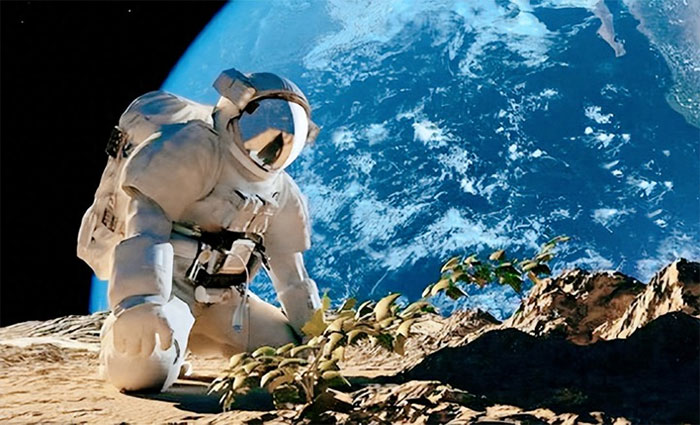
Understanding a lunar day is not only beneficial for scientific research, but also important for future space exploration programs. For example, humans planning to establish a permanent base on the Moon need to take into account the time zone difference on the Moon. They need to adjust their schedules to match a lunar day. This is very important for astronauts who will live and work on the Moon for a long time. (Photo: Sciencealert).
During their missions, astronauts must always pay attention to the passage of time . Although there is no day-night rotation on Earth, astronauts need to be highly self-disciplined and able to manage their time according to the requirements of the mission and schedule. Because traveling on the Moon is relatively slow and limited, they must arrange their working time reasonably to avoid being too tired and wasting time.
Although an astronaut's day on the Moon is very different from a day on Earth, the work they do and their goals for exploration are the same. By studying the Moon, we can better understand space and provide more information and support for future space exploration. Every day astronauts spend on the Moon is an opportunity for adventure and discovery , and it is also humanity's pursuit of the limitless possibilities of space.
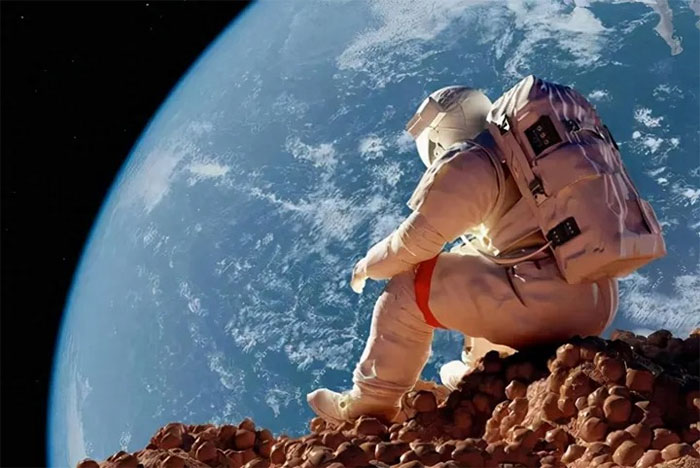
Astronaut is one of the most challenging and mysterious professions in the world. People have always been interested and curious about the astronauts living on the Moon. (Photo: Zhihu).
A day in the life of an astronaut on the Moon is filled with scientific tasks, challenges, and wonders. Although they have no awareness of time on Earth, they are always able to complete their tasks efficiently thanks to their self-discipline and strong time management skills. Through their efforts, we can learn more about the Moon and uncover the mysteries of the universe.