Until now, the Sun has always been a star that humans have not been able to reach because of its terrible heat. Scientists believe that in the future, with the development of science and technology, we will be able to approach the Sun. So when astronauts land on the Sun, what will they see on this star?
How to get close to the Sun?
Many people compare the Sun to a giant ball of fire that warms humanity. Indeed, it is so, because at the lowest temperature of the Sun, it reaches 5,504 degrees Celsius . This is also the temperature threshold that can burn almost any material in the world.

The lowest temperature on the Sun is 5,504 degrees Celsius. (Photo: Nasa)
According to Ralph McNutt, an engineer working at NASA, the current protective suits of astronauts are not designed to withstand deep space. Specifically, they can only withstand temperatures of 120 degrees Celsius. If the temperature outside of space is higher than 120 degrees Celsius, this protective suit will become a sauna, and the wearer will dehydrate to death. Thus, humans only need to pass the distance of 4.8 million km from the Sun to immediately turn into dust.
If we choose to fly to the Sun by space shuttle, we can get closer. Because the space shuttle's reinforced carbon-carbon (RCC) thermal plate helps it withstand external temperatures of up to nearly 2,600 degrees Celsius. If the entire ship were covered in this reinforced thermal plate, astronauts could get as close as 2 million kilometers to the Sun. However, at this point, the ship's protective layer would quickly be damaged and the astronauts would have to turn back.
NASA has been attempting to send the Parker Solar Probe into the Sun's atmosphere to sample particles from the corona. It was launched in 2018 and has made seven flybys of the Sun before entering the corona on its eighth flyby on April 28, 2021. Parker was 13 million kilometers from the center of the Sun during its first coronal passage.

With such high temperatures, humans would only need to cross the 4.8 million km mark from the Sun to immediately turn into dust. (Photo: Nasa)
The Parker spacecraft is protected by a 11.43 cm thick ceramic-coated carbon composite thermal armor, which can withstand temperatures up to 1,377 degrees Celsius, enough for it to withstand an approach to the Sun at a distance of 6.16 million km, nearly 7 times the record of 43 million km made by the Helios 2 spacecraft in 1976. To overcome the Sun's enormous gravity, the spacecraft must rush through space at a speed of 692,000 km/hour.
With what Parker has done, humans can fully hope that in the future, we will land on the surface of the Sun. So what will humans see there?
What's inside the Sun?
As mentioned above, when we get close to the Sun, the first thing we encounter is the corona . The corona (or heliosheath ) is the ring of light emitted from space around the Sun. This region has a low density of matter, scatters electromagnetic radiation from the Sun, and produces a faint light, which can be observed when the Sun itself is obscured during a total solar eclipse. The corona is as hot as 1 million degrees Celsius, while the Sun's photosphere (what we normally see with the naked eye) is nearly 5,500 degrees Celsius.

The corona is hot to 1 million degrees Celsius, while the Sun's photosphere is only about 5,500 degrees Celsius. (Photo: Nasa)
After passing through the corona, we will reach the photosphere of the Sun. This is the visible surface of the Sun. Through decades of research, scientists have always estimated that the temperature of the photosphere is around 6,000°C . The photosphere is about 100km thick, relying on it to radiate all the sunlight. The activities of the Sun that often occur in the photosphere are the movement of this plasma in the convection zone creating strong magnetic fields. These magnetic fields are then pulled up from inside the Sun by convection and penetrate its visible surface in the form of sunspots.
Passing the photosphere, we have actually reached the inner part of the Sun. The first stop is the convection zone . After a distance of about 200,000 km (that is, 15 times the diameter of the Earth), we reach the second stop, which is the radiation zone . This region of the Sun has a temperature of 2 million degrees Celsius . If we could see individual particles of light, called photons , we would see them jumping between tiny particles called atoms, forming plasma. This region has a temperature of up to 15 million degrees Celsius .
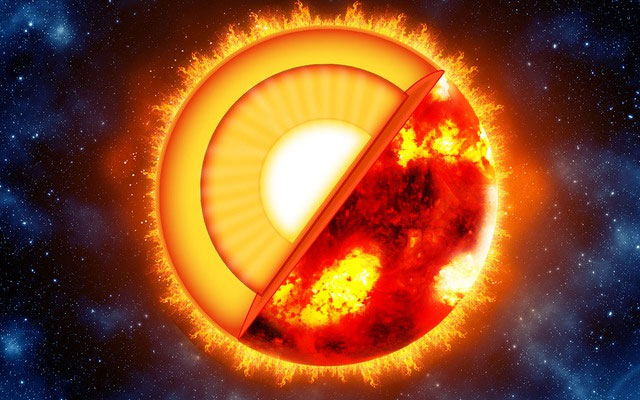
The inside of the Sun's core is believed to be pink. (Photo: Nasa)
Finally, there is the core of the Sun. But to get there, we have to shrink down to the size of an atom. Because that is the only way we can see the atoms inside the Sun's core, which are millions of times smaller than a grain of sand. They are hydrogen atoms, the lightest element in the universe. The tremendous pressure and heat squeeze these atoms so close together that they combine to form new, heavier atoms. This is called nuclear fusion. Hydrogen atoms combine to form a completely new substance called helium. And the inside of the Sun's core is a beautiful pink.