To this day, the West remains ashamed of its history of the African slave trade and abuse. From the 15th to the 19th centuries, they subjected 12.8 million Black people to horrific conditions, living lives worse than death, across Europe and America.
During this period, however, 1.25 million white people were also captured by North African pirates and sold throughout the African continent. Their fate was no less unfortunate than that of the enslaved people of color.
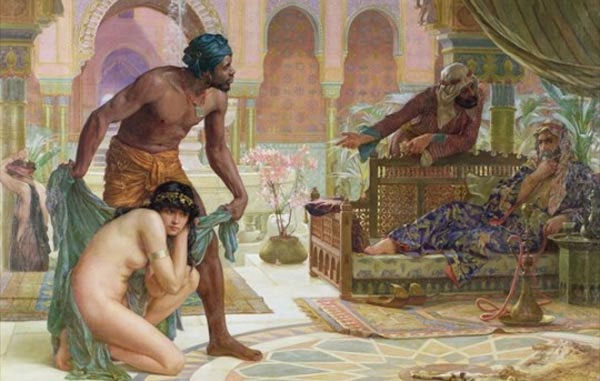
The buyers of white female slaves were African and Middle Eastern aristocrats.
Kidnapping the entire village.
At 2:00 AM on June 20, 1631, Baltimore, a coastal village in Ireland (a country in Europe), was peacefully asleep when it was suddenly attacked.
Down by the coast, over 200 Barbary pirate ships were silently moored close together. The pirates, armed with muskets, iron clubs, and torches, stormed aboard. They brazenly broke down doors and stormed into houses.
All 20 men, 33 women, and 54 children from Baltimore were forcibly taken aboard the boat, never to return.
Barbary pirates were pirates who operated in the coastal and offshore areas of North Africa. Their main fishing grounds were the ports of Salé and Rabat (Morocco), Algiers (Algeria), Tunis (Tunisia), and Tripoli (Libya). All of these ports are located on the Barbary Coast, so the pirate groups operating there are collectively known as Barbary pirates.
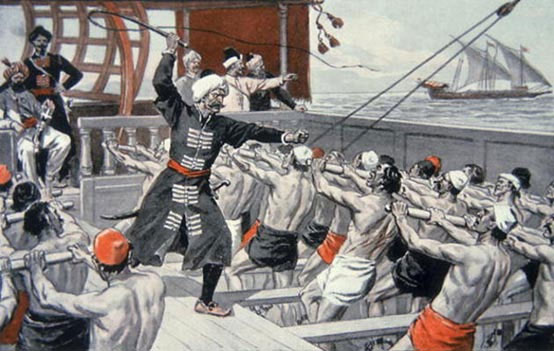
Barbary pirate ships used white male slaves as 'living oarsmen'.
According to North African history, Barbary pirates appeared around 710 AD. From the 14th century onwards, they wreaked havoc off the coast of Barbary, attacking and plundering merchant ships.
In the 15th century, Europe discovered Africa. Medieval African cultures practiced slavery, with many communities punishing members who erred by depriving them of their freedom and human rights. Greedy Western merchants immediately saw a huge profit. They bought up enslaved people of color, loaded them onto ships, and transported them back to Europe, thus beginning the African slave trade.
The shipbuilding techniques used by Barbary pirates were very outdated. Therefore, they could only operate near and off the coast of Barbary.
Europe brought advancements and improved the shipping systems of North African pirates. Starting in the 16th century, Barbary pirates easily conquered the Atlantic Ocean and landed on the shores of the Mediterranean (Europe).
An unfortunate ending
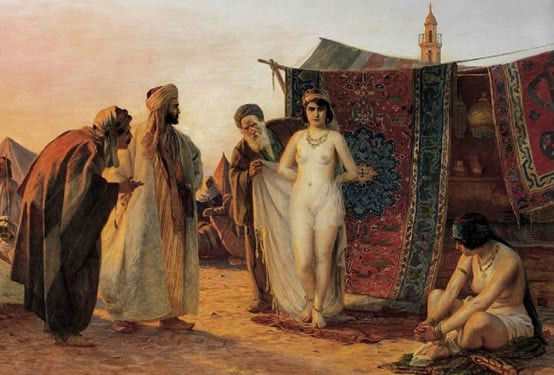
White slave children were sold to the Ottoman Empire to serve as soldiers.
In fact, Barbary pirates attacked anyone in sight. They spared no one, old or young, black or white, Christian or Muslim.
The Barbary pirates themselves weren't just Black; they were a multi-racial, multi-national, and multi-religious mix. Their only commonality was that they were based in Barbary.
The Barbary pirates' objective was plunder. Whenever they attacked ships, ports, or villages, they looted everything. In the era of the slave trade, human beings were also a commodity. Barbary pirates captured anyone they could, brought ashore, and sold for money. Their victims were called Barbary slaves.
White people were only a part of the Barbary slaves. However, Barbary slaves were still referred to as white slaves because they stood out in the Black world.
Furthermore, this term also corresponds to and represents the contrast with Black slaves in the white world.
The white victims of Barbary pirates were merchants, travelers (traveling to Africa by sea, landing in North Africa), and people living in villages and towns along the Mediterranean coast.
From the moment they were forced onto a pirate ship, their fate as Barbary slaves began. For the 107 inhabitants of Baltimore, Ireland in 1631, their new destination was the harbor of Algiers.
On the journey to Barbary, the white slaves were given only meager food and water. After long periods of being chained, imprisoned, starved, and adrift at sea, most of them became emaciated and sickly. Some did not survive the voyage, their bodies thrown overboard by pirates.
As soon as they landed in Barbary, they were dragged ashore, stripped naked, shackled, and taken to the slave market.
At the slave market, white male slaves were offered for forced labor. Their fate was lifelong forced labor. The most tragic were those turned into "living oarsmen." Pirate ships at that time relied on sails (to catch the wind) and oars (using human strength). These "living oarsmen" were chained to the hull of the ship, forced to constantly and strenuously pull and push the oars. Furthermore, they had to eat, sleep, and relieve themselves on the same spot.
White female slaves were sold to African and Middle Eastern aristocrats as maids, concubines, or tools for their amusement. Children were not spared either, being conscripted into the 'junior corps ' and subjected to grueling military training to become soldiers of the Ottoman Empire (Middle East).
A 400-year journey
As European tourists to Africa dwindled due to fear of Barbary pirates, the pirate group launched frenzied attacks on villages along the Mediterranean coast. The coastline stretching from Spain to Italy was subjected to relentless raids. In the Iberian Peninsula (southwest Europe) alone, an estimated 100,000 to 250,000 white people were abducted.
During the 17th and 18th centuries, Barbary pirates roamed the coasts of Europe. It is estimated that by 1780, they had abducted and enslaved 1.25 million white people. Compared to the pirates from North Africa, European naval forces were overwhelmingly superior in both numbers and weaponry.
However, in actual naval combat, they lost more often than they won. Barbary pirates were highly skilled in naval warfare and very agile. They attacked swiftly and retreated just as quickly, rendering European fleets helpless.
In the late 17th century, European nations sharing the Mediterranean coast had to cooperate against Barbary pirates. They fiercely protected merchant ships, preventing pirates from approaching. As a result, trade between Europe and Africa became safer.
The number of Black people trafficked to Europe and America also increased dramatically. Conversely, villages along the Mediterranean coast remained neglected, left to the ravages of Barbary pirates. In many parts of Europe, fishermen were forced to abandon their villages and retreat inland for safety.
At the beginning of the 19th century, European navies began cooperating with the American navy to drive out Barbary pirates. Numerous North African pirate gangs were fragmented and wiped out. However, the survivors continued to plunder and abduct white people.
It was not until slavery was abolished worldwide (1911) that this human trafficking ceased. Throughout Africa and the Middle East, surviving Barbary slaves were freed. The era of white slavery ended at the same time as the era of black slavery.