If Bill Gates dropped out of Harvard University to found the leading technology company Microsoft, then before the billionaire, there was a great man who did the same thing to completely change the world.
On this day in history, February 15, 1564, the world-famous Astronomer, Mathematician, and Physicist Galileo Galilei was born. He is known as the 'father' or boss of modern science.
From multi-talented boy to college dropout
Galileo Galilei was born in Pisa, Italy. He was the eldest of six children. In order for his son to succeed, his father had a very careful plan of education. Galilei was taught Greek and Latin as well as many other knowledge, except mathematics.
Since childhood, he was very hard-working and learned very well. He was able to play the piano, draw pictures and even make toys. Later, according to his father's wishes, he studied medicine at the University of Pisa. However, he did not like this field of study and instead was passionate about mathematics, science and astrology.
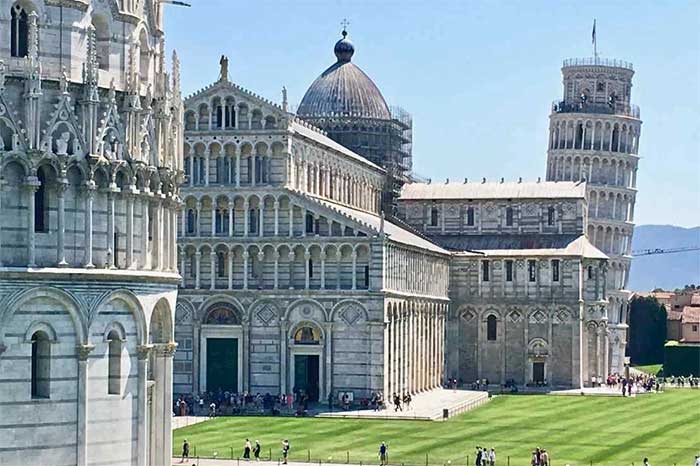
University of Pisa today.
During his first year at university, while observing a swinging chandelier in the Pisa Cathedral, he realized that the lamp always took the same time to make one oscillation, regardless of the range of its swing. This was later tested by him and he proposed the pendulum principle in regulating clocks.
A turning point in Galileo's life was in 1585, when he dropped out of school without receiving a degree. He then decided to pursue his passion, engage in mathematical research and earn money as a math tutor.
Similar to Galileo, the world many years later witnessed a similar scenario when billionaire Bill Gates dropped out of Harvard to pursue his passion and founded the software company Microsoft.
In 1586, Galilei published a paper on the hydrostatic balance . This paper made him famous throughout Italy. Later, Galilei was invited to teach mathematics at the University of Pisa, the very school from which he failed to graduate.
Journey to change the world
Galileo Galilei was on his way to becoming one of the most influential figures in world history. After his success with the hydrostatic balance, he invented many other historical works.
In 1592, Galileo was appointed professor of mathematics at the University of Padua. He made frequent visits to the Arsenal, the inland port frequented by Venetian ships, where he studied mechanical machines .
In 1594, the Venetian City Council awarded him a patent for a device for raising water that was driven by a horse. This invention was called the 'Galileo pump' and became the basis of modern pumps.
His genius did not stop there. He also proved that objects thrown in the air would move in a parabolic pattern. He was also the one who invented the primitive water thermometer and introduced the world to the concept of measuring temperature and creating the compass .
He also asserted that there is no such thing as light objects falling slowly and heavy objects falling quickly. If there were no air resistance, objects would fall at the same time. These innovations of the great scientist laid the foundation for the development of the world later on.
In addition, his historical work cannot be mentioned without mentioning the telescope. Actually, Galileo did not invent the telescope, but he made great improvements to it. In 1609, he published the telescope designs that today are collectively known as the Galileo Telescope.
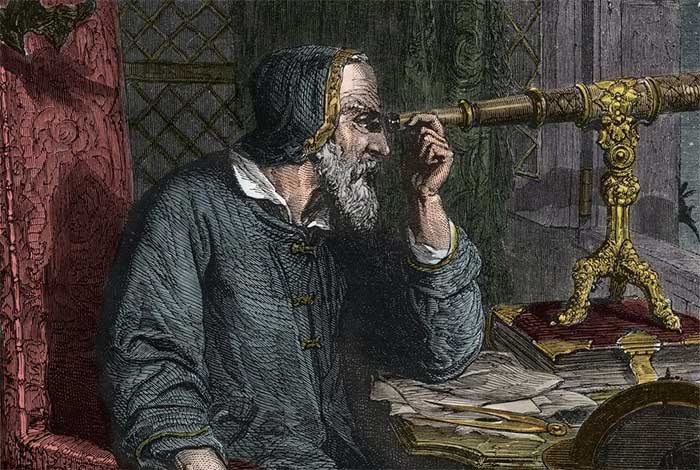
In 1609 he published designs for Galileo's telescope.
The first was a small telescope with three magnifications, followed by one with eight magnifications. Although he was not the inventor, he used the telescope to study the universe in general.
He also made many useful publications to the world through observations of a series of stars such as Jupiter, Venus and the Moon. He was also the first European to observe the dark areas on the Sun (sunspots) and also discovered that the surface of the Moon is concave and convex and the Milky Way is a collection of stars. His first astronomical observations were published in 1610 in the work 'Sidereus Nuncius' (The Starry Messenger).
Through his observations, the great scientist also saw that the Earth was revolving around the Sun and was not the center of the universe. He fully supported this theory of the Polish astronomer, Nicolaus Copernicus (1473-1573).
However, the Copernican doctrine was considered to be contrary to the teachings of the Roman Catholic Church which ruled Italy at that time. The Church believed that the Earth was the center of the universe, not the Sun, so any doctrine that contradicted this was considered heretical.
Eventually, Pope Urban VIII decided to try Galileo for heresy and put him under church surveillance for the rest of his life. Legend has it that after walking out of the court, Galileo Galilei angrily exclaimed: 'The Earth still turns'.
Only later was Galileo Galilei's theory recognized as correct. The Church also exonerated him. From then on, his name and his great contributions to world science were recognized and passed down forever. Galileo Galilei died on January 8, 1642, at the age of 77, ending a journey of great contributions.