What if we—and our entire universe—were inside a black hole? What if the edge of the universe we could never reach was actually the event horizon of a black hole?
Surely many people have wondered: If the Big Bang started everything, then what existed before the Big Bang?
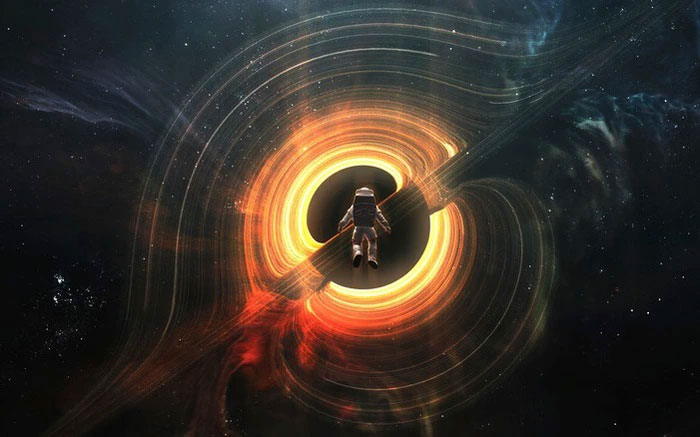
A black hole is also an infinitely dense point in spacetime.
Some suggest that we have to accept that we will never know the answers to such questions. After all, even the James Webb Space Telescope—the most powerful telescope in history—can see back 100 million years after the Big Bang (according to NASA), but it still can't see past the first moments of existence.
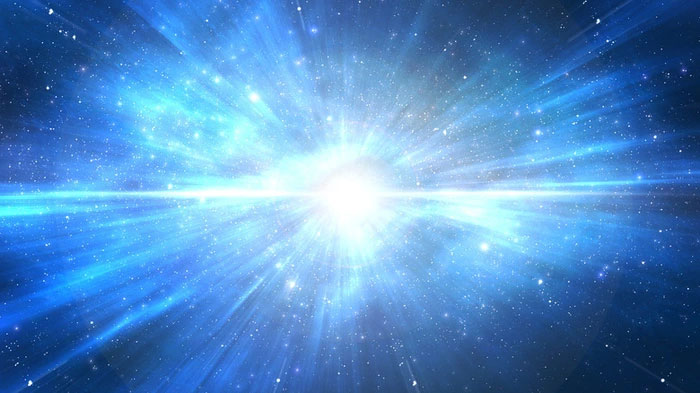
We know that the Big Bang happened about 13.7 billion years ago. Just 10 to the minus 36 seconds after the Big Bang—one trillionth of a trillionth of a trillionth of a trillionth of a second—space inflated like a balloon. The first protons and neutrons formed about 10 to the minus 6 seconds after the Big Bang, and three minutes later we had our first element—deuterium (a type of hydrogen).
Before the Big Bang? Some researchers believe that the universe existed as a single, infinitely dense point called a singularity . That singularity broke apart and has been expanding ever since. This is essentially the opposite of a black hole. A black hole is also an infinitely dense point in spacetime. However, instead of spitting things out, it sucks things in. Could the formation of a black hole mean the creation of a new universe within it?
However, at present, there are opinions that it is impossible for black holes to reach a huge size to contain the entire universe inside. This is not entirely wrong. According to current human understanding, the smallest black hole discovered so far is called IGR J17091-3624 , less than three times the mass of the Sun. Although small, this black hole is extremely violent, capable of generating winds of 32 million km/h.
But the largest black hole we've ever discovered is Ton 618 , which is incredibly massive, with an event horizon 262 billion miles long, 43 times the diameter of our Solar System, and the entire universe is about 23 trillion light years across. Yet we've only been able to see 1/250th of the entire universe - containing 2 trillion galaxies, according to Big Think. So how could the entire universe fit inside a black hole?
As Science ABC explains, the universe is expanding so rapidly that we can never reach its edge . Because of the curvature of spacetime, our universe is likely shaped like a doughnut, as Live Science explains. If you tried to go out to the edge of the universe, you would only be able to go in circles, ending up right where you started.

Just as you can't reach the edge of the universe, you can't reach the center of a black hole. As Einstein postulated through special relativity and his equation E = mc^2, time stops for objects moving at the speed of light. However, an object sucked in by a black hole won't last forever. Through a process called "spaghettification ," objects in a black hole's accretion disk—the warped shape of spacetime surrounding its singularity—will be shredded molecularly while trapped in near-zero time.
So if our universe exists inside a black hole that exists inside another universe, that means reality consists of a nested set of universes containing black holes containing universes.
If it's true that each black hole contains its own separate universe, then the true shape of the multiverse is something like a tree that branches off into branches and then branches off into other branches. Each black hole represents a "one-way door," explains University of New Haven physicist Nikodem Poplawski, as National Geographic explains it. If that's true, then what created the first universe?
The black hole cosmology theory could help us solve some other problems with physics. Specifically, as Big Think explains, it could help explain dark energy. Dark energy is the unknown substance that is driving the expansion of the universe. No one knows what it is, or why the universe is not only continuing to expand, but expanding at an ever-increasing rate.

Matter from the outside becomes energy from within and fuels our expansion.
So what if dark energy is caused by matter from outside our black hole universe being sucked into it? The matter from outside becomes the energy inside, driving our expansion. This could also help explain the early, rapid expansion of the universe after the Big Bang.
While the black hole cosmology theory may answer some questions, it raises others. As Inside Science points out, it doesn't explain why the early expansion of our universe slowed down.
We also don't know how matter from the outside becomes energy inside. But assuming we can solve all these problems, how can we test whether we are inside a black hole?