Belle physicists working at the KEK Laboratory in Japan have discovered a new elementary particle with convincing evidence that some mesons contain four quarks instead of two quarks like particles. usually, common, normal.
The new meson is named Z (4430) , a new particle is the last of several mesons discovered at Belle and will seem to be a challenge to the quark model, a model explained in great detail. public system of mesons by two constituent quarks.
First introduced in 1960 by Murray Gell-Mann (then won the Nobel Prize for this invention), the quark model allowed physicists to build the structure of countless particles produced in the Accelerator. As well as describing known protons and neutrons (containing 3 quarks), the quark model is used successfully to systematize two quarks containing 2 quarks - or more precisely, a quark and one antiquark - helps them to be linked together by strong interaction forces.
However, things began to become abnormal about 4 years ago when two experiments by BaBar (Stanford Straight Acceleration Center, Stanford University, USA) and Belle at the KEK Laboratory (Japan) discovered. producing mesons that are not structured by a pair of quarks - antiquarks. These bizarre mesons are created on both devices thanks to the impact of electrons and positrons.
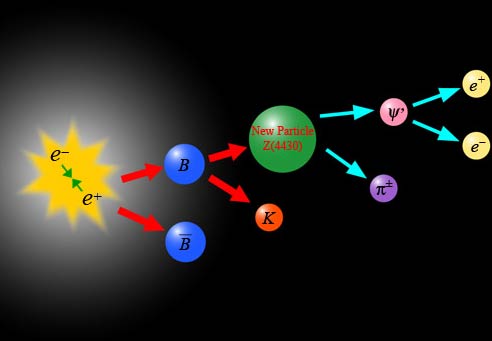
Figure 1. Model of formation and decay of Z (4430).
Some physicists have hypothesized that these new mesons (at least four of these mesons have been found) could be made up of four instead of two quarks as they are still seen. However, others believe that simple particles are in the excited state of " charming " mesons (charmonium mesons), which still contain only a charm quark (charm - c) and a counter quark c.
However, these " charm " mesons must be electrically neutral, while the newly discovered meson - Z (4430) is the first new meson discovered to carry charge. And that means Z (4430) unlike the predestined "mesons" previously known. Because of this, Belle physicists believe that this meson may be made in a state with 4 quarks, including up, down, charm and anti-charm quarks. This is consistent with observations that the Z (4430) meson decays immediately into a charmonium meson and a pi meson (this type of meson contains an up quark and an anti-down quark). If this is correct, the Z (4430) meson will be the first meson particle that cannot be described based on the 2 quark model.
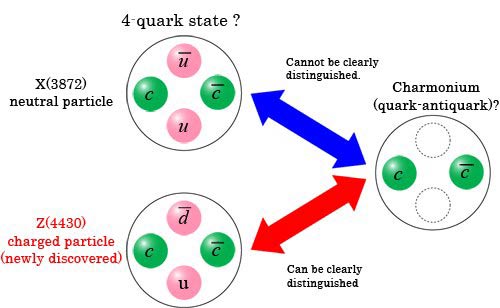
Figure 2. 4 quark states compared to 2 quarks.The meson Z (3872) electrically neutral is difficult to distinguish from the charmonium state, but the newly discovered quark is Z (4430), which has a completely differentiated charge from known states.
The discovery of Z (4430) also means that physicists will have to re-examine the accuracy of the Theory of Quantum Chromodynamics (QCD), which is used to explain why particles quarks and antiquarks can be linked to each other and to other particles. However, this information does not completely convince people. Eric Swanson of the University of Pittsburgh (USA) told Physicsworld.com that while Z (4430) figures seem very compelling, similar particles need to be discovered before he agree that 4 quark mesons are real. Eric said: "I still can't afford to find a reasonable explanation for Z (4430)".
The Doctrine of Independence