Chemists from the University of California at Los Angeles (UCLA) and the University of Washington have recently built successful " design enzymes " that mark a major advance in computer chemistry and protein engineering.
Leading UCLA chemistry group is Professor Kendall Houk and head of the Washington University team is biochemist David Baker. The study of two coordinated groups was published on March 19 in the online edition of Nature. The US Advanced Defense Project Agency ( DARPA for short) has supported this study.
Designed enzymes will be used in the prevention of bacterial wars, by inhibiting pathogenic biological agents. According to Mr. Houk, they are also used to manufacture more high-quality pharmaceuticals. Houk said: 'The intention to target reactions that are not normally catalyzed in nature for new enzymes is finally possible '. The goal of the study is to use computational methods to design the placement of chemical groups in protein molecules; thereby creating the basis for the desired response to occur.
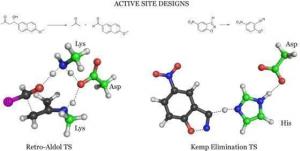
UCLA chemists design flexible points on new artificial enzymes.(Photo: Copyright of UC Regents)
"Enzymes are very powerful catalysts and we want to exploit that ability," said a UCLA chemistry graduate student in collaboration with Professor Houk's team . We want to create enzymes that catalyze reactions that enzymes often don't. Enzymes can often only catalyze a limited number of reactions compared to what we can expect from new enzymes. '
In Nature , scientists said that by combining chemistry, mathematics and physics, they finally succeeded in making enzymes designed to catalyze a reaction called Kemp's reaction. This is a chemical exchange process not in nature in which a hydrogen atom is removed from the carbon atom. In an earlier article published on March 7 in Science , chemists claimed to have successfully performed a chemical reaction that uses enzymes designed to catalyze a broken inverse reaction. bonding between two carbon atoms. The inverse reaction is an essential process for living organisms involved in the processing and synthesis of carbohydrates . According to Professor Houk, this reaction is also widely used in the manufacture of chemical products and in the pharmaceutical industry.
Professor Houk is also the lead author of both of the papers, saying: 'Previous reports of design enzymes were not very successful, some of them were canceled. It is also not surprising that we only spend days and weeks to contemplate what nature has accomplished over billions of years of evolution. The performance of the design enzymes we created only increased modestly and so far they have been unable to compete with the same natural enzymes' .
DeChancie said: 'Hopefully with the progress made in technology, we can shorten the gap between design enzymes and natural enzymes'.
According to Fernando Clemente, a former postdoctoral scholar UCLA, co-author of the Science article, 'Most scientists have thought that this hope cannot be achieved, and we also had the same thought. after many failures. But advances in design and sophistication eventually lead to success . ' Clemente currently works at Gaussian Inc., a software manufacturing company used in Professor Houk's research.
The implementation of the inverse reaction at the mobility point of an enzyme is an important challenge. This reaction includes at least six chemical transformations, requiring UCLA scientists to calculate all six chemical steps in the corresponding transformation state. The structures are then combined together in a way that allows all six steps to occur.
Both studies were funded by DARPA, the US central research and development agency, with the support of the National Science Foundation.Natural enzymes are relatively large protein molecules. They have the ability to catalyze life-sustaining reactions. They play a central role in chemical reactions involved in the conversion of food into essential nutrients that supply energy to the body. In addition, they have many other important functions.
Houk's research team consists of 30 computer chemists. They used quantum mechanical calculations to learn about chemical reactions through supercomputers. Molecular mechanics is the basic theory that predicts all chemical phenomena.
Professor Houk and Baker's team collaborated for 3 years. By using algorithms and supercomputers, UCLA chemists have designed flexible points on enzymes - this is the area where chemical reactions occur. The blueprint was then passed on to their colleagues at Washington University. Baker and his team then used computer programs to design the sequence of amino acids rolled together to create a flexible point like the design of Professor Houk's group. Baker's team carried out the production of enzymes.
Houk's team used modern computing methods based on physical laws of quantum mechanics to study in detail the mechanism of chemical reactions. They also participated in the protein design program funded by DARPA with the goal of developing technology to support the design and manufacture of artificial enzymes. UCLA chemists take on the task of designing flexible points on enzymes. By exploiting many different types of chemical groups, they can identify the most appropriate groups that make chemical exchange easy. They will then determine the exact three-dimensional arrangement of these chemical groups, which is a key feature of the enzyme's characteristic and activity with an accuracy of less than 1/100 nanometers.
According to Professor Houk, enzymes are the basic green catalyst that works with the surrounding environment, water.
This technology will bring invaluable applications in all areas of life. How much longer will design enzymes have superior applications really come into being? According to DeChancie, 'We have reached the destination. The above articles prove that our current technology is on the right track . '