In the past, people have always pursued the mysteries of science and tried to explain the nature of the universe. In this long-standing exploration, an ancient hypothesis has now attracted people's attention - 4-dimensional space.
How could a German mathematician prove the existence of 4-dimensional space?
German mathematician Ulrich Hirschfeld proved the existence of 4-dimensional space and his proof attracted wide attention in the mathematical community. In this article, we will learn in detail about his research methods and the main results obtained.
In Ulrich Hirschfeld's research, he used related concepts and tools from topology and linear algebra. He first defined a special kind of 4-dimensional space, which includes Euclidean space with additional coordinates.
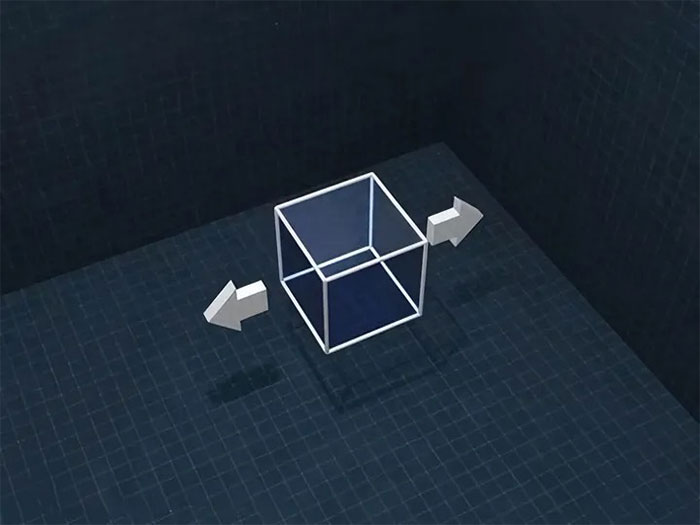
In this space, Ulrich Hirschfeld introduced additional coordinates so that this space could be described and studied mathematically rigorously. He conducted in-depth analysis of the properties of points and lines in this space, leading to some important conclusions about four-dimensional space. (Photo: Zhihu).
Ulrich Hirschfeld proposed an important concept, that of manifold . In geometry, manifold refers to a space that has a local Euclidean structure. By applying the concept of manifold to four-dimensional space, Hirschfeld was able to conduct more detailed and precise studies of this space.
He proved that four-dimensional space is a differentiable manifold, and through mathematical reasoning and proof, he derived important features and properties of space.
In further research, Hirschfeld demonstrated that four-dimensional space has some properties that are completely different from three-dimensional space. He discovered that in four-dimensional space, there are some strange geometric structures, such as hypercubes and rotating objects. These structures cannot exist in three-dimensional space at all, but they can be described and analyzed using rigorous mathematical methods in four-dimensional space.
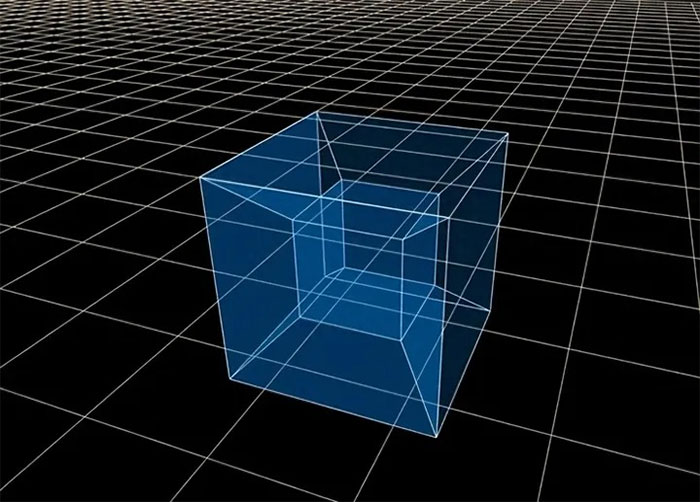
Four-dimensional space has some properties that are completely different from three-dimensional space. (Illustration: Zhihu).
In addition to geometric structures, Hirschfeld also studied vector fields and their properties in four-dimensional space. He discovered that there are some very special vector fields in four-dimensional space that are completely unimaginable in three-dimensional space. Through the analysis of these vector fields, Hirschfeld provided a deeper understanding of the structure and properties of four-dimensional space.
Hirschfeld's research was not only theoretical. He also verified his theoretical results through simulations and numerical experiments. Through these experiments, he further confirmed the existence of four-dimensional space and revealed the potential value of four-dimensional space in several practical application areas.
How does evidence of 4D space relate to our real world?
4D space has always been a complex and mysterious field of study, it goes beyond the 3D space we are familiar with and has many more possibilities and unknowns. Although we cannot directly perceive and observe 4D space, scientists have revealed the correlation between 4D space and our real world through a series of studies and experimental evidence.
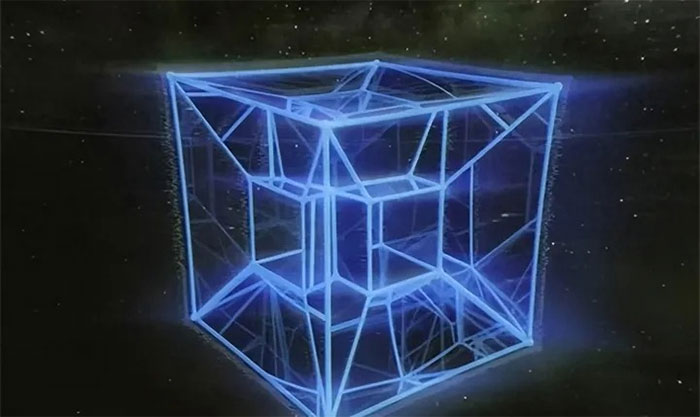
4-dimensional space has always been a complex and mysterious field of study. (Illustration: Zhihu).
Mathematics plays an important role in the study of four-dimensional space . Through mathematical models, scientists have clarified the characteristics and laws of four-dimensional space. For example, familiar three-dimensional geometry can be easily extended to four dimensions. By introducing a fourth coordinate axis, we can construct four-dimensional geometric figures, such as the four-dimensional cube. These mathematical tools not only help us understand the mathematical nature of four-dimensional space, but also provide a framework for practical applications.
Physics experiments are one of the main means of verifying four-dimensional space. Scientists observe the motion and interactions of particles through particle accelerators and other devices, and obtain a lot of experimental data about four-dimensional space. For example, particle spin is a phenomenon that cannot be fully explained in three-dimensional space.
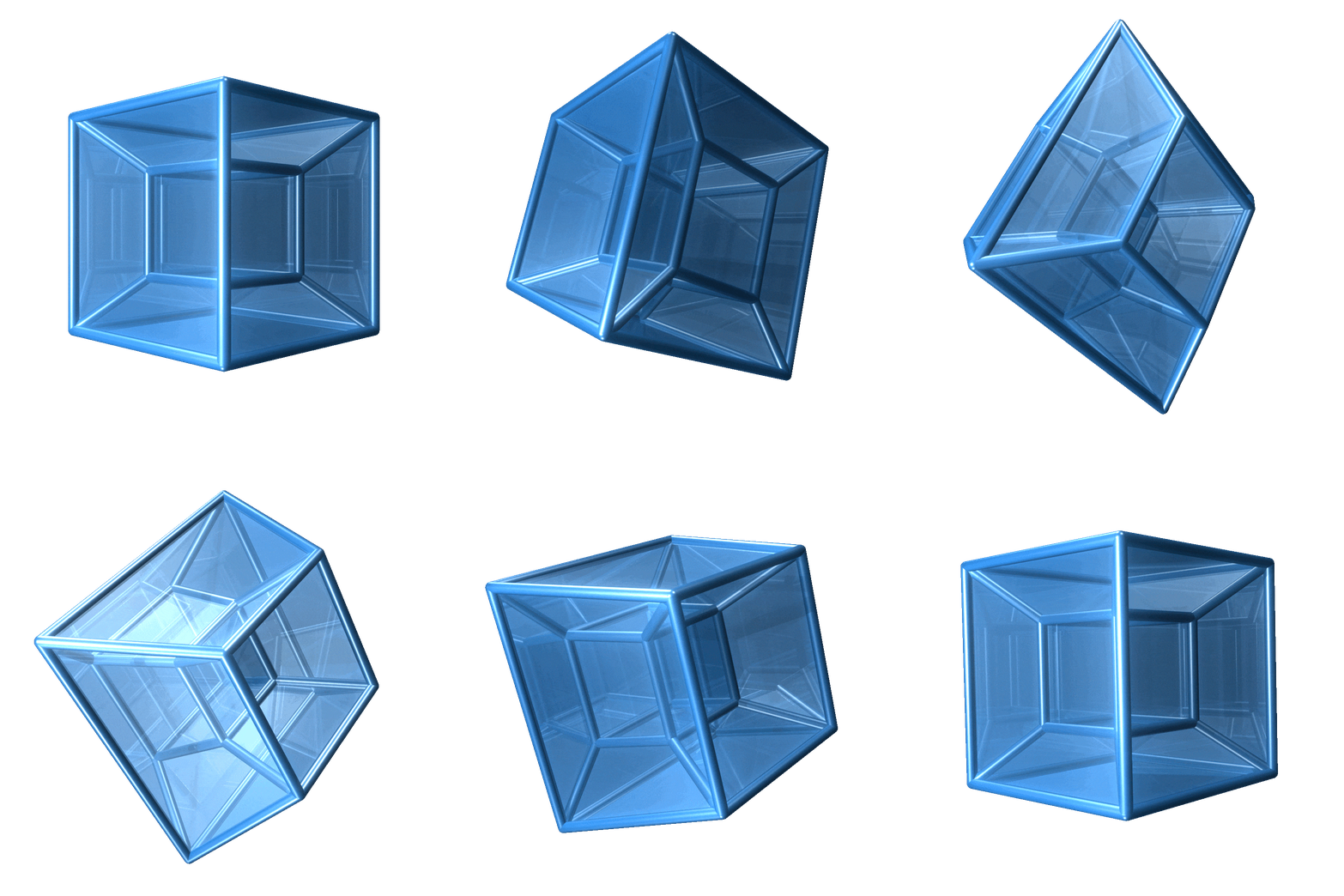
Physical experiments are the main means to verify 4-dimensional space. (Illustration: Zhihu).
By introducing the fourth dimension, we can better describe and understand how rotational phenomena work. In addition, black holes are an important experimental basis for exploring four-dimensional space. The existence and motion of black holes confirms the theory of relativity to a certain extent and indirectly supports the existence of four-dimensional space.
The real world we live in is a four-dimensional space-time – in addition to our familiar three-dimensional space, time is a fourth dimension, a fundamental assumption of Einstein's theory of relativity. The existence of time allows our experiences and observations to unfold in an orderly manner and shapes our perception of changes in things. This correlation further supports our connection to 4D space.
Although 4-dimensional space is not something we can normally perceive, there are some phenomena in our real world that seem to be related to it. For example, our perception of time is a process of change, and in 4-dimensional space, the existence of objects also changes over time.
Human spatial awareness also suggests the possibility of higher spatial dimensions. Many psychological studies have shown that humans can perceive and imagine shapes and movements beyond three dimensions, which is further evidence that we have some connection to four dimensions.
There are some phenomena in our real world that seem to be related to the 4th dimension. (Illustration: Zhihu).
Ultimately, whether we believe in the reality of 4D space or not, this research can still spark deep thinking about reality and existence. We should keep an open mind, respect the efforts of scientists, and engage in this discussion. Because only through constant questioning and innovation can we push the boundaries of human knowledge and discover more mysteries about the universe and ourselves.