Determining the existence of a civilization on Earth that predates humans is a difficult question and attracts the interest of many scientists and archaeologists.
An astrophysicist named Adam Frank often ponders this question: After mastering the technology of interstellar travel, humans will certainly try to find other civilizations in the universe. But the age of the universe is so long that by the time humans find a suitable planet to survive, the civilization that once existed on it may have long since disappeared. In this case, is there any way for us to determine whether an advanced civilization exists on this planet ?
Frank approached his friend Schmidt, a scientist working at NASA, with this question. Schmidt thought it was interesting but also difficult to answer because other planets are very far away from us and we don't know what the physical environment on them is like . Finally, Schmidt simplified the problem a bit and turned it into a question: If an industrial civilization existed on Earth, can we infer their existence?

Adam Frank is an American physicist, astronomer, and writer. His scientific research focuses on computational astrophysics with an emphasis on star formation and late-stage stellar evolution. His current work includes studies of exoplanet atmospheres and astrobiology.
This question may seem pointless because if there were other industrial civilizations on Earth, we would definitely be able to unearth what they made. Don't archaeologists often find tools that were made by humans thousands of years ago? We can learn about the existence of these ancient civilizations from those tools.
But don't forget that the Earth is 4.6 billion years old and the history of human civilization is less than 10,000 years old. Therefore, it is entirely possible that the civilization before us lived 10 million, 100 million, or 1 billion years ago .
A period of thousands of years is a relatively ancient time for humans, but it is actually just a moment in time for the Earth. On a scale of 100 million years, the Earth's mountains, rivers, and even the positions of the continental plates will undergo seismic changes. Any creation created by humans long ago will surely be reduced to dust after undergoing 100 million years of intense geological change.
What about fossils? Don't we know that dinosaurs existed through fossils? Many fossils are millions of years old and we can still find them, so surely fossils left by creatures from previous civilizations will be found?
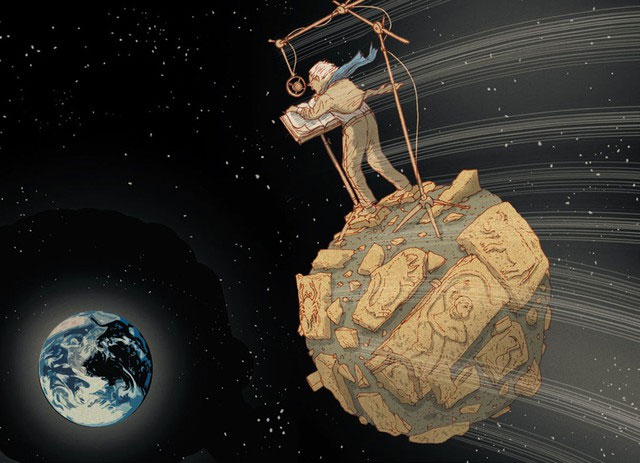
It is entirely possible that civilizations before us lived 10 million, 100 million years ago. (Illustration).
What many people don't know is that not all creatures have the chance to fossilize after death. Only a very small percentage of creatures can become fossils under certain conditions. Dinosaurs ruled the Earth for 150 million years. During this period, countless species of dinosaurs roamed the Earth. However, only a few thousand complete dinosaur fossils have been discovered in the world.
In other words, on average, every ten thousand years, only one dinosaur fossil will turn into a fossil and eventually be discovered by humans. The history of human written civilization is only a few thousand years old, while the history of industrial civilization is only a little over two hundred years old. If a civilization disappears after thousands of years of industrialization, it is very likely that they will not leave any fossil evidence.
Furthermore, even if we find fossils of intelligent beings from previous civilizations, how can we judge them as intelligent beings when there are only fossils and no artificial tools?
According to the two scientists, we cannot know that a civilization existed on Earth millions of years before humans through direct evidence such as man-made relics and fossils. To answer this question, we must change our thinking. What we need to look for are traces of civilization that can still be detected after tens of millions or hundreds of millions of years.
In the more than two hundred years since the Industrial Revolution, humans have burned a large amount of fossil fuels, which has had two consequences. First, a large amount of carbon dioxide produced by burning fossil fuels enters the atmosphere, causing the average temperature of the Earth to rise. Second, the isotope C13 contained in fossil fuels is lower than that in the atmosphere, so the widespread use of fossil fuels will reduce the proportion of C13 in the atmosphere.

Any creation created by humans long ago will surely turn to ashes after undergoing 100 million years of geological changes. (Illustration photo).
Modern scientists have developed methods to measure changes in the Earth's temperature over the past few billion years. If there was an industrial civilization that used fossil fuels extensively in the past, we could theoretically infer their existence by observing temperature changes over the Earth's history.
For example, 56 million years ago, the Earth experienced a dramatic increase in temperature called the "Paleocene-Eocene Thermal Maximum ." Over the course of about 100,000 years, the Earth's average temperature increased by 5 to 8 degrees, while a large amount of carbon dioxide was released into the atmosphere, causing a decrease in C13 levels. This is very similar to the impact that our industrial civilization has had on the Earth.
So if millions of years after human civilization perished, a new civilization formed on Earth, would they be able to detect us?
For civilizations on Earth, the best place to find evidence of a previous civilization is not Earth, but the Moon . Because the Moon has no violent geological movements and no weathering caused by the atmosphere, a man-made lunar lander could survive here intact for at least a few million years.
If one day human civilization is unfortunately destroyed, tens of millions of years later a new civilization will arise on Earth. After landing on the Moon, they may find a lunar rover left behind by humans. Then they will know that we were here before them.
