Scientists at the University of New South Wales have discovered the purpose of a famous 3,700-year-old Babylonian clay tablet, revealing it to be the world's oldest and most accurate trigonometric table.
The Pythagorean Theorem is one of the most basic and famous mathematical formulas that every student learns in school. It states that in a right triangle, the square of the length of the hypotenuse (the longest side of the triangle) is equal to the sum of the squares of the other two sides. The formula is often written as a2 + b2 = c2 , where a, b, and c are the lengths of the sides.
The theorem is named after Pythagoras, a Greek philosopher and mathematician who lived in the 6th century BC. However, recent discoveries show that Pythagoras was not the first to understand this relationship between the sides of a right triangle . In fact, the ancient Babylonians discovered the Pythagorean theorem over 1,000 years before Pythagoras was born!
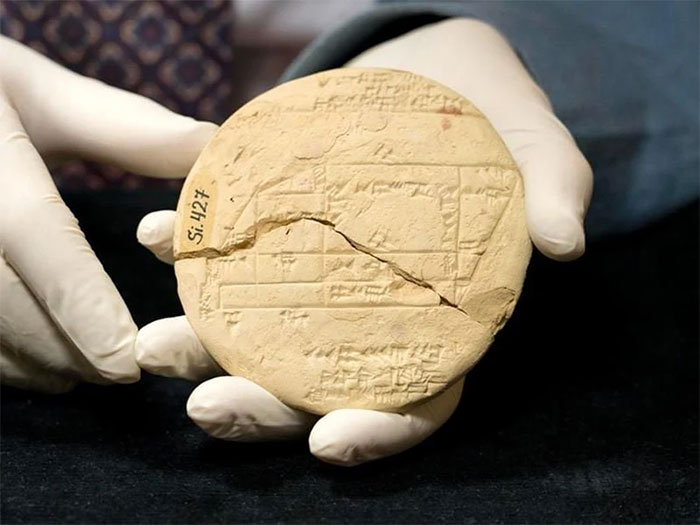
Si.427 clay tablet, the oldest known example of applied geometry.
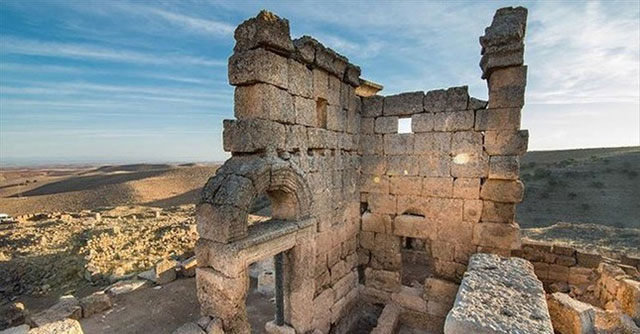
How do we know this? The evidence comes from clay tablets found in what is now Iraq, dating back to the Babylonian period (1900-1600 BC). These clay tablets contain mathematical calculations and diagrams that use the principles of the Pythagorean theorem to solve problems related to land surveying, construction, and astronomy.
One of these clay tablets, known as Si.427 , is considered the oldest known example of applied geometry. Unearthed in 1894 in present-day Iraq, it shows a diagram of four right-angled triangles inside a square, along with descriptions of land boundaries and features in cuneiform. The tablet uses what we now call Pythagorean triples, which are sets of three positive integers that satisfy the Pythagorean equation. For example, 3, 4, and 5 are Pythagorean triples, since 32 + 42 = 52.
Another tablet, known as Plimpton 322 , contains a table of 15 rows and four columns of numbers representing Pythagorean triples. It was discovered by American archaeologist Edgar Banks in 1922 and is now housed at Columbia University in New York. Mansfield, a mathematician at the University of New South Wales, and his colleague Norman Wildberger published a paper in 2017 arguing that Plimpton may have been used in the construction of canals, palaces and temples, or perhaps in land surveying.
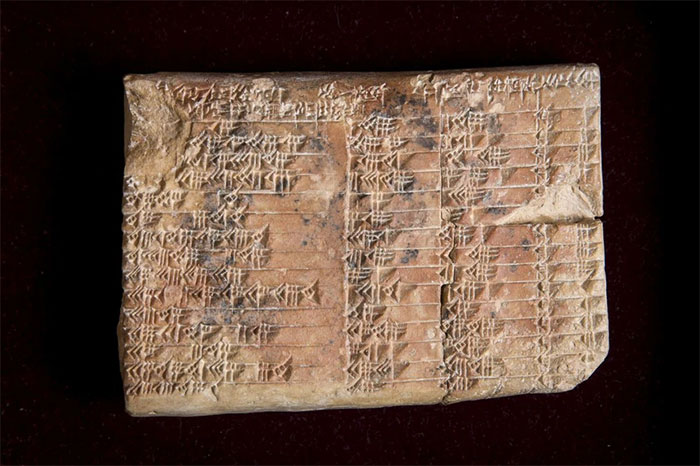
Plimpton 322, a 3,700-year-old Babylonian clay tablet housed in the Rare Book and Manuscript Library at Columbia University in New York.
The solution to the puzzle was revealed through Si.427. Mansfield came across the clay artifact at the Istanbul Archaeological Museum, where it had been quietly stored for years, largely unnoticed.
'With this new clay tablet, for the first time we can really see why the ancient Babylonians were interested in geometry: to accurately define land boundaries,' said Mansfield . 'This was a period when land was starting to become private—people were starting to think of land in terms of 'my land and your land', wanting to establish appropriate boundaries to have positive neighbourly relationships.'
Additional supporting evidence was also found on the clay tablet IM67118, which dates back to 1770 BC. The discovery includes text, diagrams, and tools for calculating the area of a rectangle and the length of its diagonal. The accompanying text outlines a solution using the Pythagorean theorem.
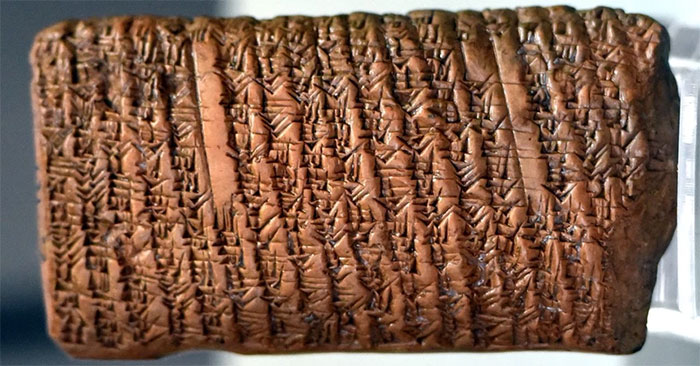
Clay tablet IM67118 presents a geometric-algebraic approach to solving problems, with a conclusion reminiscent of the Pythagorean theorem.
Notably, the Pythagorean theorem also appeared in ancient India , appearing in the 8th century BC in the Vedic Sanskrit text Sulbasutra, written by Baudhāyana. According to some scholars , the theorem, also identified in China as GouGu , may have predated common knowledge, possibly being transmitted orally as early as 2000 BC.
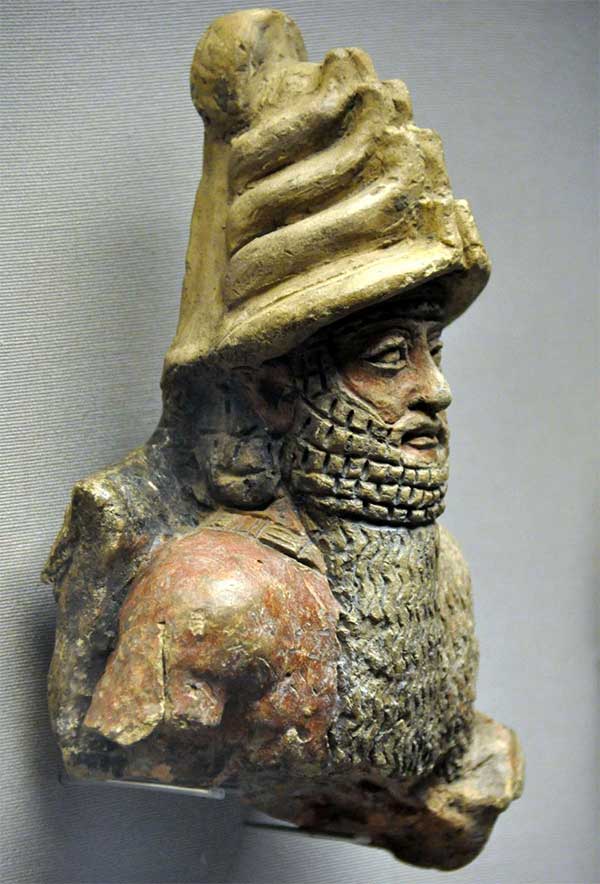
The ancient Babylonians made significant contributions to mathematics, especially in the field of geometry. They used the sexagesimal system, based on the number 60, and developed trigonometry. They also advanced in astronomy and astrology, using mathematical models to track the planet Jupiter and developing methods of keeping track of time that are still used today.
The Greeks are often credited with inventing trigonometry (the branch of mathematics that deals with angles and distances in triangles), but Mansfield and Wildberger argue that the ancient Babylonians also had their own version of trigonometry based on ratios rather than angles. They used a base-60 number system (similar to how we use minutes and seconds to measure time) to represent these ratios with great precision.
"The Greeks invented their trigonometry because they were studying astronomy, but the Babylonians had their own variation of trigonometry that they developed to solve land and boundary problems," says Mansfield.
These findings reveal that the ancient Babylonians were not only skilled mathematicians but also practical problem solvers who applied their knowledge to real-world situations. They also challenge the common assumption that Pythagoras was the first to discover the Pythagorean theorem and demonstrate that mathematical ideas can emerge independently in different cultures and times.