A red-glazed bowl from the reign of Emperor Ming Xuanzong, nearly 600 years ago, sold for $1.9 million (44 billion VND).
The price, including fees, was three times higher than the initial estimate, set at Sotheby's New York auction on March 21. The bowl has a diameter of 10.1 cm, and its base features six blue enamel characters inside a double circle.
The artifact was part of the collection of TY Chao (1912-1999) , a Hong Kong shipping magnate and renowned antique collector. The bowl was previously exhibited at the Hong Kong Museum of Art in 1978 as part of the Ming and Qing Dynasty porcelain collection of the TY Chao Family Foundation.
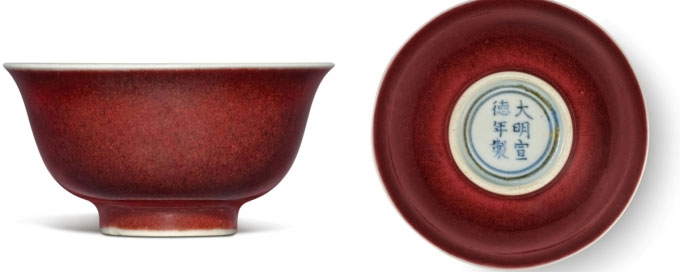
A special red enamel bowl. (Photo: Sotheby's)
According to Sotheby's, the monochromatic copper-red glaze is one of the greatest technical and aesthetic achievements of the Ming Dynasty (1368-1644). The porcelain, with its vibrant, deep red color, is likened to a rare ruby .
Experiments with monochromatic copper-red glazes took place in kilns from the Yuan Dynasty (1271-1368), but were not perfected until the reigns of Emperor Ming Chengzu (1402-1424) and Emperor Ming Xuanzong (1425-1435). Copper had to be added to the ceramic glaze intentionally to create the desired color. This material was used in small quantities and was volatile during firing, making it difficult to achieve a uniform, sharp copper color. Artisans underwent extensive research and improvements to the basic glaze formula, changing the type of copper oxide used and reducing the amount added.
A large number of red-glazed porcelain artifacts were discarded and buried in the kilns of Jingdezhen in Jiangxi, with only a few surviving. According to experts, this demonstrates the challenge faced by artisans in producing them.
Deep red, like blood, was often considered "sacrificial red." Therefore, ceremonial items during the Ming Dynasty were primarily single-color red glazed porcelain. However, during the reign of Emperor Ming Xuanzong, there was no clear distinction in the court between items used for sacrificial offerings and everyday eating utensils. Consequently, bowls could be used on altars or dining tables.
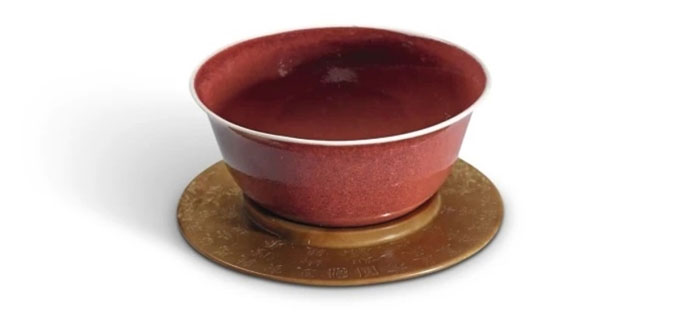
The red bowl at the National Palace Museum in Taipei. (Photo: Sotheby's).
The National Palace Museum in Taipei currently houses at least two red bowls of similar shape and size, one of which is a tea bowl. The bowl was later paired by Emperor Qianlong with a jade plate engraved with a poem.