Today, nearly half the world's population speaks an Indo-European language as their first language. The origins of these languages are believed to have emerged in the Eurasian steppes, the steppe region between Europe and China.
The regions bordering the Black Sea have long attracted the attention of many researchers, from geneticists to linguists. This landmass, stretching eastward through Türkiye and Armenia, serves as a natural bridge connecting diverse cultures from Europe and Asia. Many peoples can trace their ancestry and languages back to this region, which for millennia has been a hotbed of human activity. It continues to be a subject of study for historians seeking common threads linking European and West Asian cultures.
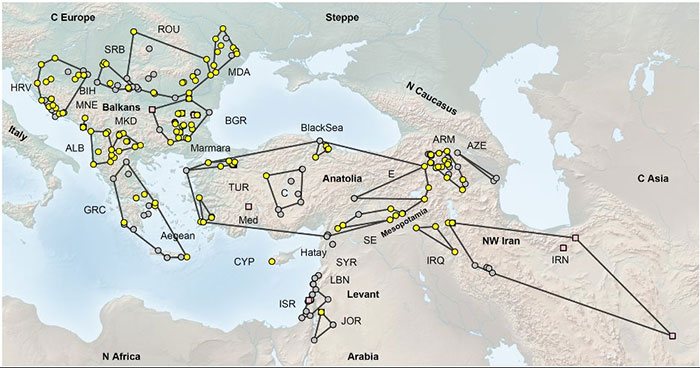
Southern arc.
Iosif Lazaridis is one of the researchers interested in this region. Lazaridis worked at Harvard University but grew up in Greece, a country renowned for its role in shaping the history, culture, and languages of Eurasia. Lazaridis has long wondered about the ancestral origins and linguistic evolution of the first peoples who lived in Greece and the surrounding areas. He questioned how ancient civilizations met and influenced each other in this region to form the cultures and anthropology we see today.
Experts have relied on archaeological artifacts such as pottery and writing to answer these questions. Although illuminated, this material may be inaccurate and difficult to interpret objectively.
Ancient DNA: A breakthrough in genetics
In some parts of the world, researchers have been able to rely on more than just archaeology. For example, they can extract ancient DNA from fossils. This allows them to study the genetic history of a site and understand how ancestors evolved. This has long been more difficult in areas with extremely high temperatures, because DNA degrades very quickly under those conditions. However, a breakthrough came in 2015, when researchers discovered that DNA in fossilized inner ear bones can survive for millennia, even in warm climates.
In a groundbreaking study, Lazaridis leveraged this technological breakthrough to conduct a large-scale genetic analysis of the ancient DNA of 777 individuals. The survey spanned an area the researchers called the Southern Arc. From western Croatia, this region stretched across the Anatolian Peninsula (modern-day Turkey) into Iran. Lazaridis, a trained geneticist, collaborated with 206 local archaeologists, linguists, and historians from 30 countries in an international effort. Their work was reported in three installments in the journal Science. Their findings represent a significant contribution to our understanding of human history in this crucial region.
Yamnaya and the Rise of Indo-European Languages
In the first paper, researchers traced genetic data to understand the linguistic evolution of Indo-European languages. Mapping the genes of migration patterns could help researchers identify opportunities for languages to meet and merge.
Today, nearly half the world's population speaks an Indo-European language as a first language. The origins of these languages are thought to have emerged in the Eurasian steppes, the steppe region between Europe and China, during the Bronze Age thousands of years ago. In this analysis, Lazaridis et al. leveraged DNA data from before and during the Bronze Age to visualize the cultural mixing hypothesized by linguists to explain the spread of Indo-European languages.
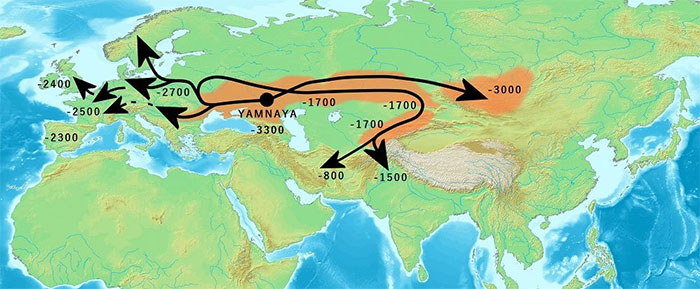
The migration journey of the Yamanaya people.
Researchers have discovered that steppe herders migrated across the Eurasian Steppe between 3,000 and 5,000 years ago. This was a people known as the Yamnaya (Russian for "culture of pits" ). Named after their distinctive pit burial customs, the Yamnaya represent a form of burial practiced by early Indo-Europeans. As the Yamnaya migrated south, they influenced diverse cultures from which Greek, Paleo-Balkan, and Albanian languages arose.
The Yamnaya people also made their way eastward, migrating across the Caucasus Mountains to Armenia, where the Armenian language originated. In fact, some men living in Armenia today are direct descendants of the Yamnaya people.
However, the DNA of the Anatolian (Türkiye) specimens showed almost no trace of Yamnaya ancestry. This surprised the authors because ancient Anatolian languages, such as ancient Hittite, resembled Indo-European languages. This linguistic connection suggested that Anatolians interacted with Yamnayas as steppe herders migrated through the Southern Arc. But strong genetic evidence refutes this theory.
The origins of a common language
Instead of showing the migration of the Yamnaya to Anatolia, newly available genetic data used by Lazaridis et al. reveals two distinct migration flows into the region. First , the researchers describe how farmers from the Levant—a region in the modern Middle East bordering the Eastern Mediterranean—settled the area 11,000 years ago. Then, 5,000 to 7,000 years ago, a second wave of hunter-gatherers with ancestors from the Caucasus moved to Anatolia. These two flows mixed together in a process that created what scientists call extraordinary homogenization.

The nomadic lifestyle of Eurasians.
Delving deeper into the region's genetic markers, researchers discovered that the Yamnaya people share some common ancestry from the South Caucasus , much like the Anatolians. This shared origin suggests that linguistic influence may have occurred early, in the West Asian highlands, long before the Yamnaya migrated to other areas of the Southern Arc.
This ancestral data also reveals that Anatolian languages may have early separated from the Indo-European language family and remained genetically and linguistically isolated. Lazaridis's team argues that we need to discover the 'break point' that spurred the transformation of the Eurasian Steppes and Anatolia to link the regions linguistically. They write: 'The discovery of such a 'missing link'… would end the centuries-long search for a common source binding across the languages and races of many peoples in Asia and Europe.'
The authors also offer an important caveat: 'The relevance of genetics to debates about the origins of language is more indirect because languages can be changed with little or no change in genes. And populations can migrate with little or no change in language. But the discovery of migration is important because it maps the evolutionary path of language.'
Along with remarkable insights into the migration of peoples across the Southern Arc during the Stone and Bronze Ages, the authors expanded the scope of their research to analyze genetic activity associated with the Mycenaean period in Greece, the Roman Empire, and the Medieval, Bronze Age.
For example, researchers analyzed new genetic data from the Mycenaean period of Greece, mythologized in the Odyssey. Previous researchers had suggested that the Yamnayas had a heavy influence on the Mycenaean era, because many Yamnayas were buried in elaborate tombs in northern Greece. This seemed to suggest a link between steppe ancestry and social status. But the authors found no such correlation. In a similar analysis, the authors were surprised to find that Anatolians contributed a large portion of DNA to the peoples of the Roman Empire and the city of Rome.
Ultimately, although the study's sample size is the largest in the history of ancient genome analysis, 777 samples spanning 10,000 years still leaves plenty of room for improvement.
Using DNA to reconstruct the past presents significant challenges in interpretation and communication. Despite this, this research represents a major breakthrough for the study of ancient genomes and solidifies ancient DNA as a pioneering new technology that will significantly alter our understanding of early human history.
- The oldest mountain ranges on Earth.
- Why does February have the fewest days in the year, at 28? The reason is quite surprising!
- Stunned by China's digital museum with a design straight out of a science fiction movie.